Thursday, December 13, 2012

Diving Pterosaurs?


http://en.wikipedia.org/wiki/Pteranodon
"Traditionally, most researchers have suggested that Pteranodon would have taken fish by dipping their beaks into the water while in low, soaring flight. However, this was probably based on the assumption that the animals could not take off from the water surface.[2] It is more likely that Pteranodon could take off from the water, and would have dipped for fish while swimming rather than while flying. Even a small, female Pteranodon could have reached a depth of at least 80 centimetres (31 in) with its long bill and neck while floating on the surface, and they may have reached even greater depths by plunge-diving into the water from the air like some modern long-winged seabirds.[2] In 1994, Bennett noted that the head, neck, and shoulders of Pteranodon were as heavily built as diving birds, and suggested that they could dive by folding back their wings like the modern Gannet.[2]"
What can't these amazing pterosaurs do?


Tuesday, December 11, 2012

In the same place

What would we expect if pterosaurs developed from birds? Well one thing is that we would find pterosaurs in the same place as birds.
If we never found them in close proximity, we would rather doubt that they were related On the other hand, if we were to find them living in the same place that would support the pterosaur to bird theory.
Well they have been found living in the same place:

http://news.discovery.com/animals/pterosaur-tracks-japan-birds.html
"The world's first pterosaur tracks from Japan, documented in a new study, suggest these Dinosaur-Age flying reptiles not only coexisted with birds, but that the two groups also hung out together when they weren't soaring the Cretaceous skies.
A lone siltstone slab contains the fossilized footprints, made by pterosaurs, birds and amphibians. It provides a literal slice of what prehistoric life was like in Japan around 127 million years ago.
"I think that a group of small pterosaurs was feeding together near a pond or near a lake," lead author Yuong-Nam Lee told Discovery News, adding "there are lots of feeding beak marks."
For the latest study, accepted for publication in the journal Cretaceous Research, Lee and his colleagues focused on the pterosaur tracks. The scientists identified a total of 64 imprints made by five to six individuals that "show a clear quadrupedal gait pattern" with feet bearing curved "hook-like sharp" claws.
"The high density of the tracks suggest gregarious behavior, but the random orientation of the trackways does not show that they were moving in the same direction as a herd," Lee said.
He and his team instead think the pterosaurs and birds randomly gathered to feed. The eating marks consist of "small round depressions on the slab," possibly where the animals repeatedly pecked away for food."


Wednesday, December 5, 2012

Another pterosaur to bird theorist

Here is a summary of the pterosaur to bird ideas of Larry Febo.
They are startlingly similar to what I have been proposing.


"NAME OF THEORY: Larry Febo`s , Birds are Pterosaur Offshoots

ORIGINATORS: May have been briefly considered by Seeley in the 1800`s. "Seeley (1881) and Weidershiem (1883, 1886) proposed a pterosaur-like ancestor for Archaeopteryx." (The Beginnings of Birds (1985) pg 16.) Otherwise, Larry believes he's the only one proposing this at the moment.

TIME OF ORIGIN OF BIRDS: Mid-Triassic (c 230mya).

IMMEDIATE ANCESTOR OF BIRDS: A hypothetical Pterosaur-bird with small cranium, and relatively small wings, itself descended from the Prolacertiform group (with Cosesaurus as an appropriate example).

TIME OF FIRST FEATHER: Mid-Triassic

EXTINCT FEATHERED GROUPS: Protoavis (of the Triassic),...and of course the late Jurassic and early Cretaceous finds.

WEAKNESSES: Dependant on a hypothetical "missing link".

STRENGTHS: Resolves the "Digit Homology" controversy between the ornithologists and the paleontologists. The missing anterior digit is accounted for as being the pteroid bone, yeilding the homologous digit count 1,2,3 as preferred by paleontologists. Uses minimal dependence on the concept of Convergence.

PREDICTIONS: More pre-Archaeopteryx feathered birds will be found, eventually closing the gap back to the Mid-Triassic.

CHANGES NEEDED FOR CONVERSION TO 2F: Nothing simple would do it.

EVIDENCE REQUIRED FOR SUCH CHANGES:

GENERAL COMMENTS:"


OTHER RELATED MATERIAL:

http://dml.cmnh.org/1999Jan/msg00453.html

Hi folks, I just got around to reading "The Beginnings of Birds" (Hect et. al.). (Hey!...I told you I was playing "catchup" with my old paleontological interests!).Anyways, ...got to the article by Hinchliffe 'One, Two, Three' or 'Two,Three,Four', and it struck me immediately that my theory on "Birds as Pterosaur Descendants" seemed to fit in...(like that annoying missing piece of a large jigsaw puzzle that was never considered because of it`s "unlikely" color). The article describes how Holmgren (1955) and Montagna (1945) (quite a while back)..."claimed to find either a transient digit or its associated distal carpal preaxial to that developing digit which eventually forms the anterior digit of the adult wing". This transient element, I call "X", because I agree with the paleontological view that it cannot be called digit 1, as digits 1,2 and 3 are already identified (via phalangeal count), in both Theropod manus and Avian wing. Yet, it has to be something, as embryologists have determined its presence. ...There`s only one creature, (that I`m aware of), that fits the bill as having and "extra" preaxial "digit", and that would be the Pterosaur, with its "pteroid bone".


http://dml.cmnh.org/2001Jan/msg00135.html
From Larry Febo:
I`m not sure exactly how feathers developed,but actinofibrils arranged in a pattern similar to flight feather rachis is very suggestive. Whatever the path, a changeover from a fully functional membrane to feathers would have to be gradual, and would require a "reason" for it to happen. I believe the reason might have been the invasion of a new, and colder enviornment. Perhaps a more upland enviornment, and natural selection acting on this primitive wing to cut down on exposed area in a colder enviornment. Contour feathers, once developed, could have extended to long flight feathers as the membrane, and wing finger gradually (over generations) shrunk, until this wing finger was itself no longer necessary.

"Suggestive"

The ideas I am presenting differ from the current mainstream theory that birds developed from dinosaurs. That is why I was intrigued by the following passage from a discussion group from years ago:

http://dml.cmnh.org/2001Jan/msg00135.html
From Larry Febo:
I`m not sure exactly how feathers developed,but actinofibrils arranged in a
pattern similar to flight feather rachis is very suggestive.
Whatever the
path, a changeover from a fully functional membrane to feathers would have
to be gradual, and would require a "reason" for it to happen. I believe the
reason might have been the invasion of a new, and colder enviornment.
Perhaps a more upland enviornment, and natural selection acting on this
primitive wing to cut down on exposed area in a colder enviornment. Contour
feathers, once developed, could have extended to long flight feathers as the
membrane, and wing finger gradually (over generations) shrunk, until this
wing finger was itself no longer necessary.

The passage includes the idea that this transition must have been "gradual". I do not think that is necessarily so. A saltation is also a possibility.

Saturday, December 1, 2012

Making the Connection


James and Pourtless' analysis links Longisquama with birds.
And Peters' work links Longisquama (and other protopterosaurs) to pterosaurs.
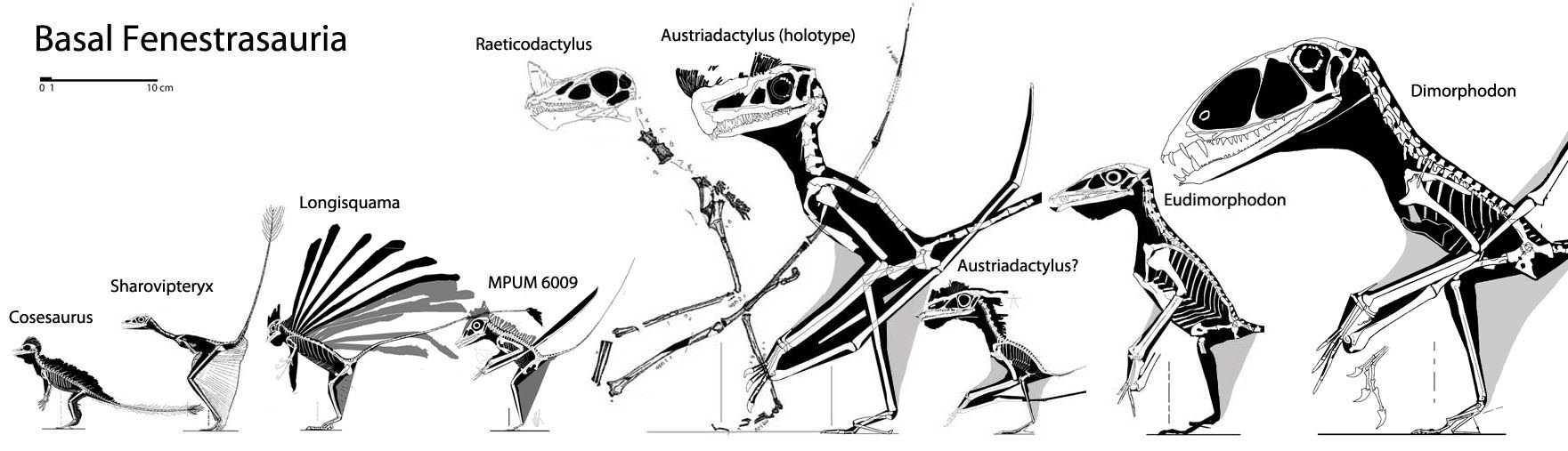
I propose that protopterosaurs (eg. Longisquama, cosesaurus) developed into pterosaurs which in turn developed into birds.

James and Pourtless list Longisquama as a possibilty as follows:
 "These results nevertheless support the possibility of a
sister-group relationship between Longisquama
and Aves (inclusive of some maniraptorans)."

In fact, Longisquama is a good candidate along with the other protopterosaurs such as Sharovipteryx and Cosesaurus.

http://en.wikipedia.org/wiki/Sharovipteryx
If Sharovipteryx was a relative of pterosaurs, then its membrane may have stretched to its front legs, or it may have had a separate membrane joined to its front limbs alone. A secondary membrane is visible between the thighs and the trunk. Front wing membranes have not been seen; Peters (2006) has claimed to have traced the fingers[2] and that they show similarities to Cosesaurus and Longisquama and to a lesser extent, pterosaurs.
This is an important connection to the idea of protopterosaurs (David Peters' work). This is consilience.


Tuesday, November 20, 2012

Early archosaur hypothesis

Here is some background on the idea that an early archosaur (eg. Longisquama,could be the ancestor of birds. The pterosaur to bird theory is much more credible.

James and Pourtless:
http://www.bio.fsu.edu/James/Ornithological%20Monographs%202009.pdf
"The   “early ­archosaur  hypothesis”
states that the origin of birds is more likely to be
among early archosaurs than among the theropod
dinosaurs
(e.g., Tarsitano and hecht 1980; feduccia
and wild 1993; welman 1995; feduccia 1999, 2002;
Czerkas and yuan 2002; Czerkas et al. 2002; Martin
2004; feduccia et al. 2005, 2007). As presently un­
derstood, this hypothesis includes the propositions
that most maniraptorans are flying and flightless
lineages within Aves (as in figs.  1B and 3f)  and
that they are, in fact, not theropod dinosaurs (Czer­
kas et al. 2002; feduccia 2002; Martin 2004; feduc­
cia et al. 2005, 2007). According to this alternative,
the  Theropoda  as  presently  constituted  are  not
monophyletic. Aves, including various manirap­
torans, is not nested inside Theropoda. Similarities
between nonmaniraptoran theropods and birds are
accounted for by homoplasy."
I would suggest they are also accounted for by symplesiomorphy .

"The best ­studied current candidate for a potential archosaurian ancestor or sister taxon is
Longisquama. Sharov (1970) noted similarities to birds in the skeleton and integument of
Longisquama and sug­ gested that it may be close to avian ancestry. Jones et al. (2000, 2001)
described the birdlike osteologi­ cal characters and the featherlike morphology of the
integumentary appendages of Longisquama, but the latter was disputed by Prum et al. (2001) and
Unwin and Benton (2001). Unwin and Ben­ ton (2001) and Senter (2004) questioned the status of
Longisquama as an archosaur, but its antorbital fenestra (Jones et al. 2000, 2001; Martin 2004; f.
James and J. Pourtless pers. obs.; see Table 1) sup­ports the classification of Sharov (1970) and Jones
et al. (2000, 2001). Martin (2004) elaborated on the osteological similarities between Longisquama and
birds in dentition, characters of the skull, and the presence of a boomerang­shaped furcula similar
to that of basal birds. Unfortunately, the pelvic girdle and hind limb are not known. Longisquama
is best considered a basal archosaur of uncertain affinity (see fig. 2)".
In addition to the results obtained through use
of Kishino-Hasegawa tests, we also recovered a
clade of maniraptorans, birds, and the basal archosaur Longisquama, though we note that it was only weakly supported (Figs. 9 and 12). These
results nevertheless support the possibility of a
sister-group [ancestral] relationship between Longisquama
and Aves (inclusive of some maniraptorans). In
addition, birds and maniraptorans were never
unambiguously associated with nonmaniraptoran theropods in any of our trees (Figs. 9–13)." 

http://en.wikipedia.org/wiki/Longisquama
Temporal range: Middle or Late Triassic
Longisquama means "long scales"; the specific name insignis refers to its small size. The Longisquama holotype is notable for a number of long structures that appear to grow from its skin. These structures have been interpreted as either primitive feathers suggesting Longisquama is a close relative of birds, or as feather-like structures that have evolved independently and do not indicate a close relationship with birds. Longisquama has been used in a heavily publicized debate on of the origin of birds. To some, Longisquama is the gliding, cold-blooded, protobird predicted by Gerhard Heilmann's hypothetical "Proavis" in 1927, and it proves that birds are not dinosaurs. The current opinion is that Longisquama is an ambiguous diapsid and has no bearing on the origin of birds.

http://www.reptileevolution.com/cosesaurus.htm
Ellenberger and DeVillalta (1974) and Ellenberger (1978, 1993) considered Cosesaurus a bird ancestor, and as such Ellenberger interpreted many aspects of Cosesaurus as proto-avian.

Here is an analysis by Peters of cosesaurus:
http://pterosaurheresies.wordpress.com/2012/03/27/dr-ellenberger-and-his-petite-cosesaurus-part-1-cranial-traits-2/

Monday, November 19, 2012

The origin of pterosaurs (2)

From David Peters:
http://www.reptileevolution.com/cosesaurus.htm
Click to enlarge:


http://en.wikipedia.org/wiki/Cosesaurus
Cosesaurus is a genus of  prolacertiform archosauromorph reptile. It is known from a single, hand-sized fossil from the middle Triassic period of Spain. The fossil is a perfect impression of a largely articulated and complete specimen preserving soft parts, including an adhering jellyfish, but no bones remain in these impressions.
In 1977, Ellenberger proposed that Cosesaurus was an ancestor of modern birds.[1] That publication followed the description of the bird-like theropod,Deinonychus, but it appeared long before the theropod ancestry of birds had been widely accepted. In his large and highly detailed treatise, Ellenberger interpreted the following traits in the fossil: a strap-like scapula, a furcula(wishbone), a keeled sternum, beak-like jaws, a retroverted pubis and tailfeathers. Some of these interpretations have not been supported by subsequent research. Padian and Chiappe (1998) regarded Cosesaurus as a member of the archosauromorph clade Prolacertiformes.[2]

http://www.reptileevolution.com/cosesaurus.htm
Ellenberger and DeVillalta (1974) and Ellenberger (1978, 1993) considered Cosesaurus a bird ancestor, and as such Ellenberger interpreted many aspects of Cosesaurus as proto-avian.

http://en.wikipedia.org/wiki/Sharovipteryx
Sharovipteryx ("Sharov's wing", known until 1981 as Podopteryx, "foot wing"), was an early gliding reptile, from the middle-late Triassic period (230-225 million years ago). Fossils have been found from the Madygen Formation ofKyrgyzstan along with the unusual reptile Longisquama. It was approximately eight inches (20 cm) long, with an extremely long tail, and weighed about 7.5 grams. It may have been closely related — or perhaps even ancestral — to pterosaurs,[1] although this remains controversial. Unlike pterosaurs, its main flight membrane was stretched between long back legs rather than its very short front limbs.If Sharovipteryx was a relative of pterosaurs, then its membrane may have stretched to its front legs, or it may have had a separate membrane joined to its front limbs alone. A secondary membrane is visible between the thighs and the trunk. Front wing membranes have not been seen; Peters (2006) has claimed to have traced the fingers[2] and that they show similarities to Cosesaurusand Longisquama and to a lesser extent, pterosaurs.


Note that David Peters no longer considers Cosesaurus to be a member of Archosauromorpha.

Sunday, November 18, 2012

The origin of pterosaurs (1)

To this point I have not posted about the origin of pterosaurs. I will do that now in a series of posts.
I will work on the basic idea that pterosaurs stem from the archosauromorpha.
And I will build upon the work of David Peters who has developed (in amazing detail) the case that pterosaurs developed from gliding creatures like Sharovipteryx and Longisquama..

Here are some helpful references:

http://pterosaurheresies.wordpress.com/2011/09/07/sharovipteryx-and-the-origin-of-pterosaurs/

http://pterosaurheresies.wordpress.com/2012/05/26/protopterosaurus-still-the-official-poster-child-for-pterosaur-ancestry/


Friday, November 9, 2012

Pterosaur Launch


http://www.livescience.com/24636-giant-pterosaurs-in-flight.html

CHARLOTTE, N.C. — It's a bird … It's a plane … It's a plane-size bird! If humans had lived 67 million years ago in what is now Texas, they would've had a hard time missing the giant flying pterosaur calledQuetzalcoatlus, which was the size of an F-16 fighter jet.  The biggest animal ever to fly in the history of the world, this pterosaur dominated the sky with its 34-foot (10 meters) wingspan.
Fossils of the creature have been found in Big Bend National Park, in an area that was heavily forested in the late Cretaceous.   But this presents a puzzle: How did it fly? The region lacked the cliffs that make flight for such large birds easy to conceive.  
A new computer simulation has the answer: These beasts used downward-sloping areas, at the edges of lakes and river valleys, as prehistoric runways to gather enough speed and power to take off, according to a study presented Wednesday (Nov. 7) here at the annual meeting of the Geological Society of America.
First the animal would start running on all fours, Texas Tech University scientist Sankar Chatterjee, a co-author of the study, told LiveScience. Then it would shift to its back legs, unfurl its wings and begin flapping. Once it generated enough power and speed, it finally would hop and take to the air, said Chatterjee, who along with his colleagues created avideo simulation of this pterosaur taking flight.
Chatterjee said the flight and landing of Quetzalcoatlus probably looked like that of an albatross or the Kori bustard, the heaviest modern-day bird capable of flight.[Avian Ancestors: Dinosaurs That Learned to Fly]

Wednesday, November 7, 2012

Walking Pterosaurs

A question occurred to me concerning pterosaurs walking.
They could be walking either with their arms held off the ground or with their hands being placed on the ground (walking on all fours).
Would the footprint of the feet be the same in both cases?

Let's look at this diagram:
http://www.nature.com/nature/journal/v391/n6670/images/391886aa.tif.2.gif
http://www.nature.com/nature/journal/v391/n6670/full/391886a0.html


It would seem possible that the plantigrade footprint is an artifact of all-fours walking.
It could well have been digitigrade when the arms were held off the ground.
This would explain the plantigrade footprints of a pterosaur found (based on an instance of all-fours walking). And explain the digitigrade footprints of birds which never walk on all fours.


* Foot posture in a primitive pterosaurJ. M. Clark1, J. A. Hopson2, R. Hernández R.3, D. E. Fastovsky4 & M. Montellano3


Saturday, October 27, 2012

Ornithomimosaurs


http://www.sciencemag.org/content/338/6106/510.full
"FEATHERED NON-AVIAN DINOSAURS FROM NORTH AMERICA PROVIDE INSIGHT INTO WING ORIGINS
Previously described feathered dinosaurs reveal a fascinating record of feather evolution, although substantial phylogenetic gaps remain. Here we report the occurrence of feathers in ornithomimosaurs, a clade of non-maniraptoran theropods for which fossilized feathers were previously unknown. The Ornithomimus specimens, recovered from Upper Cretaceous deposits of Alberta, Canada, provide new insights into dinosaur plumage and the origin of the avian wing. Individuals from different growth stages reveal the presence of a filamentous feather covering throughout life and winglike structures on the forelimbs of adults. The appearance of winglike structures in older animals indicates that they may have evolved in association with reproductive behaviors. These specimens show that primordial wings originated earlier than previously thought, among non-maniraptoran theropods."
Ornithomimosaurs have been considered as secondarily flightless birds.  
"Gregory S. Paul has proposed that Ornithomimosauria might be a group of primitive, flightless birds, more advanced than Deinonychosauria and Oviraptorosauria.[9]"
"Flightless birds are birds which lack the ability to fly, relying instead on their ability to run or swim. They evolved from flying ancestors.[1] There are about forty species in existence today,[2] the best known being the ostrichemu,cassowaryrheakiwi, and penguin." 
http://www.prehistoric-wildlife.com/articles/ornithomimids-ornithomimosaurs.html
Because ornithomimosaurs are treated as being members of the Maniraptoriformes they are expected by many to have had feathers like many other dinosaurs that belong to this group have been confirmed to have had.‭ ‬Unfortunately there is currently no firm evidence to confirm this for ornithomimosaurs,‭ ‬and the impression that confirms a gular‭ (‬throat‭) ‬pouch in Pelecanimimus does not show the presence of feathers.‭

Saturday, April 7, 2012

Yutyrannus - Not Feathers

http://blogs.scientificamerican.com/tetrapod-zoology/2012/04/04/giant-feathered-tyrannosaurs/
"As usual, the main gee-whiz points about Yutyrannus are already being widely discussed. We’ve known for a while (since the publication of Dilong paradoxus in 2004) that at least some tyrannosauroids possess stage 1 feathers (Xu et al. 2004). That is, filamentous integumentary structures that seem to be evolutionary precursors to the true, complex feathers that evolved elsewhere within coelurosaurian theropods. Yutyrannus is another feathery/filamenty tyrannosauroid, but it’s remarkable in being huge – it’s about 9 m long, meaning that here is the first GIANT feathery/filamenty tyrannosauroid."

http://en.wikipedia.org/wiki/Feather
"Feather evolution was broken down into the following stages by Xu and Guo in 2009:1. Single filament2. Multiple filaments joined at their base. 3. Multiple filaments joined at their base to a central filament4. Multiple filaments along the length of a central filament5. Multiple filaments arising from the edge of a membranous structure6. Pennaceous feather with vane of barbs and barbules and central rachis7. Pennaceous feather with an asymmetrical rachis8. Undifferentiated vane with central rachis"


Notice the unsupported part:
"Yutyrannus is another feathery/filamenty tyrannosauroid."

Yutyrannus is in no way "feathery". 

If people believed that birds were descended from pigs, they would call these pig bristles, "protofeathers":


But that is the sort of thing they claim now, in regard to the "filaments" (bristles) found on dinosaurs.


http://www.mcorriss.com/Prum_&_Brush_2002.pdf
"Darwinian  approaches to the  origin  of feathers, exemplified by Bock (1965),  have hypothesized a microevolutionary and functional continuum between  feathers and a hypothesized  antecedent structure (usually an elongate scale). Feathers, however, are hierarchically complex  assemblages of numerous evolutionary novelties—the feather follicle, tubular feather germ, feather branched structure,  interacting differentiated barbules—that have no homolog in any antecedent structures (Brush  1993, 1996, 2000; Prum  1999).
Genuine evolutionary novelties are distinct from simple microevolutionary changes in that they are qualitatively or categorically different from any antecedent or homonomous structure (Nitecki  1990; Mu¨ ller and  Wagner  1991; Raff 1996)."

So there is as much connection between pig bristles and feathers as there is between dinosaur "filaments" and feathers. In both cases, all the intermediates (all the "hierarchically complex  assemblages of numerous evolutionary novelties") are missing.
In one case, it would be a jump from pig bristle right to feather.
In the other case, it is a jump from dinosaur "filament" right to feather.

More from Darren Naish:
http://blogs.scientificamerican.com/tetrapod-zoology/2012/04/04/giant-feathered-tyrannosaurs/
"I must confess to being somewhat sceptical of the tyrannosauroid identification for Yutyrannus. I reviewed this paper (to those who don’t know: I did my PhD thesis on basal tyrannosauroids), and noted immediately that Yutyrannus actually resembles carcharodontosaurian allosauroids in some respects."

Porcupine with multi-coloured bristles:


https://upload.wikimedia.org/wikipedia/commons/thumb/f/f1/Stekelvarken_Aiguilles_Porc-%C3%A9pic.jpg/330px-Stekelvarken_Aiguilles_Porc-%C3%A9pic.jpg


https://web.archive.org/web/20120417134949/http://www.xinglida.net/pdf/Xu_et_al_2012_Yutyrannus.pdf
Filamentous integumentary structures are preserved in all three specimens. Those preserved in ZCDM V5000 are evidently associated with the posterior caudal vertebrae. As preserved, they are parallel to each other and form an angle of about 30u with the long axis of the tail. The filaments are at least 15 cm long. They are too densely packed for it to be possible to determine whether they are elongate broad filamentous feathers (EBFFs) like those seen in the therizinosauroid Beipiaosaurus, slender monofilaments, or compound filamentous structures. Those of ZCDM V5001 are near the pelvis and pes. They are filamentous structures, but morphological details are not preserved


Thursday, April 5, 2012

Another claim of a "feathered dinosaur"

http://www.guardian.co.uk/science/2012/apr/04/giant-feathered-dinosaur-china-big-fly
The discovery of the largest known feathered dinosaur was announced by scientists in China on Wednesday. Similar in size and shape to Tyrannosaurus rex, palaeontologists at the Chinese academy of sciences in Beijing have named the new species Yutyrannus huali, meaning "beautiful feathered tyrant". At nine metres long and weighing more than 1.4 tonnes, it is also the largest feathered animal ever discovered – either alive or extinct.
Local farmers found three specimens in a small quarry in the Liaoning province of north-east China. Palaeontologists estimate that they are 125m years old, dating from the early Cretaceous period, and they believe that, like Tyrannosaurus rex, the animals hunted in packs. The three were found alongside the remains of a sauropod dinosaur that the researchers think they may have been hunting when they died.
I will say a few things about this in the next post.
Needless to say, this is not a feathered dinosaur.

Saturday, February 25, 2012

Pterosaur and Bird Similarities (Redux)

In a very early post I quoted a passage of basic info about pterosaurs which indicates that there is a great deal of similarity between pterosaurs and birds. Here I review them again.

http://en.wikipedia.org/wiki/Pterosaur

"Pterosaur bones were hollow and air filled, like the bones of birds. They had a keeled breastbone that was developed for the attachment of flight muscles and an enlarged brain that shows specialised features associated with flight.[4] In some later pterosaurs, the backbone over the shoulders fused into a structure known as a notarium, which served to stiffen the torso during flight, and provide a stable support for the scapula (shoulder blade).
As evidenced by hollow cavities in the wing bones of larger species and soft tissue preserved in at least one specimen, some pterosaurs extended their system of respiratory air sacs into the wing membrane itself.
Most pterosaur skulls had elongated, beak-like jaws. Some advanced forms were toothless (such as the pteranodonts and azhdarchids, though most sported a full complement of needle-like teeth
Unlike most archosaurs, which have several openings in the skull in front of the eyes, in pterodactyloid pterosaurs the antorbital opening and the nasal opening was merged into a single large opening, called the nasoantorbial fenestra. This likely evolved as a weight-saving feature to lighten the skull for flight
Pterosaurs are well known for their often elaborate crests.
The presence of pycnofibres (and the demands of flight) imply that pterosaurs were endothermic (warm-blooded).
The mechanics of pterosaur flight are not completely understood or modeled at this time[22][23], but it is almost certain that this group of animals was capable of powered flight in at least as wide a range of conditions as modern birds.
The wings were probably flapped in a manner grossly similar to that seen in birds (a group which displays many different flapping strategies among and within different species and different situations).
A 2009 study showed that pterosaurs had a lung-air sac system and a precisely controlled skeletal breathing pump, which supports a flow-through pulmonary ventilation model in pterosaurs, "analogous"to that of birds. The presence of a subcutaneous air sac system in at least some pterodactyloids would have further reduced the density of the living animal
The pterosaurs' flocculi occupied 7.5% of the animals' total brain mass, more than in any other vertebrate. Birds have unusually large flocculi compared with other animals, but these only occupy between 1 and 2% of total brain mass
Pterosaur's hip sockets are oriented facing slightly upwards, and the head of the femur (thigh bone) is only moderately inward facing, suggesting that pterosaurs had a semi-erect stance.
Pteranodon had slightly larger feet (47% the length of the tibia), while filter-feeding pterosaurs like the ctenochasmatoids had very large feet (69% of tibial length in Pterodactylus, 84% inPterodaustro), adapted to walking in soft muddy soil, similar to modern wading birds
It is not known whether pterosaurs practiced any form of parental care, but their ability to fly as soon as they emerged from the egg and the numerous flaplings found in environments far from nests and alongside adults has led most researchers, including Christopher Bennett and David Unwin, to conclude that the young were only dependent on their parents for a very short period of time, while the wings grew long enough to fly, and left the nest to fend for themselves within days of hatching."

Summary of Similarities:

Here is a summary of the posts on this site that refer to particular similarities between pterosaurs and birds:

Breathing:
http://pterosaurnet.blogspot.com/2010/04/avian-bird-and-pterosaur-breathing.html

Landing:
http://pterosaurnet.blogspot.com/2010/04/landing.html

Brain:
http://pterosaurnet.blogspot.com/2010/04/bird-brain-pterosaur-brain.html
http://pterosaurnet.blogspot.com/2010/05/more-on-brain_27.html
http://pterosaurnet.blogspot.com/2011/11/breathing-pterosaurs-are-like-birds.html

Pteroid/Thumb:
http://pterosaurnet.blogspot.com/2010/05/continued-2.html


Alula:
http://pterosaurnet.blogspot.com/2010/05/bird-and-wing-structure-3.html


Vision:
http://pterosaurnet.blogspot.com/2010/05/vision.html


Feathers:
http://pterosaurnet.blogspot.com/2010/05/feathers.html
http://pterosaurnet.blogspot.com/2010/05/wing-fibers-and-feathers.html


Glenoid fossa:
http://pterosaurnet.blogspot.com/2010/05/wing-fibers-and-feathers.html
"As in birds, the glenoid fossa in most pterosaurs is elevated by a dorsolaterally directed elongation of the coracoid and lies almost level with the vertebral column"
and
http://en.wikipedia.org/wiki/Coracoid_tubercle


Fused pelvic bones:
http://pterosaurnet.blogspot.com/2010/05/pelvic-bones.html


Notarium:
http://pterosaurnet.blogspot.com/2010/05/notarium.html
http://pterosaurnet.blogspot.com/2010/05/notarium-continued-1.html


Gizzard Stones (Gastrolith)
http://pterosaurnet.blogspot.com/2010/05/gizzard-stones.html


Uncinate Processes:
http://pterosaurnet.blogspot.com/2010/05/uncinate-processes.html


Pneumatization:
http://pterosaurnet.blogspot.com/2010/05/pneumaticity.html

Synsacrum:
http://pterosaurnet.blogspot.com/2010/05/synsacrum.html

Keeled Breastbone:
http://pterosaurnet.blogspot.com/2010/05/keeled-breastbone.html

Warm Blooded (Endothermic):
http://pterosaurnet.blogspot.com/2010/05/warm-blooded-endothermic.html

Acetabulum:
http://pterosaurnet.blogspot.com/2010/05/acetabulum.html

Furcula:
http://pterosaurnet.blogspot.com/2010/05/furcula.html

Powered flight:
http://pterosaurnet.blogspot.com/2010/05/come-fly-with-me.html

Feet:
http://pterosaurnet.blogspot.com/2010/05/bird-and-pterosaur-feet.html

Horizontal thigh bone:
http://pterosaurnet.blogspot.com/2010/05/horizontal-thigh-bone-tells-story.html
http://pterosaurnet.blogspot.com/2010/05/pterosaur-thigh-bone.html

Timing:
http://pterosaurnet.blogspot.com/2010/05/timing.html
http://pterosaurnet.blogspot.com/2010/05/timing-2.html
http://pterosaurnet.blogspot.com/2010/06/more-on-timing.html

Small genomes:
http://pterosaurnet.blogspot.com/2010/05/more-genetic-genome-similarities.html

Leg:
http://pterosaurnet.blogspot.com/2010/05/leg-similarities.html
http://pterosaurnet.blogspot.com/2010/05/more-about-leg.html
http://pterosaurnet.blogspot.com/2010/05/leg-similarities-3.html
http://pterosaurnet.blogspot.com/2010/05/leg-similarities-4.html

Ankles:
http://pterosaurnet.blogspot.com/2010/05/bird-and-pterosaur-ankles.html
http://pterosaurnet.blogspot.com/2010/05/more-on-ankles.html

Dentition:
http://pterosaurnet.blogspot.com/2010/05/something-to-sink-your-teeth-into.html

Carpus (wrist):
http://pterosaurnet.blogspot.com/2010/05/carpus-deum.html
http://pterosaurnet.blogspot.com/2010/05/bird-and-pterosaur-carpus-2.html

Trabeculae:
http://pterosaurnet.blogspot.com/2010/05/trabeculae-same-right-down-to-bone.html

Crests:
http://pterosaurnet.blogspot.com/2010/05/crests.html

Beaks:
http://pterosaurnet.blogspot.com/2010/05/beak.html

High metabolic rate:
http://pterosaurnet.blogspot.com/2010/05/high-metabolic-rate.html

Pubic bones:
http://pterosaurnet.blogspot.com/2010/05/pubic-bones.html

Skulls:
http://pterosaurnet.blogspot.com/2010/05/skull.html

Neuroanatomy:
http://pterosaurnet.blogspot.com/2010/05/neuroanatomy-3.html

Aspiration Pump:
http://pterosaurnet.blogspot.com/2010/05/aspiration-pump.html

Sternal Ribs:
http://pterosaurnet.blogspot.com/2010/05/sternal-ribs.html

Fingers and Wrists:
http://pterosaurnet.blogspot.com/2010/06/fingers-and-wrists.html
http://pterosaurnet.blogspot.com/2010/06/discontinuity.html

Thursday, February 23, 2012

Aviremigia

It is possible to be more precise about the point where pterosaurs developed into primitive birds. I have been saying (for simplicity) that that point is the appearance of maniraptors. But not all taxa that are labeled "maniraptor" are birds. (For example, members of Ornitholestes are not birds).
At least the "maniraptors" from the paraves/oviraptors to the present, are birds. They are called Aviremigia.
Also called Chuniaoae.

Here is Naish:
http://scienceblogs.com/tetrapodzoology/2009/06/10/birds-come-first-no-they-dont/

Quote:
The fact that long remiges have now been documented in oviraptorosaurs, dromaeosaurids and other maniraptorans shows that feathered arms essentially the same as those present in basal birds evolved somewhere round about the base of the oviraptorosaur + paravian clade, and there is no evidence that wing-like arms were present in more basal coelurosaurs, nor in other theropods, or other dinosaurs, or other archosaurs.