Saturday, November 20, 2010

* Comparing dinos to birds

Many people think that birds evolved from dinosaurs.
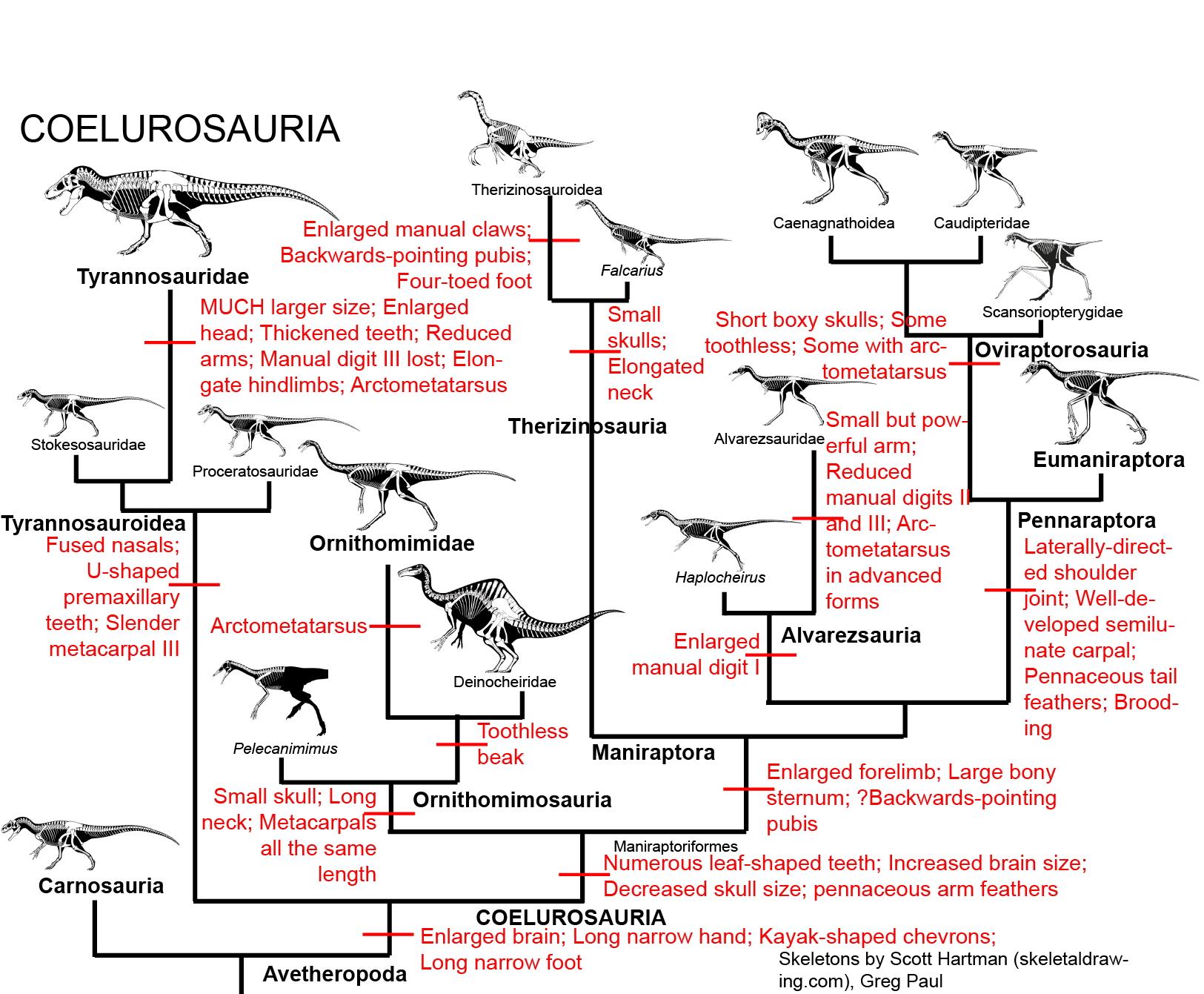
To be more precise their claim is that birds evolved from non-maniraptoran coelurosaurs.
And yet when they compare a "dinosaur" to a bird, they do not take a drawing of a non-maniraptor coelurosaurian, (eg. tyrannosaur) but they take a drawing of a non-neornithine Aves (eg. Ichthyornithes) creature and compare it with a modern bird.
This of course is irrelevant.
The issue is NOT WITHIN AVES but between non-maniraptor coelurosaurs and maniraptors.

Here are some non-maniraptor coelurosaurs.
Tyrannosaur:

Compsognathid:

These are believed to be sister taxa to the non-maniraptor coelurosaur ancestor of birds. But as we all know, the dino to bird theory enthusiasts never present any pictorial representation of any purported non-maniraptor coelurosaur, bird ancestor.
So who knows what it looks like.

But certainly if we want to understand what the dino to bird theory is actually claiming, we need to compare the non-maniraptor coelurosaurs to modern birds and not non-neornithine Aves creatures to modern birds.

Pterosaur Hand

Here is a great drawing of a pterosaur


It shows the "pteroid bone" which is a neomorph. It shows the other fingers including the extended 4th finger.
It shows that the pterosaurs bent their wings at the junction of the metacarpals and the fingers.
This is different than their descendant modern birds that have fused the hand so they no longer bend at the junction of the metacarpals and the fingers. Instead modern birds bend at the wrist.

Friday, November 19, 2010

Primitive to Modern Birds

Here is a first cut at the development of primitive bird groups to modern bird groups.

See the updated version here:
http://pterosaurnet.blogspot.com/2012/02/overview-of-basic-ideas.html

Friday, November 12, 2010

Prow Beaks

I have been analyzing the pterosaurs to see if they actually had beaks as we use the term "beak". Rhamphorhynchoid stands for "prow beaks". This kind of "beak" is not the extending kind of beak that we associate with the word "beak".
When the pterosaurs evolved into primitive birds, it may well be that the most basal primitive "beakless" birds had snouts, like prow-beaked pterosaurs.
And "beaks", as we use the word, evolved within the primitive birds.
This idea is in line with the fossil record.
This idea requires more analysis but it seems right to me at this point.

Tuesday, November 2, 2010

Protofeathers on the wing membrane

Here is a reference to the "pycnofibres"  - even as early as the Rhamphorhynchus.
If they are  related to feathers they correspond to downy feathers and not pennaceous (contour) feathers. 


http://en.wikipedia.org/wiki/Pterodactylus
"The wings were long, and the wing membranes appear to have lacked the furry covering of pycnofibres present in some other pterosaurs (such as Pterorhynchus and Jeholopterus)."

http://en.wikipedia.org/wiki/Pterorhynchus
"This type specimen consists of an articulated, nearly-complete skeleton with remains of the integument. These included the wing membrane, hair-like structures, a long version of the vane found at the end of "rhamphorhynchoid" tails, and a head crest with both a low bony base and a large keratin extension"

http://en.wikipedia.org/wiki/Jeholopterus
"The specimen is crushed into a slab and counterslab pair, so that parts of the specimen are preserved on one side of a split stone and some on the other. This includes exquisite preservation of carbonized skin fibers and, arguably, "hair" or "protofeathers." The fibers are preserved around the body of the specimen in a "halo." Wing tissue is preserved, though its extent is debatable, including the exact points of attachment to the legs (or if it attached to the legs at all). In 2009 Alexander Kellner published a study reporting the presence of three layers of fibres [actinofibrils] in the wing, allowing the animal to precisely adapt the wing profile.[3]"


Monday, November 1, 2010

Painten Pelican

Here is a reference to a very interesting picture:
http://pterosaur-net.blogspot.com/20...-throwing.html
"An unusual pterosaur skull, nicknamed the Painten Pelican, has caused a lot of discussion amongst pterosaur palaeontologists because it is, superficially at least, so danged weird (see image, above). The specimen comprised a complete skull, mandible and cervical vertebra and, if you’re around in Southern Germany, you can see it for yourself: it’s on display in the Solnhofen Museum. A cast and UV photographs of the specimen were making quite a buzz at the 2007 Flugsaurier Meeting, and, apparently, the specimen is very slowly being written up."

Wednesday, October 27, 2010

Questions

If anyone has questions, comments or objections, feel free to post them. I will do my best to answer them

Tuesday, October 26, 2010

Two Dimensions

In situations where we see contradictions, the answer is often that there are two dimensions that are involved but we are only acknowledging one of them.
That is what is going on with the subject we are looking at - the origin and development of species.
There are actually two dimensions. You could call one the horizontal and one the vertical.
Cladistics for example, does not acknowledge the vertical dimension and tries to collapse everything into the horizontal line of time. This can never be successful of course.
The Linnaean conception acknowledges the vertical dimension but not the horizontal dimension.
Both dimensions must be acknowledged because REALITY is in two dimensions.
It is only when we acknowledge both dimensions that we will understand the underlying reality.

For what it is worth, the closest we come now, is the conception of serial anagenesis with parallel evolution. That is the model I use in the pterosaur to bird theory.

Wednesday, October 13, 2010

* Dino to Bird Theory (4)

CIRCULARITY:
http://www.bio.fsu.edu/James/Ornitho...phs%202009.pdf
"The congruence of other characters is sometimes
offered as justification for such assumptions:
birds are theropods because they share
other characters with theropods and, therefore,
must have the same digital identities as theropods
(e.g., Wagner and Gauthier 1999, Makovicky and
Dyke 2001, Padian 2001b). This reasoning is circular.
Synapomorphies are invoked to defend the
hypothesis; the hypothesis is invoked to defend
the synapomorphies."

* Dino to Bird Theory (3)

Here is a reference to what I am talking about:
http://www.bio.fsu.edu/James/Ornitho...phs%202009.pdf
"Unjustifiable assumptions of homology incorporated
into data matrices.—The most glaring example of
this problem is the coding of avian and theropod
manual, carpal, and tarsal characters as if they were
homologous, despite the ambiguity of the data,
and despite the assumption this coding entails that
the BMT [dino to bird theory] hypothesis is correct a priori
(Martin et al.
1980; Martin 1983, 1991; Martin and Stewart 1985;
Burke and Feduccia 1997; Feduccia 1999; Wagner
and Gauthier 1999; Feduccia and Nowicki 2002;
Kundrát et al. 2002; Larsson and Wagner 2002; Galis
et al. 2003, 2005; Mayr et al. 2005, 2007; Vargas
and Fallon 2005a, b; Welten et al. 2005; Appendix
3)."

Saturday, October 9, 2010

* Dino to Bird Theory (2)

Here is the larger context to put this in, related to "normal science".
http://gothling.tripod.com/paradigm.html
"Textbooks, more than perhaps any other force in science, represent the bulwarks of existing paradigms. Students of science learn to deal with the world around them in the context of the paradigm they are taught. Ideally, students then grapple with the issues left unresolved within their paradigm and thus continue what Kuhn [Thomas Kuhn] calls the enterprise of "normal science"--"an attempt to force nature into the preformed and relatively inflexible box that the paradigm supplies". In dealing with nature through an existing paradigm, scientists are inherently conservative. They generally shun new theories that may shake their views of the world. According to Kuhn, however, this conservatism is not only inevitable, it is desirable: "By focusing attention upon a small range of relatively esoteric problems, the paradigm forces scientists to investigate some part of nature in a detail and depth that would otherwise be unimaginable". Normal science is essential for fact-gathering that may help confirm, clarify, or even extend paradigms. They also help to match facts with theory, and they even help to make theories more acceptable by, for instance, making them more aesthetically palatable. More fundamentally, normal science can be seen as puzzle-solving, where paradigms determine the parameters and rules for the puzzle. In other words, the paradigm sets the parameters in which scientists may view the world. Researchers must then attempt to solve the puzzles by looking for missing pieces and connecting them into a cohesive whole.

Where Paradigms Fail. This [normal science] period of puzzle solving, however, is often disrupted by discovery, at which point scientists must call into question the rules by which they were solving the puzzle. Restated, "Discovery commences with the awareness of anomaly, i.e. with the recognition that nature has somehow violated the paradigm-induced expectations that govern normal science". Anomaly must emerge within the context of an existing paradigm--otherwise, scientists would be unable to even recognize it."

* Dino to Bird Theory (1)

Here is a rather typical article on the dino to bird theory:
http://www.biomedsearch.com/attachme...j0149-0001.pdf

It purports to show the relationships between certain taxa and implies the validity of the dino to bird theory.
But what it actually does is, it assumes the validity of the dino to bird theory and then shows that if that theory is valid here is how the taxa would be related.
If only they would be honest and say that, things would be so much clearer.

This pattern occurs quite frequently. The authors of many, many studies and articles do not evaluate the validity of the dino to bird theory. THEY ASSUME the validity of the theory and then arrange things around that assumption.
And then people in this field say that the dino to bird theory is valid because look at how much validating material there is over the years. They forget (ignore) that those studies were based on the assumption of the dino to bird theory.

Wednesday, September 8, 2010

Anagenesis on the pterosaur line (2)

It is suggested you read the previous post before reading this one.

In the previous post we saw that there were anagenetic events/process on the pterosaur line. What prevents that line from continuing? Nothing actually. In fact it did continue. Through the processes of cladogenesis and anagenesis it continued on into the line of primitive birds, and then modern birds, just as this entire site has been presenting.
That being the case, we can correct the placement of birds on the cladograms. We remove them from where they are misplaced now and place them on the pterosaur line.

Anagenesis on the pterosaur line

Here is a standard cladogram.
http://biology.unm.edu/ccouncil/Biology_203/Images/Phylogeny/ReptileCladogram1.jpg


This shows pterosaurs as a diverging line.
Let's consider that line in a bit more detail.
First let's review the general idea about what happens on a line (whether it be diverging or not).
Anagenesis is what happens on lines. (Which is perfectly reasonable).
Remember this cladogram?


Notice the short red horizontal lines. Each represents an event/process of anagenesis.
Notice that such lines appear on the diverging lines.

Putting these ideas together we can see that there were such anagenetic events/process on the pterosaur line. And we know that is the case, because there are the Rhamphorhynchoidea and the Pterodactyloidea (the pterodactyls). The pterodactyls developed as a result of anagenesis.
I will continue this in the next post.

Friday, September 3, 2010

Looking for an ancestor

In the earlier post I said:
"The reason this is very significant is because dino to bird enthusiasts have never offered any creatures (any taxa) as the actual ancestor of modern birds. If Senter had put modern birds on the scatterplot he would have faced that issue. But he did not face up to it.".

The idea that "dino to bird enthusiasts have never offered any creatures (any taxa) as the actual ancestor of modern birds" may have come as a surprise to some people. But that is a simple uncontested fact.

Here is a reference to that fact:
http://en.wikipedia.org/wiki/Temporal_paradox_%28paleontology%29
"First, no one has proposed that maniraptoran dinosaurs of the Cretaceous are the ancestors of birds. They have merely found that dinosaurs like dromaeosaurs, troodontids and oviraptorosaurs are close relatives of birds. "

It is not my intention to enter into an analysis here about cladistic analysis.
But what is relevant is the following:
We saw how the dino to bird idea does not stand up to the fact that the line would have to wander and backtrack all over the place from one unconnected group to another.
But the situation is actually worse than that (if such a thing is conceivable).
Evolutionists are not even saying that any of those groups actually evolved into any others of those groups. They are saying that there is a separate line of unfound fossils of different creatures that winds its way from dinosaurs to birds.

Thankfully that is not a part of the thinking I am presenting.

Wednesday, September 1, 2010

Where are the modern birds?

If we look carefully at the Senter scatterplot we find an interesting thing.
Modern birds are not on the chart!
The "birdlike cluster" is just that - BIRDLIKE. But not birds in the sense of modern birds.
If modern birds were on the chart, would we see them as another cluster?
It is interesting to wonder what standard dino to bird theory would predict.
If anyone has an opinion on this I would be very interested.

There is another interesting thing about the Senter scatterplot.
To understand this we need some background. As people may know evolutionists place modern birds as a member of Aves.
But let's take a look at the scatterplot and the legend beneath it. The legend says that the violet dots are Archaeopteryx (31) and "other Aves" (32 and 33).
32 is Sapeornis. 33 is Confuciusornis.
This confirms what I had said about the missing modern birds. Even though the legend says "other Aves" the cluster does not include modern birds. It leaves out the most significant Aves creatures, the modern birds (neornithes). The group is actually "non-neornithine Aves".
The reason this is very significant is because evolutionists have never offered any creatures (any taxa) as the actual ancestor of modern birds. If Senter had put modern birds on the scatterplot he would have faced that issue. But he did not face up to it.

Tuesday, August 31, 2010

Presenting the picture

We have seen that the Senter scatterplot completely contradicts the standard dinosaur to bird idea. The supposed path from dino to bird wanders all over the place between unconnected groups.
So how does the scatterplot relate to the ideas that I have been presenting?
First we would remove the Tyrannosaur cluster since it is not related at all to the origin and development of birds. We are left with the "Birdlike cluster" and an assortment of other unconnected groups.
According to the hypothesis I have been presenting, the Birdlike cluster developed from the pterosaurs, which unfortunately are not shown on the chart. So we cannot analyze that aspect of the subject.
But we can consider the relationship of the Birdlike Cluster to the other groups such as the Oviraptors, Alvarezsaurids, Therizonosaurids etc.

What I have been presenting is the idea that these groups developed from the flying birds within the Birdlike cluster. They are SECONDARILY flightless.
The reason that they appear morphologically unconnected in terms of the scatterplot is that they are as different as flightless birds are from flying birds. And there is no way in practice to distinguish intermediates because if a bird fossil is found - it is identified as either one or the other.

Friday, August 27, 2010

The long and winding road

I have been pointing out that the "birdlike cluster" is not related to the "tyrannosaur cluster". But the situation is actually more interesting than that.
In every cladogram that purports to show an evolution from dinosaur to bird, we find the following:
The dino-to-bird enthusiasts place non-flying creatures like the Ornithomimosauria, Therizinosauridae and Oviraptorosauria between the dinosaurs (eg. tyrannosaurs) and the birds.
The idea is that terrestrial dinosaurs evolved into terrestrial, feathered creatures which then evolved into flying birds.
But take a look at the Senter scatterplot. Trace the line that is imagined to have occurred between these groups, supposedly winding its way to the birdlike cluster.
It is a wandering line between groups that are not connected.
The dino-to-bird idea is completely incompatible with the evidence from the Senter study.

For those who might like to have this spelled out, the dino to bird purported sequence would roughly go from the red points to the pink points, backtrack to the olive points, over to the green points, over to the blue points and then backtrack to the violet points. Quite a fantastic, supposed journey.
When the data is accurately charted like this we see that the dino to bird idea is simply incorrect.

Thursday, August 26, 2010

The "birdlike cluster"

Senter has shown that there is a "birdlike cluster" which is "morphologically continuous". When we look at what creatures are included in the birdlike cluster, we see that they are all "maniraptors".
This is precisely one of the major points I have been making. The group labeled "maniraptors" are in fact flying and secondarily flightless birds. (Of course I am not the only one who has made this point).

I am also saying that the flying birds within the birdlike cluster developed from pterosaurs. And the flightless birds within the birdlike cluster developed from the flying birds within the birdlike cluster.

An intellectual exercise

Here is an intellectual exercise.
Let us take the 3 groups:
A: Non-maniraptor dinosaurs (eg Tyrannosaur, Compsognathidae)
B: Non-avian maniraptors (eg. Dromaeosaurids, Oviraptors etc.)
C: Aves (eg. Enantiornithes, Confuciusornis etc.)

People agree that C is related to B.
But some people go further and say also that B is related to A.
But the people who believe that B is related to A, do not put it in that simple way. They keep saying that C is related to the "non-avian group" (A + B).
To be precise, C is related to the B part of the "non-avian group", not the A part of the "non-avian group". The phrase "non-avian group" is just misleading. Whether B is related to A has still to be shown.
And that is the question!
Does everyone see the issue?

And then think about how many times you have seen the phrases "non-avian coelurosaurs" and "non-avian dinosaurs".