Here is a partial list of primitive (feathered, long-bony-tailed) flying and secondarily flightless birds.
Scansoriopterygids (Temporal range: Late Jurassic, 165–156 Ma)
Anchiornis (Temporal range: Late Jurassic, 161–160.5 Ma)
Aurornis (Temporal range: Late Jurassic, 160 Ma)
Xiaotingia (Temporal range: Late Jurassic, 160 Ma)
Zhongornis (Temporal range: Early Cretaceous, 122 Ma)
Oviraptors (secondarily flightless)
Zhenyuanlong?
Archaeopteryx?
Microraptor?
Eosinopteryx? (Temporal range: Late Jurassic, 160 Ma)
Pedopenna? (Temporal range: Middle or Late Jurassic, 164 Ma)
Jeholornis?
Alvarezsaurids?
Ornithomimosaurs?
Velociraptor?
Jixiangornis?
The flying primitive (feathered, long-bony-tailed) birds evolved from pterosaurs.
The secondarily flightless primitive birds evolved from the flying primitive birds.
Sunday, August 9, 2015


Monday, July 20, 2015
Basalmost Paraves
There is a set of 4-winged, flying, primitive birds (eg. Anchiornis, Aurornis, Xiaotingia etc.) that at times have been classified as avialans and sometimes as dromaeosaurids. They actually belong to the basalmost Paraves.
They are the Tetrapterygidae and the Scansoriopterygids.
They are the Tetrapterygidae and the Scansoriopterygids.
I suggest that these flying primitive birds evolved from pterosaurs.
Later, some of these primitive birds settled on the ground and became secondarily flightless (eg. eudromaeosaurids, oviraptors etc).
https://en.wikipedia.org/wiki/Paraves
https://en.wikipedia.org/wiki/Tetrapterygidae
Later, some of these primitive birds settled on the ground and became secondarily flightless (eg. eudromaeosaurids, oviraptors etc).
https://en.wikipedia.org/wiki/Paraves
the work of Xu et al. (2003), (2005) and Hu et al. (2009) provide examples of basal and early paravians with four wings,[10][11][12] adapted to an arboreal lifestyle who would only lose their hindwings when some adapted to a life on the ground and when avialans evolved powered flight.[13] Newer research also indicates that gliding, flapping and parachuting was another ancestral trait of Paraves, while true powered flight only evolved once, in the lineage leading to modern birds.[14]
https://en.wikipedia.org/wiki/Tetrapterygidae
Tetrapterygidae (meaning "four-wings") is a group of four-winged dinosaurs proposed by Sankar Chatterjee in the second edition of his book The Rise of Birds: 225 Million Years of Evolution, where he included Microraptor, Xiaotingia, Aurornis, and Anchiornis.[1] The group was named after the characteristically long flight feathers on the legs of all included species, as well as the theory that the evolution of bird flight may have gone through a four-winged (or "tetrapteryx") stage, first proposed by naturalist William Beebe in 1915.[2] Chatterjee suggested that all dinosaurs with four wings formed a natural group exclusive of other paravians, and that this family was the sister taxon to the group Avialae, although most phylogenetic analyses have placed the animals of his Tetrapterygidae elsewhere in Paraves, such as Xiaotingia, Aurornis, and Anchiornis being placed in Avialae.[3]
Zhenyuanlong
Zhenyuanlong is a secondarily flightless member of Paraves.
http://www.nature.com/srep/2015/150716/srep11775/full/srep11775.html (2015)

https://www.washingtonpost.com/news/speaking-of-science/wp/2015/07/16/scientists-find-a-new-dinosaur-with-well-preserved-bird-like-wings-but-not-for-flight/
http://www.nature.com/srep/2015/150716/srep11775/full/srep11775.html (2015)
A large, short-armed, winged dromaeosaurid (Dinosauria: Theropoda) from the Early Cretaceous of China and its implications for feather evolution
Regardless of the precise phylogenetic relationships of dromaeosaurids, Zhenyuanlong provides the first glimpse of feather morphologies in a short-armed dromaeosaurid. Feathers are not preserved on the holotype of Tianyuraptor, and the shortness of the forearm in this taxon led to the suggestion that its arms lacked aerodynamic function15. Although the arms of Zhenyuanlong are short, they supported large and complex wings comprised of pennaceous coverts, primaries, and secondaries, some of which are asymmetric. Whether these wings served any type of aerodynamic function is a separate question that can only be answered with biomechanical analysis, but the wings of Zhenyuanlong are strikingly similar to those of Microraptor in general size, morphology, and composition, albeit they are supported by much smaller arms.
The integumentary similarities between Zhenyuanlong and Microraptor-type animals could suggest one of several explanations. First, the large short-armed dromaeosaurids may have had some volant abilities, unrecognized previously because Tianyuraptor was preserved without feathers and its small arms were assumed to be un-flightworthy15. Perhaps there was not a large functional and behavioural gap between animals like Microraptor and Zhenyuanlong. We find this unlikely, however, given the striking differences in body size between them, and the incredibly short arms of Zhenyuanlong which do not appear optimized for flight (although we reiterate that biomechanical modelling is needed to properly test this). Alternatively, the integumentary similarities between small and clearly volant dromaeosaurids7 and larger and presumably non-volant dromaeosaurids could suggest that the larger and short-armed Zhenyuanlong evolved from more volant ancestors and maintained a many aspects of the integument through the inertia of common descent or for other selective reasons, not because it needed them for flight. It may be that such large wings comprised of multiple layers of feathers were useful for display purposes40, and possibly even evolved for this reason and not for flight, and this is one reason why they may have been retained in paravians that did not fly.
https://www.washingtonpost.com/news/speaking-of-science/wp/2015/07/16/scientists-find-a-new-dinosaur-with-well-preserved-bird-like-wings-but-not-for-flight/
Zhenyuanlong suni didn't have wings well suited for flight -- but it did have the feathers one would need to get off the ground. Because of this, they suspect that suni came after a flying ancestor, losing the capability for muscle-powered flight but retaining the related plumage, perhaps to use its wings for mating displays.
Sunday, July 5, 2015
Primitive birds flying
Primitive birds (basalmost paraves) flapped their wings and flew using the same set of muscles as their pterosaur ancestors.
http://press.princeton.edu/witton/sa...pterosaurs.pdf
|
| Furthermore, the supracoracoideus muscle, and hence an ossified sternum, is not necessary to effect the recovery stroke of the wing. Thus the main evidence for Archaeopteryx having been a terrestrial, cursorial predator is invalidated. There is nothing in the structure of the pectoral girdle of Archaeopteryx that would preclude its having been a powered flier. |
| Concerning the lack of asymmetric feathers in flying basalmost paraves, the following seems relevant: https://gwawinapterus.wordpress.com/...-introduction/
http://www.sciencedirect.com/science/article/pii/S0960982212011943 Primitive bird: In modern birds (Neornithes), the wing is composed of a layer of long, asymmetrical flight feathers overlain by short covert feathers [1-3]. It has generally been assumed that wing feathers in the Jurassic bird Archaeopteryx [4-9] and Cretaceous feathered dinosaurs [10, 11] had the same arrangement. Here, we redescribe the wings of the archaic bird Archaeopteryx lithographica [3-5] and the dinosaur Anchiornis huxleyi [12, 13] and show that their wings differ from those of Neornithes in being composed of multiple layers of feathers. In Archaeopteryx, primaries are overlapped by long dorsal and ventral coverts. Anchiornis has a similar configuration but is more primitive in having short, slender, symmetrical remiges. Archaeopteryx and Anchiornis therefore appear to represent early experiments in the evolution of the wing. This primitive configuration has important functional implications: although the slender feather shafts of Archaeopteryx [14] and Anchiornis [12] make individual feathers weak, layering of the wing feathers may have produced a strong airfoil. Furthermore, the layered arrangement may have prevented the feathers from forming a slotted tip or separating to reduce drag on the upstroke. The wings of early birds therefore may have lacked the range of functions seen in Neornithes, limiting their flight ability. Longrich NR, Vinther J, Meng Q, Li Q, Russell AP. https://en.wikipedia.org/wiki/Bird_flight
|
Altogether we have a picture of a flying, feathered, 4 winged, arboreal, primitive bird with a long bony tail, that flew like a pterosaur. With elliptical wings and symmetric feathers
At times people have argued that a flying pterosaur would not devolve into a gliding primitive bird. But this is misguided, because the evidence indicates that flying pterosaurs evolved into flying primitive birds, not into gliding primitive birds.
Here are the aspects related to flight capability:
- muscles used
- keeled or not keeled sternum
- flight feathers (asymmetric or not)
- feathered hindlimbs
See here for more details:
http://pterosaurnet.blogspot.ca/2010/05/keeled-breastbone.html
http://pterosaurnet.blogspot.ca/2015/07/primitive-birds-flying.html
http://pterosaurnet.blogspot.ca/2014/09/flight-without-supracoracoideus.html
http://pterosaurnet.blogspot.ca/2013/02/flight-stroke.html
http://www.nature.com/articles/ncomms14576 (2017)
A stiffer feathered postpatagium in Anchiornis may have compensated for its aerodynamically inferior arm feathers to some degree
Thursday, July 2, 2015
Fingers - Quick Summary
https://en.wikipedia.org/wiki/Origin_of_birds#Digit_homology
But birds have hands with digits x-2-3-4-x.
This is a problem for the dino to bird theory.
To overcome this problem, the dino to bird folk propose changes that include the following:
The pterosaur transition (from 2-3-4-5-x) would be:
Frame shift
http://www.researchgate.net/publication/259253962_Thumbs_down_a_molecular-morphogenetic_approach_to_avian_digit_homology
https://commons.wikimedia.org/wiki/File:Bird_and_dino_hand_difference_debate.JPG

If scansoriopterygids are the basalmost members of paraves, then the very first paraves were (or were very similar to) the scansoriopterygids, which have x-2-3-4-x with digit IV being the longest.
Which is consistent with a pterosaur ancestry and contrary to a dino ancestry.
See here for more details:
http://pterosaurnet.blogspot.ca/2014/07/pterosaur-fingers.html
There is a debate between embryologists and paleontologists whether the hands of theropod dinosaurs and birds are essentially different, based on phalangeal counts, a count of the number of phalanges (fingers) in the hand. This is an important and fiercely debated area of research because its results may challenge the consensus that birds are descendants of dinosaurs.Dinosaurs have hands with digits 2-3-4-x-x. (Roman numerals represent fingers, numbers represent phalanges).
But birds have hands with digits x-2-3-4-x.
This is a problem for the dino to bird theory.
To overcome this problem, the dino to bird folk propose changes that include the following:
- the loss of digit I
- the reappearance of the lost digit IV
- digits II-III-IV adopting the phalangeal count and characteristics of the earlier digits I-II-III (via a frame shift) resulting in x-2-3-4-x with digit III the longest.
The pterosaur transition (from 2-3-4-5-x) would be:
- the loss of digit I
- digits II-III-IV lose one phalange each, resulting in x-2-3-4-x with digit IV the longest (as in scansoriopterids).
Frame shift
http://www.researchgate.net/publication/259253962_Thumbs_down_a_molecular-morphogenetic_approach_to_avian_digit_homology
Thus the change of the phalangeal formula (as in the PRH) is actually caused by the change of the transcriptome (as in the FSH [frame shift hypothesis]), which in turn is directly caused by the loss of digit I (probably shh and hoxD mediated).
https://commons.wikimedia.org/wiki/File:Bird_and_dino_hand_difference_debate.JPG

Dinosaur to bird (notice the original loss of digit IV and its re-appearance)
In the diagram, Neotheropoda ( 1 ), basal tetanurae ( 2 ), a coelurosaurian ( 3 ), the bird (?)Archaeopteryx ( 4 ) and modern bird ( 5 ).
If scansoriopterygids are the basalmost members of paraves, then the very first paraves were (or were very similar to) the scansoriopterygids, which have x-2-3-4-x with digit IV being the longest.
Which is consistent with a pterosaur ancestry and contrary to a dino ancestry.
See here for more details:
http://pterosaurnet.blogspot.ca/2014/07/pterosaur-fingers.html
Wednesday, July 1, 2015
Bristles and feathers - Quick summary
Dinosaurs (eg. tyrannosaurs) had bristles. They did not have any form of feather.
On the other hand, pterosaurs had Stage I and Stage II feathers. Those early stage feathers kept the endothermic pterosaur warm, which was necessary in flying.
Primitive birds (basal paraves) had pennaceous feathers. Those pennaceous feathers developed in the transition from pterosaur to primitive bird.
In order to understand this topic, it is essential to understand the development stages a feather goes through.
Drawing B represents Stage I. Note that the follicle appears at Stage II (drawing C):

See here for more details:
http://pterosaurnet.blogspot.ca/2014/01/helpful-background.html
On the other hand, pterosaurs had Stage I and Stage II feathers. Those early stage feathers kept the endothermic pterosaur warm, which was necessary in flying.
Primitive birds (basal paraves) had pennaceous feathers. Those pennaceous feathers developed in the transition from pterosaur to primitive bird.
In order to understand this topic, it is essential to understand the development stages a feather goes through.
Drawing B represents Stage I. Note that the follicle appears at Stage II (drawing C):
v3.jpg)
See here for more details:
http://pterosaurnet.blogspot.ca/2014/01/helpful-background.html
Friday, June 26, 2015
Primitive birds - Quick summary
There were pennaceous-feathered, long-bony-tailed primitive birds.
The most basal were flying (eg. scansoriopterygids, tetrapterygids).
Some later ones became secondarily flightless (eg. oviraptors, eudromaeosaurids etc).
These primitive birds have a great deal in common with pterosaurs. They evolved from pterosaurs.
These primitive birds have almost nothing in common with dinosaurs.
Scansoriopterygid

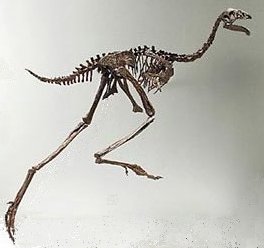
Oviraptor (secondarily flightless)

The most basal were flying (eg. scansoriopterygids, tetrapterygids).
Some later ones became secondarily flightless (eg. oviraptors, eudromaeosaurids etc).
These primitive birds have a great deal in common with pterosaurs. They evolved from pterosaurs.
These primitive birds have almost nothing in common with dinosaurs.
Scansoriopterygid

Oviraptor (secondarily flightless)
Monday, June 22, 2015
Oviraptor Propatagium
More evidence that oviraptors were secondarily flightless and not transitional between dinosaurs and Paraves.
https://www.google.ca/url?sa=t&rct=j&q=&esrc=s&source=web&cd=2&cad=rja&uact=8&ved=0CCMQFjAB&url=https%3A%2F%2Fbio.unc.edu%2Ffiles%2F2011%2F04%2FFeducciaCzerkas2015.pdf&ei=YEiHVfvbLMWRyAS67JKYBQ&usg=AFQjCNEJgIr2smR2Fi7zU35DviaiAu1sVg&sig2=R0xmD8EIWD2vnj8Zf__yMw&bvm=bv.96339352,d.aWw
See here for more details about oviraptors as secondarily flightless:
http://pterosaurnet.blogspot.ca/2014/09/oviraptors-as-secondarily-flightless.html
https://www.google.ca/url?sa=t&rct=j&q=&esrc=s&source=web&cd=2&cad=rja&uact=8&ved=0CCMQFjAB&url=https%3A%2F%2Fbio.unc.edu%2Ffiles%2F2011%2F04%2FFeducciaCzerkas2015.pdf&ei=YEiHVfvbLMWRyAS67JKYBQ&usg=AFQjCNEJgIr2smR2Fi7zU35DviaiAu1sVg&sig2=R0xmD8EIWD2vnj8Zf__yMw&bvm=bv.96339352,d.aWw
Testing the neoflightless hypothesis: propatagium reveals flying ancestry of oviraptorosaurs (2015)
Alan Feduccia1• Stephen A. Czerkas2
Considerable debate surrounds the numerousThere is actually no link between dinosaurs and Paraves.
avian-like traits in core maniraptorans (oviraptorosaurs,
troodontids, and dromaeosaurs), especially in the
Chinese Early Cretaceous oviraptorosaur Caudipteryx,
which preserves modern avian pennaceous primary remiges
attached to the manus, as is the case in modern birds.
Was Caudipteryx derived from earth-bound theropod dinosaurs,
which is the predominant view among palaeontologists,
or was it secondarily flightless, with volant avians
or theropods as ancestors (the neoflightless hypothesis),
which is another popular, but minority view. The discovery
here of an aerodynamic propatagium in several specimens
provides new evidence that Caudipteryx (and hence oviraptorosaurs)
represent secondarily derived flightless
ground dwellers, whether of theropod or avian affinity, and
that their presence and radiation during the Cretaceous may
have been a factor in the apparent scarcity of many other
large flightless birds during that period.
See here for more details about oviraptors as secondarily flightless:
http://pterosaurnet.blogspot.ca/2014/09/oviraptors-as-secondarily-flightless.html
Friday, June 5, 2015
Dinosaurs are not similar to primitive birds
The following study shows that there were 51 synapomorphies (unique defining characteristics) for Paraves (primitive birds). This means that of the 374 characteristics that were evaluated, 51 of them were different than the claimed dinosaur ancestor. This is more than 1 in 8. This means that primitive birds are not similar to dinosaurs, which is a point that I have being making for a very long time. It is good to see a cladistic analysis confirm this point.
Note that this number would be very much larger if the oviraptors etc were taken as secondarily flightless.
2011 study (Xu et al):
http://www.nature.com/nature/journal/v475/n7357/full/nature10288.html
http://www.ivpp.cas.cn/qt/papers/201403/P020140314389417822583.pdf
An Archaeopteryx-like theropod [Xiaotingia] from China and the origin of Avialae
Note that this number would be very much larger if the oviraptors etc were taken as secondarily flightless.
2011 study (Xu et al):
http://www.nature.com/nature/journal/v475/n7357/full/nature10288.html
http://www.ivpp.cas.cn/qt/papers/201403/P020140314389417822583.pdf
An Archaeopteryx-like theropod [Xiaotingia] from China and the origin of Avialae
Here we report a new Archaeopteryx-like theropod from China. This find further demonstrates that many features formerly regarded as being diagnostic of Avialae, including long and robust forelimbs, actually characterize the more inclusive group Paraves (composed of the avialans and the deinonychosaurs).
Paraves: 1.1, 10.1, 13.0, 14.0, 15.1, 20.1, 21.1, 28.1, 39.0, 61.1, 65.0, 66.0, 69.0, 79.0, 91.0,95.0, 96.1, 97.1, 106.0, 109.1, 119.1, 125.0, 127.1, 129.1, 137.1, 138.1, 139.1, 154.0, 155.1,156.1, 160.1, 166.0, 176.1, 179.1, 180.1, 184.1, 202.1, 221.1, 232.0, 237.1, 262.1, 267.1,277.2, 292.0, 304.2, 306.1, 319.1, 320.2, 336.1, 354.0, and 362.1
Saturday, May 2, 2015
Yi qi
Yi qi study:
https://www.researchgate.net/publication/275669107_A_bizarre_Jurassic_maniraptoran_theropod_with_preserved_evidence_of_membranous_wings
http://www.nature.com/nature/journal/vaop/ncurrent/full/nature14423.html#extended-data
Abstract:
http://www.nature.com/nature/journal/vaop/ncurrent/full/nature14423.html

Yi qi is the perfect candidate for transitional between pterosaur and paraves.

Here are a few other references:
http://phenomena.nationalgeographic.com/2015/04/29/chinese-dinosaur-had-bat-like-wings-and-feathers/
http://www.nature.com/articles/nature14392.epdf?referrer_access_token=ZfVGgFg7XRdurry3TN0QoNRgN0jAjWel9jnR3ZoTv0PiQtvFAER-nO6rVanRtj7cIVRMaXAe5x5JlY3vpNDkkxI0a1Q8_ZTmq63AsO-pCE_wZ6-LixrY3IBCK0O57ofs-sVhrdtkwoPKG1MmYYRWBnKtWySldMOVBfPZhs5YnU3psTTjZa6_HEcPzvjKZvRO962MU9ssjnM38C1xE3d-slSGO5xkY9Myf0Z8kfmYNxU%3D&tracking_referrer=www.nature.com
http://www.nature.com/news/more-on-unicorns-1.17419
https://whyevolutionistrue.wordpress.com/2015/04/30/dino-bat-a-new-flying-dinosaur-with-membranous-wings/
https://www.sciencenews.org/article/dinosaur%E2%80%99s-ride-may-have-been-glide
https://www.researchgate.net/publication/275669107_A_bizarre_Jurassic_maniraptoran_theropod_with_preserved_evidence_of_membranous_wings
Xu et al "identify the three manual digits of Yi and other maniraptors as II-III-IV".
https://www.nature.com/articles/nature14392.epdf?referrer_access_token=_dLCCVvlPegFyP3c4GsuFtRgN0jAjWel9jnR3ZoTv0PiQtvFAER-nO6rVanRtj7cIVRMaXAe5x5JlY3vpNDkkxI0a1Q8_ZTmq63AsO-pCE_ObpObUo01kQljGZf1pg1VspxlgGl1ag1_Ppi_rb_KR7QdR4znn2erMDIpDZm-cbNYt9xObOVZ_5AGyUA2Z_P6ucWWcItD4wgO7HN6CfeNNw%3D%3D&tracking_referrer=www.nature.com
Note that David Peters make an interesting case for the idea that the Yi qi "styliform element" is a displaced radius and ulna.
https://pterosaurheresies.wordpress.com/2015/05/03/no-styliform-element-on-yi-qi-thats-just-a-displaced-radius/
https://pterosaurheresies.wordpress.com/2015/05/04/yi-qi-and-occams-razor/
https://www.researchgate.net/publication/275669107_A_bizarre_Jurassic_maniraptoran_theropod_with_preserved_evidence_of_membranous_wings
A bizarre Jurassic maniraptoran theropod with preserved evidence of membranous wings
The wings of birds and their closest theropod relatives share a uniform fundamental architecture, with pinnate flight feathers as the key component1, 2, 3. Here we report a new scansoriopterygid theropod, Yi qi gen. et sp. nov., based on a new specimen from the Middle–Upper Jurassic period Tiaojishan Formation of Hebei Province, China4. Yi is nested phylogenetically among winged theropods but has large stiff filamentous feathers of an unusual type on both the forelimb and hindlimb. However, the filamentous feathers of Yi resemble pinnate feathers in bearing morphologically diverse melanosomes5. Most surprisingly, Yi has a long rod-like bone extending from each wrist, and patches of membranous tissue preserved between the rod-like bones and the manual digits. Analogous features are unknown in any dinosaur but occur in various flying and gliding tetrapods6, 7, 8, 9, 10, suggesting the intriguing possibility that Yi had membranous aerodynamic surfaces totally different from the archetypal feathered wings of birds and their closest relatives. Documentation of the unique forelimbs of Yi greatly increases the morphological disparity known to exist among dinosaurs, and highlights the extraordinary breadth and richness of the evolutionary experimentation that took place close to the origin of birds.Supplementary information:
If a membrane is reconstructed lateral to the trunk, the wing is similar in outline to ........ a pterosaur wing if the styliform element is approximately laterally oriented.Extended data:
http://www.nature.com/nature/journal/vaop/ncurrent/full/nature14423.html#extended-data
Abstract:
http://www.nature.com/nature/journal/vaop/ncurrent/full/nature14423.html

Yi qi is the perfect candidate for transitional between pterosaur and paraves.

Here are a few other references:
http://phenomena.nationalgeographic.com/2015/04/29/chinese-dinosaur-had-bat-like-wings-and-feathers/
These wings were mutually exclusive: dinosaur or pterosaur, feathery or leathery. But Yi went for both options! It had membrane wings with a feathery covering on the leading edge. It shows that at least some dinosaurs had independently evolved the same kind of wings as pterosaurs—an extraordinary example of convergent evolution.
http://www.nature.com/articles/nature14392.epdf?referrer_access_token=ZfVGgFg7XRdurry3TN0QoNRgN0jAjWel9jnR3ZoTv0PiQtvFAER-nO6rVanRtj7cIVRMaXAe5x5JlY3vpNDkkxI0a1Q8_ZTmq63AsO-pCE_wZ6-LixrY3IBCK0O57ofs-sVhrdtkwoPKG1MmYYRWBnKtWySldMOVBfPZhs5YnU3psTTjZa6_HEcPzvjKZvRO962MU9ssjnM38C1xE3d-slSGO5xkY9Myf0Z8kfmYNxU%3D&tracking_referrer=www.nature.com
http://www.nature.com/news/more-on-unicorns-1.17419
It is here that we enter unicorn territory — for no dinosaur, however unusual, has been found with anything like this feature. The authors are appropriately cautious, therefore, in their interpretation.http://www.theguardian.com/science/lost-worlds/2015/apr/29/bird-yi-qi-the-dinosaur-evolution-flight-feather-nature
https://whyevolutionistrue.wordpress.com/2015/04/30/dino-bat-a-new-flying-dinosaur-with-membranous-wings/
https://www.sciencenews.org/article/dinosaur%E2%80%99s-ride-may-have-been-glide
A dinosaur called Yi qi appears to have lifted a page from pterosaurs’ flight plan. Protruding from each of the newly discovered dinosaur’s wrists was a weird rodlike bone that may have attached to a fleshy wing that helped the dinosaur glide or fly, researchers report April 29 in Nature.“We’ve never seen anything like this in a dinosaur before,” says paleontologist Sarah Werning of Stony Brook University in New York. “It’s almost like this dinosaur was pretending to be a pterosaur.”
https://www.researchgate.net/publication/275669107_A_bizarre_Jurassic_maniraptoran_theropod_with_preserved_evidence_of_membranous_wings
Xu et al "identify the three manual digits of Yi and other maniraptors as II-III-IV".
https://images.nature.com/full/nature-assets/nature/journal/v521/n7550/extref/nature14423-s1.pdf
The Pterosaur Model (not shown) differs from the Bat Model in having
a laterally oriented styliform element (which is redundant functionally with the elongated manual digit IV), but otherwise is nearly identical to the Bat Model.
A key weakness of the Bat and Pterosaur Models is that no membranous soft tissue is preserved lateral to the body and posterior to the humerus and ulna in the holotype of Yi qi, whereas relatively large feathers are clearly present in this region. The feathers may simply have been situated ventrally and/or dorsally on the membrane, for purposes of insulation and/or display, but their large size implies that they might then have increased the drag experienced by the animal to strongly disadvantageous levels.
The major strength of the Bat and Pterosaur Models is that the reconstructed wing has a large membranous area and represents a general type of aerodynamic apparatus that is common among volant tetrapods other than birds and their close relatives 14-19,22Kevin Padian commentary:
https://www.nature.com/articles/nature14392.epdf?referrer_access_token=_dLCCVvlPegFyP3c4GsuFtRgN0jAjWel9jnR3ZoTv0PiQtvFAER-nO6rVanRtj7cIVRMaXAe5x5JlY3vpNDkkxI0a1Q8_ZTmq63AsO-pCE_ObpObUo01kQljGZf1pg1VspxlgGl1ag1_Ppi_rb_KR7QdR4znn2erMDIpDZm-cbNYt9xObOVZ_5AGyUA2Z_P6ucWWcItD4wgO7HN6CfeNNw%3D%3D&tracking_referrer=www.nature.com
Note that David Peters make an interesting case for the idea that the Yi qi "styliform element" is a displaced radius and ulna.
https://pterosaurheresies.wordpress.com/2015/05/03/no-styliform-element-on-yi-qi-thats-just-a-displaced-radius/
https://pterosaurheresies.wordpress.com/2015/05/04/yi-qi-and-occams-razor/
Friday, January 9, 2015
Dino to bird - off on the wrong foot
The revival of the dino to bird idea began with the work of John Ostrom in the 1970's. But Ostrom misinterpreted the flightless Deinonychus as a land-based transitional between dinosaur and Paraves.
But it is now clear that Deinonychus is a secondarily flightless member of Paraves. It is a secondarily flightless dromaeosaur which is included in Paraves. "Secondarily" means that it descended from a flying ancestor.The current dino to bird theory revival dates back to Ostrom's misinterpretations in the 1970's.
There is no connection between actual dinosaurs and Paraves.
Relevant links:
https://books.google.ca/books?id=SihlpQTlVdAC&pg=PA255&dq=secondarily+flightless+Deinonychus&hl=en&sa=X&ei=u_WpVKGHIYqHyQSDgIGgAw&ved=0CB4Q6AEwAA#v=onepage&q=secondarily%20flightless%20Deinonychus&f=false
http://dinosaur-museum.org/featheredinosaurs/Are_Birds_Really_Dinosaurs.pdf
With the benefit of hindsight it is easy to see that if fossils of the
small flying dromaeosaurs from China had only been discovered before the larger flightless dromaeosaurs like Deinonychus or Velociraptor were found, the interpretations of the past three decades on how birds are related to dinosaurs would have been significantly different. If it had already been established that dromaeosaurs were birds that could fly, then the most logical interpretation of larger flightless dromaeosaurs found afterwards would have to be that they represented birds, basically like the prehistoric equivalent of an Ostrich, which had lost their ability to fly.
https://en.wikipedia.org/wiki/Dromaeosauridae#Alternative_theories_and_flightlessness
At least two schools of researchers have proposed that dromaeosaurids may actually be descended from flying ancestors.
They even have a category for the flightless members of Dromaeosauridae which are actually secondarily flightless:
http://en.wikipedia.org/wiki/Eudromaeosauria
Quote:
| Eudromaeosaurs Temporal range: Early Cretaceous – Late Cretaceous, 143–66Ma Eudromaeosauria ("true dromaeosaurs") is a subgroup of terrestrial dromaeosaurid theropod dinosaurs. They were relatively large-bodied, feathered hypercarnivores (with diets consisting almost entirely of other terrestrial vertebrates) that flourished in the Cretaceous Period. |
http://www.bio.fsu.edu/James/Ornithological%20Monographs%202009.pdf
If some maniraptorans were
birds, and if birds were not theropods, similarities
between maniraptorans and theropods could
be readily explained by convergence on a cursorial
morphotype subsequent to the loss of flight.
Even distantly related reptiles could converge
closely, in some cases almost indistinguishably,
on the theropod morphotype through the acquisition
of cursoriality, as the case of Effigia, noted
above, dramatically demonstrates (Nesbitt and
Norell 2006, Nesbitt 2007). If this is the case, some
maniraptorans represent lineages of cryptic birds
whose true phylogenetic relationships have been
obscured by convergence and the loss of flight.
Given the evidence that some maniraptorans
may belong within Aves and that, consequently,
Aves may not belong within Theropoda, this possibility
must be seriously considered.
In the case of Effigia, the trend toward bipedalism produced extreme convergence throughout the cranial and
postcranial skeleton on that of highly cursorial
ornithomimosaurs, with further convergence on
numerous characters of the avemetatarsalian,
dinosaurian, theropod, neotetanurine, and coelurosaurian
skeletons; in some cases, the relevant
characters are identical across taxa (Nesbitt and
Norell 2006, Nesbitt 2007).
The taxa that were originally thought to provide support for a dino to bird theory (eg. Deinonychus) are no longer considered to be related to the purported line from dinosaur to Paraves. Rather they are members of Paraves.
http://en.wikipedia.org/wiki/Deinonychus
Several years later, Ostrom noted similarities between the forefeet of Deinonychus and that of birds, an observation which led him to revive the hypothesis that birds are descended from dinosaurs.[34]http://onlinelibrary.wiley.com/doi/10.1111/j.1095-8312.1976.tb00244.x/epdf
http://biostor.org/reference/110202.text
http://biostor.org/reference/110202
Saurischian monophyly and the origin of birdsOstrom (1976)
Jacques Gauthier
http://onlinelibrary.wiley.com/doi/10.1111/j.1095-8312.1976.tb00244.x/epdf
This is the original Ostrom article. He notes the similarity of caudal rods.
Page 135:
Of greatest interest, though, is the peculiar elongated form of the zygopophyses
of the last 15 to 16 vertebrae. While not so extreme as in the dromaeosaurids
Deinonychus or Velociruptor, or in the rhamphorhynchoid pterosaurs, their
form is very reminiscent of the condition in struthiomimid theropods.
Similarly, the chevrons behind the seventh caudal are also greatly elongated
antero-posteriorly and severely flattened dorso-ventrally, as in both
struthiomimids and dromaeosaurids.
To the best of my knowledge, these conditions are not known in any pseudosuchian, or in any other reptile other than the theropods cited and rhamphorhynchoids.
https://bio.unc.edu/files/2011/04/FeducciaCzerkas2015.pdf
Following their discovery, dromaeosaurs
were initially thought to be flightless nonavian
dinosaurs ancestral to actual birds which eventually
evolved the ability to fly; hence, according to this
hypothesis, avian aerodynamic adaptations evolved by
exaptations in earth-bound forms (Sereno 1999). The
dromaeosaurs therefore appeared to represent feathered
dinosaurs which were wingless ancestors of birds that
were not yet capable of flight. However, with the discovery
of fully volant basal dromaeosaurs, the microraptors,
with a four-winged, tetrapteryx bauplan and
avian pennaceous, asymmetric flight remiges, the concept
of a dinosaurian trees-down model was introduced
(Zhou and Zhang 2006; Chatterjee and Templin 2012).
Also interesting:
http://en.wikipedia.org/wiki/Origin_of_birds
http://en.wikipedia.org/wiki/Origin_of_birds#Secondary_flightlessness_in_dinosaurs
https://en.wikipedia.org/wiki/Archaeopteryx
https://en.wikipedia.org/wiki/Specimens_of_Archaeopteryx
2011 study (Xu):
http://www.nature.com/nature/journal/v475/n7357/full/nature10288.html
http://www.ivpp.cas.cn/qt/papers/201403/P020140314389417822583.pdf
2008 study (Zhang)
www.ivpp.ac.cn/qt/papers/201206/P020120601535055482173.pdf
http://www.nature.com/nature/journal/v455/n7216/suppinfo/nature07447.html
A bizarre Jurassic maniraptoran from China with elongate ribbon-like feathers
Characters 361-363 are newly added. Characters 4, 25, 33, 40-42, 65, 67, 69, 82, 85, 91,
99, 106, 110, 115, 116, 121, 122, 136, 138, 142, 146, 148, 151, 153, 163, 165-167,
169, 171, 178, 181, 200-203, 212, 230-360 are from Senter (2007); others are from
Kirkland et al. (2005).
2009 study (Hu, D.Y. et al)
A pre-Archaeopteryx troodontid from China with long feathers on the
metatarsus. Nature 461, 640-643
2009 study (Nesbitt)
http://onlinelibrary.wiley.com/doi/10.1002/jmor.10724/pdf
2010 study (Xu)
Xu, X., Ma, Q.-Y. & Hu, D.-Y. Pre-Archaeopteryx coelurosaurian dinosaurs and their
implications for understanding avian origins. Chin. Sci. Bull. 55, 3971–3977
www.ivpp.ac.cn/qt/papers/201403/P020140314383143868220.pdf
2011 study (Nesbitt)
http://digitallibrary.amnh.org/dspace/handle/2246/6112
Includes basal pterosaurs (Dimorphodon, Eudimorphodon).
2012 study (Michael S. Y. Lee):
http://rsbl.royalsocietypublishing.org/content/8/2/299
2012 study (Turner et al)
http://digitallibrary.amnh.org/handle/2246/6352
"One step" Figure 75
2012 study (Senter)
http://journals.plos.org/plosone/article?id=10.1371/journal.pone.0036790
http://www.nature.com/nature/journal/v498/n7454/full/nature12168.html#supplementary-information
----------------------------------------------
PTEROSAURS
2013 (Andres, Myers)
http://journals.cambridge.org/action/displayAbstract?fromPage=online&aid=9036361&fileId=S1755691013000303
https://www.academia.edu/4033902/Lone_Star_pterosaurs

2010 (Andres, Clark, Xu)
http://www.tandfonline.com/doi/full/10.1080/02724630903409220?scroll=top&needAccess=true
----------------------------
2014 study (Stephen L. Brusatte)
http://www.cell.com/current-biology/abstract/S0960-9822(14)01047-1
http://webcache.googleusercontent.com/search?q=cache:Xh48ucIC9jMJ:https://datadryad.org/bitstream/handle/10255/dryad.69251/BrusatteetalRevisionDryadF
http://www.terratreasures.com/amber/research/publications/Gradual%20Assembly%20of%20Avian%20Body%20Plan%202014.pdf
2001 study (Norell)
https://www.google.ca/url?sa=t&rct=j&q=&esrc=s&source=web&cd=7&cad=rja&uact=8&ved=0CDwQFjAG&url=http%3A%2F%2Fpeabody.yale.edu%2Fsites%2Fdefault%2Ffiles%2Fdocuments%2Fscientific-publications%2FNorell.pdf&ei=WTJzVdm3J8-cyQTE04LIBQ&usg=AFQjCNHXFS86E3amp_s8Rawptna25kZgsg&sig2=JE9mqQQXJJD-gsBoEy9qCw&bvm=bv.95039771,d.aWw
2004 study (Renesto)
http://dipbsf.uninsubria.it/paleo/vallesaurus.pdf
Includes one pterosaur (Eudimorphodon)
Unwin
https://books.google.ca/books?id=8CKYxcylOycC&pg=PA151&lpg=PA151&dq=pterosaur+humerus+femur&source=bl&ots=SqlVhvxEf8&sig=rFe60Gylylfa_tjGGNALcIenUuU&hl=en&sa=X&ved=0CB0Q6AEwAGoVChMI99bb_IyExgIVho6SCh23TABo#v=onepage&q=pterosaur%20humerus%20femur&f=false
2007 study (Senter)
http://www.tandfonline.com/doi/abs/10.1017/S1477201907002143
2009 study (Xing Xu)
http://www.nature.com/articles/nature08124.epdf?referrer_access_token=1LIOYM249T2ALXmHhUVXQtRgN0jAjWel9jnR3ZoTv0NAxxXDTxDgb7tt7vNCs5i7CDx_p1E8pIL0dPMGIw0CIZ1LRnUZIDT1a3FIDY_UW4FRwpODRDVwWg-KbK448VK63yIXiGAa_H8fA42yVK8TsNhr_ASjWKKTbM-PJCMVzpKKElR4FEstewHl9DZGaHr9&tracking_referrer=www.nature.com
2015 study (Cau)
https://peerj.com/articles/1032/
http://www.academia.edu/543988/Theropod_diversity_and_the_refinement_of_avian_characteristics

http://www.cell.com/current-biology/pdf/S0960-9822(15)00945-8.pdf (2015)
http://www.nature.com/nature/journal/v511/n7507/full/nature13467.html
http://en.wikipedia.org/wiki/Origin_of_birds
In 1969, this dinosaur was described and named Deinonychus by John Ostrom of Yale University.[24] The next year, Ostrom redescribed a specimen of Pterodactylus in the Dutch Teyler Museum as another skeleton of Archaeopteryx.[25] The specimen consisted mainly of a single wing and its description made Ostrom aware of the similarities between the wrists of Archaeopteryx and Deinonychus.[26]https://en.wikipedia.org/wiki/Archaeopteryx
The Haarlem [archaeoptyeryx] Specimen (TM 6428/29, also known as the Teyler Specimen) was discovered in 1855 near Riedenburg, Germany, and described as a Pterodactylus crassipes in 1857 by Meyer. It was reclassified in 1970 by John Ostrom and is currently located at the Teylers Museum in Haarlem, Netherlands.https://en.wikipedia.org/wiki/John_Ostrom#Archaeopteryx_and_the_origin_of_flight.2C_and_hadrosaur_herds
Ostrom's interest in the dinosaur-bird connection started with his study of what is now known as the Haarlem Archaeopteryx. Discovered in 1855, it was actually the first specimen recovered but, incorrectly labeled as Pterodactylus crassipes, it languished in the Teylers Museum in the Netherlandsuntil Ostrom's 1970 paper (and 1972 description) correctly identified it as one of only eight "first birds" (counting the solitary feather).
http://en.wikipedia.org/wiki/Origin_of_birds#Secondary_flightlessness_in_dinosaurs
A hypothesis, credited to Gregory Paul and propounded in his books Predatory Dinosaurs of the World (1988) and Dinosaurs of the Air (2002), suggests that some groups of non-flying carnivorous dinosaurs—especially deinonychosaurs, but perhaps others such as oviraptorosaurs, therizinosaurs, alvarezsaurids and ornithomimosaurs—actually descend from birds.http://www.researchgate.net/publication/227857345_Birds_have_paedomorphic_dinosaur_skulls
https://en.wikipedia.org/wiki/Archaeopteryx
Because it displays a number of features common to both birds and non-avian dinosaurs, Archaeopteryx has often been considered a link between them.[11] In the 1970s, John Ostrom, following T. H. Huxley's lead in 1868, argued that birds evolved within theropod dinosaurs and Archaeopteryx was a critical piece of evidence for this argument; it had a number of avian features, such as a wishbone, flight feathers, wings, and a partially reversed first toe along with a number of dinosaur and theropod features. For instance, it has a long ascending process of the ankle bone, interdental plates, anobturator process of the ischium, and long chevrons in the tail. In particular, Ostrom found that Archaeopteryx was remarkably similar to the theropod family Dromaeosauridae.[14][15][16][17][18][19][20][21][22]
https://en.wikipedia.org/wiki/Specimens_of_Archaeopteryx
Shortly after, Wagner presented a talk at the Bavarian Academy of Sciences, which was later published as an article in 1862. In this talk, Wagner gives a detailed account of the curious combination of avian and saurian features that made the fossil so unique and mysterious. He describes the feather imprints of the fossil to be "those of true birds", and went on to describe other features, like the long tail, that bore "not the least resemblance to that of a bird". He compares the fossil to Rhamphorhynchus, a Solnhofen pterosaur which also possessed a long, bony tail. He regarded the creature as a "mongrel" of bird and reptile, the whole of which was incomprehensible to him.[1][20]
Furthermore, a large distal carpal occupying the same position in the basal neotheropods Syntarsus and Coelophysis has been identified as a compound bone formed by fusion of distal carpals 1 and 2, leading Gauthier to suggest that these distal carpals were also homologous to the ‘semilunate' carpal of non-avian maniraptorans9. However, this hypothesis is in conflict with ontogenetic data from both Mesozoic birds10 and living birds2,3, which show that the distal carpal proximal to the medialmost metacarpal is absent in birds and the lateralmost carpal is involved in the formation of the transversely convex and trochlear proximal articular surface. This conflict has been repeatedly cited as evidence against the theropod hypothesis of avian origins (e.g., ref.11,12).
Gauthier was wrong in the first place about this subject. This is one of the
reasons why the dinosaur to bird theory started out on the basis of wrong
analysis.
=========================================
-------------------------------------------------------------------2011 study (Xu):
http://www.nature.com/nature/journal/v475/n7357/full/nature10288.html
http://www.ivpp.cas.cn/qt/papers/201403/P020140314389417822583.pdf
An Archaeopteryx-like theropod from China and the origin of Avialae
Archaeopteryx is widely accepted as being the most basal bird, and accordingly it is regarded as central to understanding avialan origins; however, recent discoveries of derived maniraptorans have weakened the avialan status of Archaeopteryx. Here we report a new Archaeopteryx-like theropod from China. This find further demonstrates that many features formerly regarded as being diagnostic of Avialae, including long and robust forelimbs, actually characterize the more inclusive group Paraves (composed of the avialans and the deinonychosaurs). Notably, adding the new taxon into a comprehensive phylogenetic analysis shifts Archaeopteryx to the Deinonychosauria. Despite only tentative statistical support, this result challenges the centrality ofArchaeopteryx in the transition to birds. If this new phylogenetic hypothesis can be confirmed by further investigation, current assumptions regarding the avialan ancestral condition will need to be re-evaluated.
(Characters 1-363 are from Hu et al. (2009), whereas 364-374 are newly
added).
Deinonychosauria: 29.1, 72.1, 75.1, 82.0, 111.1, 134.1, 171.2, 183.1, 189.0, 199.1, 233.1,
238.0, 255.0, 294.1, 297.1, 302.1, 323.1, 334.1, 335.2, 359.0, 364.0, 365.0, 366.1, 367.0,
368.0, 371.0, and 372.1
Paraves: 1.1, 10.1, 13.0, 14.0, 15.1, 20.1, 21.1, 28.1, 39.0, 61.1, 65.0, 66.0, 69.0, 79.0, 91.0,
95.0, 96.1, 97.1, 106.0, 109.1, 119.1, 125.0, 127.1, 129.1, 137.1, 138.1, 139.1, 154.0, 155.1,
156.1, 160.1, 166.0, 176.1, 179.1, 180.1, 184.1, 202.1, 221.1, 232.0, 237.1, 262.1, 267.1,
277.2, 292.0, 304.2, 306.1, 319.1, 320.2, 336.1, 354.0, and 362.1
Paraves-Oviraptorosauria-Therizinosauroidea clade: 13.1, 14.1, 28.0, 29.0, 39.1, 41.2, 54.0,
66.2, 79.1, 91.2, 106.1, 116.1, 117.1, 119.0, 121.1, 125.1, 126.1, 127.0, 130.1, 131.1, 136.1,
144.1, 157.2, 166.2, 167.2, 200.1, 238.1, 255.1, 276.1, 284.1, 300.1, 329.1, 351.1, 354.1,
359.1, 363.1, 364.1, 365.1, 367.1, 368.1, and 371.1.
2008 study (Zhang)
www.ivpp.ac.cn/qt/papers/201206/P020120601535055482173.pdf
http://www.nature.com/nature/journal/v455/n7216/suppinfo/nature07447.html
A bizarre Jurassic maniraptoran from China with elongate ribbon-like feathers
Characters 361-363 are newly added. Characters 4, 25, 33, 40-42, 65, 67, 69, 82, 85, 91,
99, 106, 110, 115, 116, 121, 122, 136, 138, 142, 146, 148, 151, 153, 163, 165-167,
169, 171, 178, 181, 200-203, 212, 230-360 are from Senter (2007); others are from
Kirkland et al. (2005).
2009 study (Hu, D.Y. et al)
A pre-Archaeopteryx troodontid from China with long feathers on the
metatarsus. Nature 461, 640-643
2009 study (Nesbitt)
http://onlinelibrary.wiley.com/doi/10.1002/jmor.10724/pdf
2010 study (Xu)
Xu, X., Ma, Q.-Y. & Hu, D.-Y. Pre-Archaeopteryx coelurosaurian dinosaurs and their
implications for understanding avian origins. Chin. Sci. Bull. 55, 3971–3977
www.ivpp.ac.cn/qt/papers/201403/P020140314383143868220.pdf
2011 study (Nesbitt)
http://digitallibrary.amnh.org/dspace/handle/2246/6112
Includes basal pterosaurs (Dimorphodon, Eudimorphodon).
2012 study (Michael S. Y. Lee):
http://rsbl.royalsocietypublishing.org/content/8/2/299
2012 study (Turner et al)
http://digitallibrary.amnh.org/handle/2246/6352
"One step" Figure 75
2012 study (Senter)
http://journals.plos.org/plosone/article?id=10.1371/journal.pone.0036790
2013 study (Pascal Godefroit, Cau): (1,500 characters)
http://www.nature.com/nature/journal/v498/n7454/full/nature12168.htmlhttp://www.nature.com/nature/journal/v498/n7454/full/nature12168.html#supplementary-information
----------------------------------------------
PTEROSAURS
2013 (Andres, Myers)
http://journals.cambridge.org/action/displayAbstract?fromPage=online&aid=9036361&fileId=S1755691013000303
https://www.academia.edu/4033902/Lone_Star_pterosaurs
2010 (Andres, Clark, Xu)
http://www.tandfonline.com/doi/full/10.1080/02724630903409220?scroll=top&needAccess=true
----------------------------
2014 study (Stephen L. Brusatte)
http://www.cell.com/current-biology/abstract/S0960-9822(14)01047-1
http://webcache.googleusercontent.com/search?q=cache:Xh48ucIC9jMJ:https://datadryad.org/bitstream/handle/10255/dryad.69251/BrusatteetalRevisionDryadF
http://www.terratreasures.com/amber/research/publications/Gradual%20Assembly%20of%20Avian%20Body%20Plan%202014.pdf
Permutation tests, which assess whether the morphospace means of two groups significantly differ from each other over all axes, find birds to be indistinct from their closest paravian relatives (Tables S1 and S2; Supplemental Experimental Procedures).
Although birds are clearly distinct compared to all other living vertebrates, the avian bauplan isn’t especially distinct relative to other coelurosaurs, particularly their closest relatives.
These results are consistent with many recent phylogenetic studies, ours included (see ‘‘Phylogenetic Analysis’’ in the Results), which find few characters separating Avialae from nonavialan theropods. These results may also help explain why so many alternative phylogenetic analyses have difficulty in placing certain taxa (such as Anchiornis and Archaeopteryx) consistently in either Avialae or among the clades of nonavialan theropods most closely related to birds [7–14].
In general anatomical terms, birds are a continuum of millions of years of theropod evolution. There is no great jump between nonbirds and birds in morphospace. Instead, those features that today combine to set birds apart from other vertebrates—feathers, wishbones, air sacs, and hundreds more—evolved piecemeal in Mesozoic theropods [18]. Therefore, we surmise that a Mesozoic naturalist would make no immediate distinction between a Velociraptor-type animal and an Archaeopteryx-type animal.
The clade consisting of Oviraptorosauria and Paraves is supported by a Bremer value of 1 and a jackknife percentage of less than 50%. Paraves—consisting of dromaeosaurids, troodontids, and avialans—is also poorly supported, as it also has a Bremer value of 1 and a jackknife of less than 50%.
2001 study (Norell)
https://www.google.ca/url?sa=t&rct=j&q=&esrc=s&source=web&cd=7&cad=rja&uact=8&ved=0CDwQFjAG&url=http%3A%2F%2Fpeabody.yale.edu%2Fsites%2Fdefault%2Ffiles%2Fdocuments%2Fscientific-publications%2FNorell.pdf&ei=WTJzVdm3J8-cyQTE04LIBQ&usg=AFQjCNHXFS86E3amp_s8Rawptna25kZgsg&sig2=JE9mqQQXJJD-gsBoEy9qCw&bvm=bv.95039771,d.aWw
2004 study (Renesto)
http://dipbsf.uninsubria.it/paleo/vallesaurus.pdf
Includes one pterosaur (Eudimorphodon)
Unwin
https://books.google.ca/books?id=8CKYxcylOycC&pg=PA151&lpg=PA151&dq=pterosaur+humerus+femur&source=bl&ots=SqlVhvxEf8&sig=rFe60Gylylfa_tjGGNALcIenUuU&hl=en&sa=X&ved=0CB0Q6AEwAGoVChMI99bb_IyExgIVho6SCh23TABo#v=onepage&q=pterosaur%20humerus%20femur&f=false
2007 study (Senter)
http://www.tandfonline.com/doi/abs/10.1017/S1477201907002143
2009 study (Xing Xu)
http://www.nature.com/articles/nature08124.epdf?referrer_access_token=1LIOYM249T2ALXmHhUVXQtRgN0jAjWel9jnR3ZoTv0NAxxXDTxDgb7tt7vNCs5i7CDx_p1E8pIL0dPMGIw0CIZ1LRnUZIDT1a3FIDY_UW4FRwpODRDVwWg-KbK448VK63yIXiGAa_H8fA42yVK8TsNhr_ASjWKKTbM-PJCMVzpKKElR4FEstewHl9DZGaHr9&tracking_referrer=www.nature.com
2015 study (Cau)
https://peerj.com/articles/1032/
The phylogenetic affinities of the bizarre Late Cretaceous Romanian theropod Balaur bondoc (Dinosauria, Maniraptora): dromaeosaurid or flightless bird?
https://blogs.scientificamerican.com/tetrapod-zoology/the-romanian-dinosaur-balaur-seems-to-be-a-flightless-bird/Based on phylogenetic analyses and critique of the various unusual features of this theropod, we argue that Balaur is likely not a dromaeosaurid, but a secondarily flightless bird. If you’re at all aware of the discussion that’s surrounded the possible evolution of flightlessness in non-bird paravians (Paul 1988, 2002), the significance of this won’t be lost on you. Our paper (Cau et al. 2015) is published in the open access journal PeerJ, so is available for free to everyone.
http://www.academia.edu/543988/Theropod_diversity_and_the_refinement_of_avian_characteristics
http://www.cell.com/current-biology/pdf/S0960-9822(15)00945-8.pdf (2015)
Over the past two decades of research, one overarching pattern has become clear: many features — such as feathers, wishbones, egg brooding, and perhaps even flight — that are seen only in birds among living animals first evolved in the dinosaurian ancestors of birds (Figures 4 and 5). Other features, such as rapid growth, a keeled sternum, pygostyle, and beak, are absent in the earliest birds and evolved, often multiple times, in more derived birds during the Cretaceous. Therefore, what we think of as the bird ‘blueprint’ was pieced together gradually over many tens of millions of years of evolution, not during one fell swoop (Figure 1) [2,3,19,20].
http://www.nature.com/nature/journal/v511/n7507/full/nature13467.html
Discoveries of bird-like theropod dinosaurs and basal avialans in recent decades have helped to put the iconic ‘Urvogel’ Archaeopteryx1 into context2, 3, 4, 5, 6 and have yielded important new data on the origin and early evolution of feathers7. However, the biological context under which pennaceous feathers evolved is still debated. Here we describe a new specimen of Archaeopteryx with extensive feather preservation, not only on the wings and tail, but also on the body and legs. The new specimen shows that the entire body was covered in pennaceous feathers, and that the hindlimbs had long, symmetrical feathers along the tibiotarsus but short feathers on the tarsometatarsus. Furthermore, the wing plumage demonstrates that several recent interpretations8, 9 are problematic. An analysis of the phylogenetic distribution of pennaceous feathers on the tail, hindlimb and arms of advanced maniraptorans and basal avialans strongly indicates that these structures evolved in a functional context other than flight, most probably in relation to display, as suggested by some previous studies10, 11, 12. Pennaceous feathers thus represented an exaptation and were later, in several lineages and following different patterns, recruited for aerodynamic functions. This indicates that the origin of flight in avialans was more complex than previously thought and might have involved several convergent achievements of aerial abilities.
Subscribe to:
Posts (Atom)