http://onlinelibrary.wiley.com/doi/10.1111/j.1420-9101.2011.02349.x/abstract
"The results of this study indicate that transitional fossils linking at least four major dinosaurian groups to the rest of Dinosauria are yet to be found."(P. Senter, 2011)
I think this is the first time an evolutionist has told the simple truth. There are no transitional fossils between actual dinosaurs (such as Compsognathus and Tyrannosaurus) and Maniraptors.
Thursday, August 11, 2011


Wednesday, July 6, 2011
Senter Strikes Again
Senter shows that Maniraptors are not related to dinosaurs:
http://onlinelibrary.wiley.com/doi/10.1111/j.1420-9101.2011.02349.x/abstract
"Creationist literature claims that sufficient gaps in morphological continuity exist to classify dinosaurs into several distinct baramins (‘created kinds’). Here, I apply the baraminological method called taxon correlation to test for morphological continuity within and between dinosaurian taxa. The results show enough morphological continuity within Dinosauria to consider most dinosaurs genetically related, even by this creationist standard. A continuous morphological spectrum unites the basal members of Saurischia, Theropoda, Sauropodomorpha, Ornithischia, Thyreophora, Marginocephalia, and Ornithopoda with Nodosauridae and Pachycephalosauria and with the basal ornithodirans Silesaurus and Marasuchus. Morphological gaps in the known fossil record separate only seven groups from the rest of Dinosauria. Those groups are Therizinosauroidea + Oviraptorosauria + Paraves [all of which are Maniraptors], Tazoudasaurus + Eusauropoda, Ankylosauridae, Stegosauria, Neoceratopsia, basal Hadrosauriformes and Hadrosauridae.
Each of these seven groups [one of which is Maniraptors] exhibits within-group morphological continuity, indicating common descent for all the group’s members, even according to this creationist standard.
Maniraptors are not related to actual dinosaurs, such as Compsognathus and Tyrannosaurus (ie. not related to "non-maniraptor coelurosaurs").
Maniraptors (ie. birds) developed from pterosaurs.
 Figure 15. Summary of results of taxon correlation analyses across Dinosauria. Each boxed group of silhouettes indicates a group for which taxon correlation found within-group morphological continuity; for silhouette groups in different boxes, taxon correlation found morphological discontinuity between the groups. Dotted lines represent uncertainty as to whether morphological discontinuity is truly present (see Discussion). On the cladogram, triangles indicate paraphyletic groups.
http://onlinelibrary.wiley.com/doi/10.1111/j.1420-9101.2011.02349.x/abstract
"Creationist literature claims that sufficient gaps in morphological continuity exist to classify dinosaurs into several distinct baramins (‘created kinds’). Here, I apply the baraminological method called taxon correlation to test for morphological continuity within and between dinosaurian taxa. The results show enough morphological continuity within Dinosauria to consider most dinosaurs genetically related, even by this creationist standard. A continuous morphological spectrum unites the basal members of Saurischia, Theropoda, Sauropodomorpha, Ornithischia, Thyreophora, Marginocephalia, and Ornithopoda with Nodosauridae and Pachycephalosauria and with the basal ornithodirans Silesaurus and Marasuchus. Morphological gaps in the known fossil record separate only seven groups from the rest of Dinosauria. Those groups are Therizinosauroidea + Oviraptorosauria + Paraves [all of which are Maniraptors], Tazoudasaurus + Eusauropoda, Ankylosauridae, Stegosauria, Neoceratopsia, basal Hadrosauriformes and Hadrosauridae.
Each of these seven groups [one of which is Maniraptors] exhibits within-group morphological continuity, indicating common descent for all the group’s members, even according to this creationist standard.
Maniraptors are not related to actual dinosaurs, such as Compsognathus and Tyrannosaurus (ie. not related to "non-maniraptor coelurosaurs").
Maniraptors (ie. birds) developed from pterosaurs.

Tuesday, February 15, 2011
Symplesiomorphy
Turning back to the development of pterosaurs to modern birds:
It is believed that dinosaurs and pterosaurs were Ornithodirans.
The dinosaurs went their way on the land and the pterosaurs went their way in the air.
Ornithodira --> Dinosaurs
Ornithodira --> Pterosaurs --> Primitive birds --> Modern birds
The similarities of dinosaurs and primitive birds are symplesiomorphic.
To visualize the idea I am expressing you can think of it this way:
Very early on there was a split of creatures into one line that became land-based dinosaurs and another line that became air-based pterosaurs. Over time, each line developed to adapt to their ecological niche.
The pterosaurs developed through a series of steps to primitive birds (basal paraves) and eventually modern birds.
The dinosaurs on the land developed at the same time on their own line, but eventually died off.
Similarities between dinosaurs and primitive birds are due to their common origin as ornithodirans.
Those similarities are symplesiomorphic.
It is believed that dinosaurs and pterosaurs were Ornithodirans.
The dinosaurs went their way on the land and the pterosaurs went their way in the air.
Ornithodira --> Dinosaurs
Ornithodira --> Pterosaurs --> Primitive birds --> Modern birds
The similarities of dinosaurs and primitive birds are symplesiomorphic.
To visualize the idea I am expressing you can think of it this way:
Very early on there was a split of creatures into one line that became land-based dinosaurs and another line that became air-based pterosaurs. Over time, each line developed to adapt to their ecological niche.
The pterosaurs developed through a series of steps to primitive birds (basal paraves) and eventually modern birds.
The dinosaurs on the land developed at the same time on their own line, but eventually died off.
Similarities between dinosaurs and primitive birds are due to their common origin as ornithodirans.
Those similarities are symplesiomorphic.
Friday, February 11, 2011
The ancestor of ducks, geese and swans
http://en.wikipedia.org/wiki/Presbyornithidae
Presbyornithidae were a family of waterbirds with an apparently global distribution that lived until the Earliest Oligocene, but are now extinct. Initially, they were believed to present a mix of characters shown by waterbirds, shorebirds and flamingos and were used to argue for an evolutionary relationship between these groups (Feduccia 1976), but they are now generally accepted to be "wading ducks", the sister taxon [actually ancestor] of the Anatidae, and thus essentially modern waterbirds. They were generally long-legged, long-necked birds, standing around one meter high, with the body of a duck, feet similar to a wader but webbed, and a flat duck-like bill adapted for filter feeding. Apparently, at least some species were very social birds that lived in large flocks and nested in colonies.
Tuesday, February 8, 2011
Analyzing the three major branches
Working with the idea that very early on, three major branches of birds formed (water birds, shorebirds, and land birds), we can look at the landbirds.
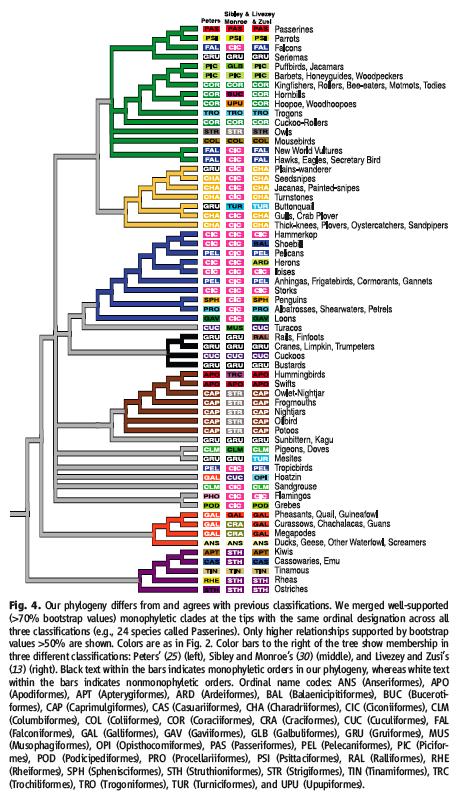
As we have seen the chart shows them as green.
http://www.owlpages.info/downloads/A_Phylogenomic_Study_of_Birds_Reveals_Their_Evolutionary_History.pdf
But we can also see that the birds in brown are a subgroup of the landbird major branch.
So we see landbird subgroups in green and others in brown.
Turning to the birds in red, we note that they are in two distinct groups labeled Anseriformes and Galliformes. The Anseriformes are clearly waterbirds and the Galliformes are secondarily weak-flying landbirds.
Also, including the purple group, we see that they are secondarily flightless landbirds. So we can add them to the summary:
landbirds - green, brown, red (Galliformes), purple (Ratites)
shorebirds - gold (Charadriiformes/Charadrii)
waterbirds - blue, gold (Charadriiformes/Lari), red (Anseriformes)
All that is left are the grey and black groups, which as we have seen are still unsettled. So their lineages are unclear, but in time may become clearer. .
Everything we have seen, that is clear, supports the idea of a very early divergence into the three major branches, with subbranches stemming from each major branch.
As we have seen the chart shows them as green.
http://www.owlpages.info/downloads/A_Phylogenomic_Study_of_Birds_Reveals_Their_Evolutionary_History.pdf
But we can also see that the birds in brown are a subgroup of the landbird major branch.
So we see landbird subgroups in green and others in brown.
Turning to the birds in red, we note that they are in two distinct groups labeled Anseriformes and Galliformes. The Anseriformes are clearly waterbirds and the Galliformes are secondarily weak-flying landbirds.
Also, including the purple group, we see that they are secondarily flightless landbirds. So we can add them to the summary:
landbirds - green, brown, red (Galliformes), purple (Ratites)
shorebirds - gold (Charadriiformes/Charadrii)
waterbirds - blue, gold (Charadriiformes/Lari), red (Anseriformes)
All that is left are the grey and black groups, which as we have seen are still unsettled. So their lineages are unclear, but in time may become clearer. .
Everything we have seen, that is clear, supports the idea of a very early divergence into the three major branches, with subbranches stemming from each major branch.
Confirmation
http://www.owlpages.info/downloads/A_Phylogenomic_Study_of_Birds_Reveals_Their_Evolutionary_History.pdf

By "diversification" I take it they are referring to ancestry.
As I have said, the ancestry of birds was into a few major branches with subbranches off those major branches.
The authors of this study confirm this, presenting the major branches as "water birds, shorebirds, and land birds".
And the authors confirm the subbranching when they say:
They are confirming exactly what I have proposed.
Quote:
| Modern birds occupy a wide diversity of niches and exhibit a variety of behaviors. The broad structure of our phylogeny suggested diversification along general ecological divisions, such as water birds, shorebirds, and land birds. |
As I have said, the ancestry of birds was into a few major branches with subbranches off those major branches.
The authors of this study confirm this, presenting the major branches as "water birds, shorebirds, and land birds".
And the authors confirm the subbranching when they say:
Quote:
| adaptations to these environments clearly arose multiple times, |
Thursday, January 20, 2011
Seabirds
http://en.wikipedia.org/wiki/Seabird
"There exists no single definition of which groups, families, and species are seabirds, and most definitions are in some way arbitrary. In the words of two seabird scientists, "The one common characteristic that all seabirds share is that they feed in saltwater; but, as seems to be true with any statement in biology, some do not."[2] However, by convention all of the Sphenisciformes and Procellariiformes, all of the Pelecaniformes except the darters, and some of the Charadriiformes (the skuas, gulls, terns, auks and skimmers) are classified as seabirds. The phalaropes are usually included as well, since although they are waders ("shorebirds" in North America), two of the three species are oceanic for nine months of the year, crossing the equator to feed pelagically.
Loons and grebes, which nest on lakes but winter at sea, are usually categorized as water birds, not seabirds. Although there are a number of sea ducks in the family Anatidae which are truly marine in the winter, by convention they are usually excluded from the seabird grouping. Many waders (or shorebirds) and herons are also highly marine, living on the sea's edge (coast), but are also not treated as seabirds."
"There exists no single definition of which groups, families, and species are seabirds, and most definitions are in some way arbitrary. In the words of two seabird scientists, "The one common characteristic that all seabirds share is that they feed in saltwater; but, as seems to be true with any statement in biology, some do not."[2] However, by convention all of the Sphenisciformes and Procellariiformes, all of the Pelecaniformes except the darters, and some of the Charadriiformes (the skuas, gulls, terns, auks and skimmers) are classified as seabirds. The phalaropes are usually included as well, since although they are waders ("shorebirds" in North America), two of the three species are oceanic for nine months of the year, crossing the equator to feed pelagically.
Loons and grebes, which nest on lakes but winter at sea, are usually categorized as water birds, not seabirds. Although there are a number of sea ducks in the family Anatidae which are truly marine in the winter, by convention they are usually excluded from the seabird grouping. Many waders (or shorebirds) and herons are also highly marine, living on the sea's edge (coast), but are also not treated as seabirds."
More detail on the major branches
http://www.owlpages.info/downloads/A_Phylogenomic_Study_of_Birds_Reveals_Their_Evolutionary_History.pdf
"The largest clade in Neoaves was a well supported
land bird clade (green, node F, Fig. 2)
(3) that contained the Passeriformes (perching
birds, representing more than half of all avian
species), which is allied with several morphologically
diverse orders. These included Piciformes
(woodpeckers and allies), Falconiformes (hawks
and falcons), Strigiformes (owls), Coraciiformes
(kingfishers, hornbills, rollers, and allies), Psittaciformes
(parrots), Coliiformes (mousebirds), and
Trogoniformes (trogons). One of the most unexpected
findings was the sister relationship
between Passeriformes and Psittaciformes (node
A, Fig. 2), with Falconidae (falcons) sister to this
clade. This relationship varied slightly among
analyses and gene-jackknifing (Fig. 1), yet the
close relationship between passerines with parrots
and/or falcons appeared consistently.
Sister to the land birds is the Charadriiformes
(shorebirds, gulls, and alcids; yellow, node G,
Fig. 2). This grouping seems to be driven primarily
by the b-fibrinogen gene (FGB), because
it was present in analyses of only this gene and
disappeared when the gene was removed through
jackknifing (Fig. 1). Regardless of the exact
placement of the Charadriiformes in our analyses,
we consistently support that this order is not
basal within Neoaves (24) and thus refute the
hypothesis that transitional shorebirds gave rise
to allmodern birds (7). Our phylogeny revealed a
highly supported water bird clade (blue, node H,
Fig. 2) (3, 14), including members of the
Pelecaniformes (totipalmate birds), Ciconiiformes
(storks and allies), Procellariiformes (tubenosed
birds), Sphenisciformes (penguins), and
Gaviiformes (loons)."
But notice that they have lumped the shorebirds, gulls, and alcids together.
"The largest clade in Neoaves was a well supported
land bird clade (green, node F, Fig. 2)
(3) that contained the Passeriformes (perching
birds, representing more than half of all avian
species), which is allied with several morphologically
diverse orders. These included Piciformes
(woodpeckers and allies), Falconiformes (hawks
and falcons), Strigiformes (owls), Coraciiformes
(kingfishers, hornbills, rollers, and allies), Psittaciformes
(parrots), Coliiformes (mousebirds), and
Trogoniformes (trogons). One of the most unexpected
findings was the sister relationship
between Passeriformes and Psittaciformes (node
A, Fig. 2), with Falconidae (falcons) sister to this
clade. This relationship varied slightly among
analyses and gene-jackknifing (Fig. 1), yet the
close relationship between passerines with parrots
and/or falcons appeared consistently.
Sister to the land birds is the Charadriiformes
(shorebirds, gulls, and alcids; yellow, node G,
Fig. 2). This grouping seems to be driven primarily
by the b-fibrinogen gene (FGB), because
it was present in analyses of only this gene and
disappeared when the gene was removed through
jackknifing (Fig. 1). Regardless of the exact
placement of the Charadriiformes in our analyses,
we consistently support that this order is not
basal within Neoaves (24) and thus refute the
hypothesis that transitional shorebirds gave rise
to allmodern birds (7). Our phylogeny revealed a
highly supported water bird clade (blue, node H,
Fig. 2) (3, 14), including members of the
Pelecaniformes (totipalmate birds), Ciconiiformes
(storks and allies), Procellariiformes (tubenosed
birds), Sphenisciformes (penguins), and
Gaviiformes (loons)."
But notice that they have lumped the shorebirds, gulls, and alcids together.
Tuesday, January 18, 2011
Strong Support
Here is strong support for what I am proposing:
http://www.owlpages.info/downloads/A_Phylogenomic_Study_of_Birds_Reveals_Their_Evolutionary_History.pdf
"Modern birds occupy a wide diversity of
niches and exhibit a variety of behaviors. The
broad structure of our phylogeny suggested diversification
along general ecological divisions,
such as water birds, shorebirds, and land birds.
However, adaptations to these environments clearly
arose multiple times, because many aquatic birds were not part of the water bird clade (e.g.,
tropicbirds, flamingos, and grebes) and terrestrial
birds were found outside of the land bird clade
(e.g., turacos, doves, sandgrouse, and cuckoos).
Our phylogeny also indicated several distinctive
niches, such as nocturnal (owls, nightjars, and
allies), raptorial (falcons, hawks, eagles, New
World vultures, seriema, and owls), or pelagic
(tubenosed birds, frigatebirds, and tropicbirds)
lifestyles, have evolved multiple times."
http://www.owlpages.info/downloads/A_Phylogenomic_Study_of_Birds_Reveals_Their_Evolutionary_History.pdf
"Modern birds occupy a wide diversity of
niches and exhibit a variety of behaviors. The
broad structure of our phylogeny suggested diversification
along general ecological divisions,
such as water birds, shorebirds, and land birds.
However, adaptations to these environments clearly
arose multiple times, because many aquatic birds were not part of the water bird clade (e.g.,
tropicbirds, flamingos, and grebes) and terrestrial
birds were found outside of the land bird clade
(e.g., turacos, doves, sandgrouse, and cuckoos).
Our phylogeny also indicated several distinctive
niches, such as nocturnal (owls, nightjars, and
allies), raptorial (falcons, hawks, eagles, New
World vultures, seriema, and owls), or pelagic
(tubenosed birds, frigatebirds, and tropicbirds)
lifestyles, have evolved multiple times."
Taking this a little further, the birds listed in green are from the landbird line.
The birds listed in gold are in two different lines. Some (Charadriiformes/Charadrii) are in the wader line and the others (Charadriiformes/Lari) are in the seabird line.
The birds in blue come from the seabird line.
The birds in red are in two different lines. Some are in the waterbird line and the others are in the landfowl line.
Saturday, January 15, 2011
Petrels
The pattern of development is interesting.
http://en.wikipedia.org/wiki/Procellariidae
http://en.wikipedia.org/wiki/Procellariidae
"According to the famous DNA hybridization study into avian phylogenetic relationships by Sibley and Ahlquist, the split of the Procellariiformes into the four families occurred around 30 million years ago; a fossil bone often attributed to the order, described as the genus Tytthostonyx, has been found in rocks dating around the Cretaceous-Tertiary boundary (70-60 mya), but the remains are too incomplete for placement within the Procellariiformes to be certain.[2] The molecular evidence suggests that the [swimming] storm-petrels were the first to diverge [develop] from the ancestral stock [ichthyornithes], and the albatrosses next, with the procellariids and diving petrels splitting [developing] most recently. Many taxonomists used to retain the diving petrels in this family also, but today their distinctiveness is considered well supported."
Tuesday, January 11, 2011
Owls
This chart shows that owls have their own separate lineage (within the landbird branch) which supports what I have proposed concerning owls:
Monday, January 10, 2011
The Branching Tree
Many existing bird orders trace back to Enantiornithes niche subgroups.
Quote:
| http://en.wikipedia.org/wiki/Enantiornithes so that it is possible that enantiornithines may actually represent successive outgroups on the lineage leading to modern birds. AND http://en.wikipedia.org/wiki/Apsaravis This would mean that, rather than a radiation of primitive birds separate from the radiation that led to modern birds, "enantiornithines" would actually be steps along the way to becoming modern birds. |
Quote:
| http://en.wikipedia.org/wiki/Enantiornithes Enantiornithine fossils appear to include waders, swimmers, fish-catchers, and hook-beaked raptors. And http://en.wikipedia.org/wiki/Bird Enantiornithes occupied a wide array of ecological niches, from sand-probing shorebirds and fish-eaters to tree-dwelling forms and seed-eaters. |
It is a branching tree. In this picture there is increasing specializations and expansion within the niche and expansion across the globe exploiting that niche..
For example, the wader groups of Enantiornithes developed into a variety of specialized wader bird orders and expanded across the globe in their niche.
Wednesday, January 5, 2011
Aves 3D
This is a very cool website showing bird structures in 3D:
Here is an ostrich sternum (not keeled):
http://aves3d.org/specimens/129-Struthio-camelus/specimen_elements/342-Sternum
Here is an ostrich sternum (not keeled):
http://aves3d.org/specimens/129-Struthio-camelus/specimen_elements/342-Sternum
Friday, December 17, 2010
The Basic Picture
The basic picture is that during the Cretaceous, separate primitive bird lines were established, each within its particular niche. And then each line transitioned into the corresponding modern bird orders of that niche.
FLIGHTLESS BIRDS (Ratites)
http://upload.wikimedia.org/wikipedia/commons/c/cd/Velociraptor_dinoguy2.jpg
Ornithomimid
http://upload.wikimedia.org/wikipedia/commons/thumb/3/39/Ornithomimid.jpg/800px-Ornithomimid.jpg
Ostrich
http://upload.wikimedia.org/wikipedia/commons/thumb/8/87/FlappingOstriches.jpg/643px-FlappingOstriches.jpg
Kiwi
http://0.tqn.com/d/goaustralia/1/0/9/i/kiwi.jpg
http://upload.wikimedia.org/wikipedia/commons/thumb/8/89/Iberomesornis-model.jpg/250px-Iberomesornis-model.jpg
Ichthyornis
http://upload.wikimedia.org/wikipedia/commons/thumb/f/f2/Ichthyornis_BW.jpg/250px-Ichthyornis_BW.jpg
Gull
http://upload.wikimedia.org/wikipedia/commons/thumb/1/13/Black-headed_Gull_-_St_James%27s_Park%2C_London_-_Nov_2006.jpg/250px-Black-headed_Gull_-_St_James%27s_Park%2C_London_-_Nov_2006.jpg
WADERS/SHOREBIRDS
http://upload.wikimedia.org/wikipedia/commons/thumb/8/89/Iberomesornis-model.jpg/250px-Iberomesornis-model.jpg
Shorebird
http://upload.wikimedia.org/wikipedia/commons/thumb/0/00/Calidris-pusilla-001.jpg/240px-Calidris-pusilla-001.jpg
AQUATIC BIRDS (Hesperornithes line)
Enantiornithes
http://upload.wikimedia.org/wikipedia/commons/thumb/8/89/Iberomesornis-model.jpg/250px-Iberomesornis-model.jpg
Hesperonis
http://upload.wikimedia.org/wikipedia/commons/thumb/d/d1/Hesperornis_BW.jpg/220px-Hesperornis_BW.jpg
Loon
http://bwfov.typepad.com/birders_world_field_of_vi/images/2007/07/18/loon_2.jpg
WATERFOWL (Anatidae)
http://upload.wikimedia.org/wikipedia/commons/thumb/8/89/Iberomesornis-model.jpg/250px-Iberomesornis-model.jpg
Presbyornis
http://critters.pixel-shack.com/WebImages/crittersgallery/Presbyornis.jpg
Goose
http://upload.wikimedia.org/wikipedia/commons/thumb/c/c0/Magpie.goose.grooming.arp.750pix.jpg/222px-Magpie.goose.grooming.arp.750pix.jpg
http://upload.wikimedia.org/wikipedia/commons/thumb/8/89/Iberomesornis-model.jpg/250px-Iberomesornis-model.jpg
Modern Land Bird
http://upload.wikimedia.org/wikipedia/commons/thumb/3/32/House_sparrow04.jpg/220px-House_sparrow04.jpg
LANDFOWL
Enantiornithes
http://upload.wikimedia.org/wikipedia/commons/thumb/8/89/Iberomesornis-model.jpg/250px-Iberomesornis-model.jpg
Fowl
http://upload.wikimedia.org/wikipedia/commons/thumb/7/79/Sonnerathuhn.jpg/240px-Sonnerathuhn.jpg
Tinamou
http://leesbirdblog.files.wordpress.com/2010/06/red-winged-tinamou-rhynchotus-rufescens-by-c2a9wiki.jpg
LANDBIRDS (OWL)
http://upload.wikimedia.org/wikipedia/commons/thumb/8/8f/Meilong_mmartyniuk_wiki.png/250px-Meilong_mmartyniuk_wiki.png
Owl
http://upload.wikimedia.org/wikipedia/commons/thumb/1/14/Northern_Spotted_Owl.USFWS-thumb.jpg/220px-Northern_Spotted_Owl.USFWS-thumb.jpg
*Dromaeosaurids developed from pterosaurs.
ANALYSIS
So far in the analysis, we have separate primitive bird lines leading to specific modern bird orders.
All the lines trace back to Dromaeosauridae (which then traces back to Pterosauria).
The primitive bird lines are based on:
FLIGHTLESS BIRDS (Ratites)
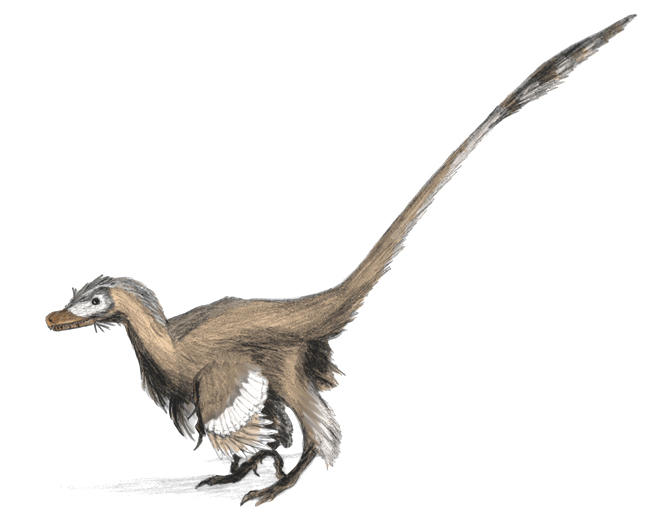
- A Dromaeosaurid* subgroup --> Ornithomimosaurids --> Modern ratites (Ostrich (Struthio), Rhea (Rheidae), Cassowary, Emu (Casuariidae), Kiwi (Apteryx))
http://upload.wikimedia.org/wikipedia/commons/c/cd/Velociraptor_dinoguy2.jpg
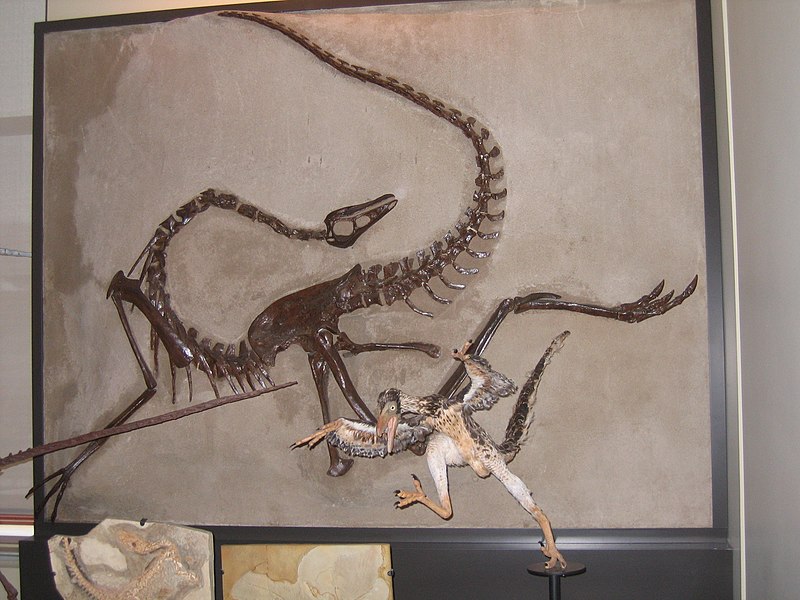
Ornithomimid
http://upload.wikimedia.org/wikipedia/commons/thumb/3/39/Ornithomimid.jpg/800px-Ornithomimid.jpg
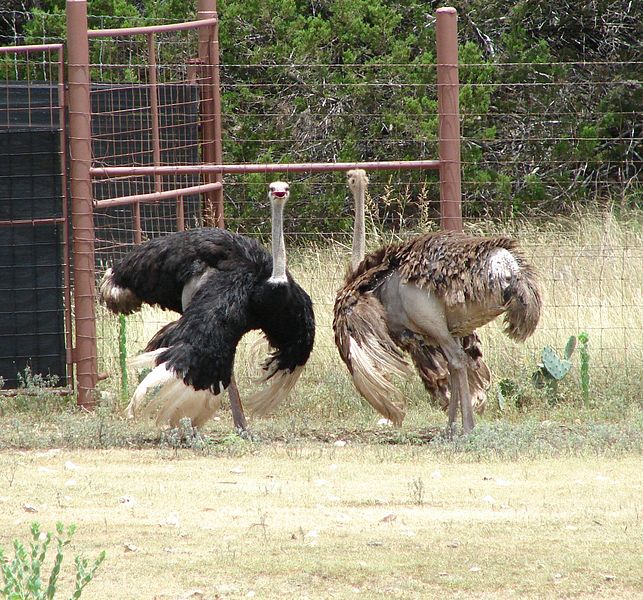
Ostrich
http://upload.wikimedia.org/wikipedia/commons/thumb/8/87/FlappingOstriches.jpg/643px-FlappingOstriches.jpg
Kiwi
http://0.tqn.com/d/goaustralia/1/0/9/i/kiwi.jpg

SEABIRDS (Ichthyornithes line)
- A Dromaeosaurid* subgroup -->
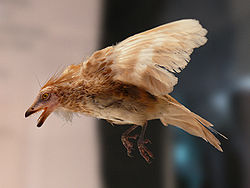
- An Enantiornithes seabird subgroup -->
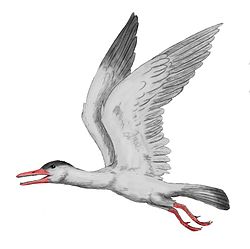
- An Ichthyornithes subgroup --> Gulls, Skimmers (Charadriiformes/Lari) AND
- An Ichthyornithes subgroup --> Petrels (Procellariiformes), Sphenisciformes, Pelecaniformes
http://upload.wikimedia.org/wikipedia/commons/thumb/8/89/Iberomesornis-model.jpg/250px-Iberomesornis-model.jpg
Ichthyornis
http://upload.wikimedia.org/wikipedia/commons/thumb/f/f2/Ichthyornis_BW.jpg/250px-Ichthyornis_BW.jpg
Gull
http://upload.wikimedia.org/wikipedia/commons/thumb/1/13/Black-headed_Gull_-_St_James%27s_Park%2C_London_-_Nov_2006.jpg/250px-Black-headed_Gull_-_St_James%27s_Park%2C_London_-_Nov_2006.jpg

WADERS/SHOREBIRDS
- A Dromaeosaurid* subgroup -->
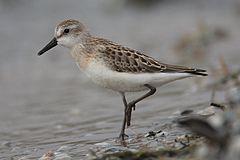
- An Enantiornithes shorebird subgroup --> Primitive shorebird (eg. Graculavus) --> Modern shorebirds - eg. plovers, oystercatchers, sandpipers (Charadriiformes/Charadrii)
http://upload.wikimedia.org/wikipedia/commons/thumb/8/89/Iberomesornis-model.jpg/250px-Iberomesornis-model.jpg
Shorebird
http://upload.wikimedia.org/wikipedia/commons/thumb/0/00/Calidris-pusilla-001.jpg/240px-Calidris-pusilla-001.jpg
AQUATIC BIRDS (Hesperornithes line)
- A Dromaeosaurid* subgroup -->
- An Enantiornithes aquatic subgroup --> Baptornithidae (Hesperornithes) --> (primarily foot-propelled) WEB FOOT diving bird orders, eg. Cormorants (Phalacrocoracidae), Loons (Gaviidae)). AND
- An Enantiornithes aquatic subgroup --> Hesperornithidae (Hesperornithes) --> (primarily foot-propelled) LOBE FOOT diving bird orders eg. Grebes (Podicipedidae).
Enantiornithes
http://upload.wikimedia.org/wikipedia/commons/thumb/8/89/Iberomesornis-model.jpg/250px-Iberomesornis-model.jpg
Hesperonis
http://upload.wikimedia.org/wikipedia/commons/thumb/d/d1/Hesperornis_BW.jpg/220px-Hesperornis_BW.jpg

Loon
http://bwfov.typepad.com/birders_world_field_of_vi/images/2007/07/18/loon_2.jpg

WATERFOWL (Anatidae)
- A Dromaeosaurid* subgroup -->
- An Enantiornithes waterbird subgroup --> Presbyornithids--> Modern Anseriformes (eg. Duck, Geese , Swan)
http://upload.wikimedia.org/wikipedia/commons/thumb/8/89/Iberomesornis-model.jpg/250px-Iberomesornis-model.jpg
Presbyornis
http://critters.pixel-shack.com/WebImages/crittersgallery/Presbyornis.jpg

Goose
http://upload.wikimedia.org/wikipedia/commons/thumb/c/c0/Magpie.goose.grooming.arp.750pix.jpg/222px-Magpie.goose.grooming.arp.750pix.jpg

LANDBIRDS (General)
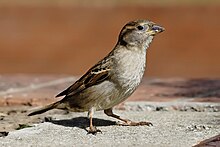
- A Dromaeosaurid* subgroup --> Primitive flying birds (Enantiornithes) --> Modern Land Bird Orders
http://upload.wikimedia.org/wikipedia/commons/thumb/8/89/Iberomesornis-model.jpg/250px-Iberomesornis-model.jpg
Modern Land Bird
http://upload.wikimedia.org/wikipedia/commons/thumb/3/32/House_sparrow04.jpg/220px-House_sparrow04.jpg
LANDFOWL
- A Dromaeosaurid* subgroup --> Primitive flying birds (Enantiornithes) --> Modern "Galliformes" (eg. Chicken, Turkey, Pheasant, Quail) and Tinamiformes (Tinamou)
Enantiornithes
http://upload.wikimedia.org/wikipedia/commons/thumb/8/89/Iberomesornis-model.jpg/250px-Iberomesornis-model.jpg
Fowl
http://upload.wikimedia.org/wikipedia/commons/thumb/7/79/Sonnerathuhn.jpg/240px-Sonnerathuhn.jpg
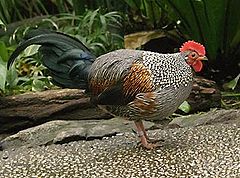
Tinamou
http://leesbirdblog.files.wordpress.com/2010/06/red-winged-tinamou-rhynchotus-rufescens-by-c2a9wiki.jpg

LANDBIRDS (OWL)
- A Dromaeosaurid* subgroup -->
- Troodontid subgroup -->
- Primitive owls (eg. The supposed "Cretaceous owls"Bradycneme and Heptasteornis) -->
- Strigiformes (eg. owls) AND
- Caprimulgiformes (eg. nighthawks)
http://upload.wikimedia.org/wikipedia/commons/thumb/8/8f/Meilong_mmartyniuk_wiki.png/250px-Meilong_mmartyniuk_wiki.png
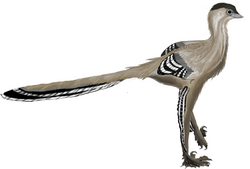
Owl
http://upload.wikimedia.org/wikipedia/commons/thumb/1/14/Northern_Spotted_Owl.USFWS-thumb.jpg/220px-Northern_Spotted_Owl.USFWS-thumb.jpg

*Dromaeosaurids developed from pterosaurs.
ANALYSIS
So far in the analysis, we have separate primitive bird lines leading to specific modern bird orders.
All the lines trace back to Dromaeosauridae (which then traces back to Pterosauria).
The primitive bird lines are based on:
- Ornithomimosaurids
- Enantiornithes
- Ichthyornithes
- Hesperornithes
- Troodontids
- Presbyornithids
Sunday, December 12, 2010
Bird Groupings
Here is one study of how modern birds can be classified.
Hackett et al. cladogram
http://www.owlpages.info/downloads/A_Phylogenomic_Study_of_Birds_Reveals_Their_Evolutionary_History.pdf
Click to enlarge.

Hackett et al. cladogram
http://www.owlpages.info/downloads/A_Phylogenomic_Study_of_Birds_Reveals_Their_Evolutionary_History.pdf
Click to enlarge.

Saturday, December 4, 2010
Filling in the picture (2)

Consider all the taxa (gold bars) that extend to near the K/T extinction (65 mya). Those are Oviraptorids, Troodontids, Dromaeosaurids, Alvarezsaurids, Euenantiornithes, Hesperornithiforrms and Ichthyornis.
Each of those is a candidate for a euphyletic (ancestral) relationship with corresponding modern bird taxa.
For example the taxa labelled "modern birds" (which should read "Some modern birds") can represent the taxa of modern birds that developed from Ichthyornis.
The other modern birds that developed from the other taxa (eg from Euenantiornithes etc) are simply not shown on this chart.
Filling in the picture (1)

To repeat an important point, consider the time-based cladogram (above) that we saw earlier
Note that the group labeled "Modern birds" at the bottom right should say "Some modern birds" since modern bird taxa developed from the various taxa on the chart, such as Enantiornithes etc.
Friday, December 3, 2010
Additional fossils
Here are some additional fossils.
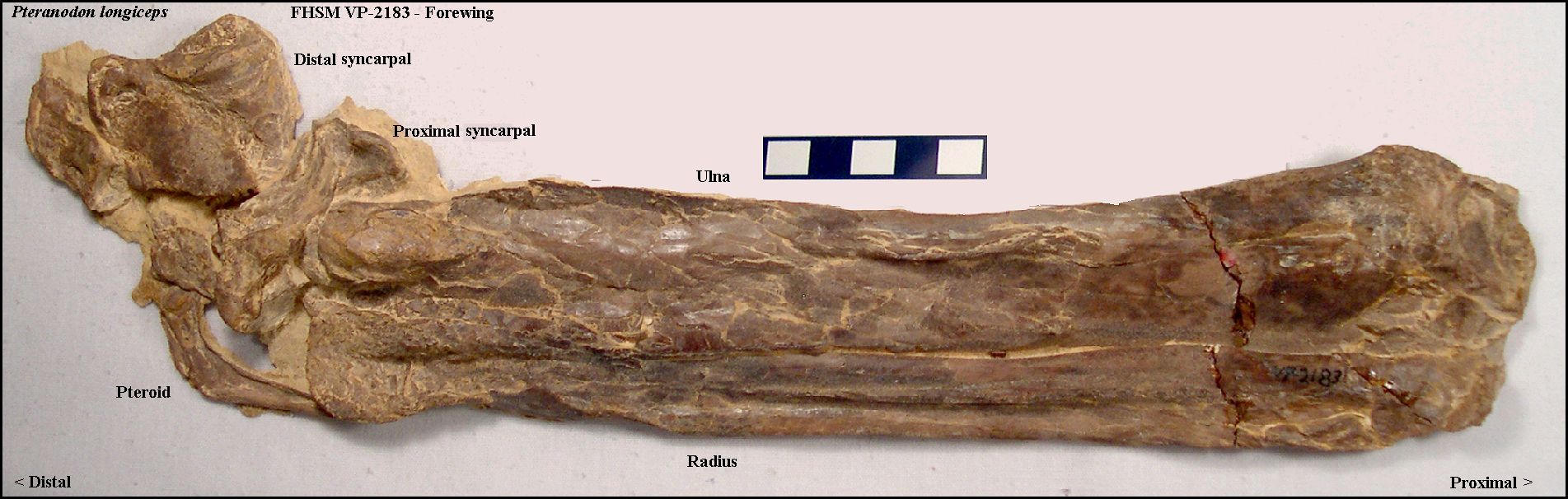
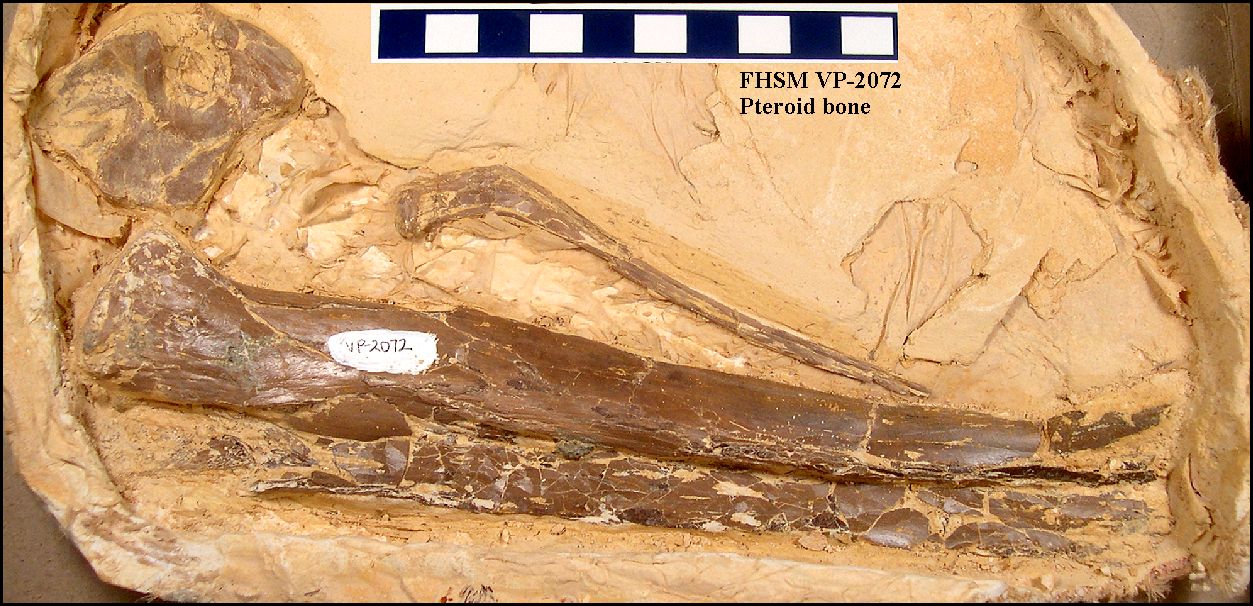
http://www.oceansofkansas.com/Pteranodon.html
Notice the pteroid bone. In both pictures the pteroid bone is shown pointing back toward the body. It is more likely it pointed away from the body.


http://www.oceansofkansas.com/Pteranodon.html
Notice the pteroid bone. In both pictures the pteroid bone is shown pointing back toward the body. It is more likely it pointed away from the body.
Thursday, December 2, 2010
The primitive bird 1st metacarpal.
Here is the primitive bird Deinonychus hand:
http://www.pnas.org/content/96/9/5111/F3.large.jpg
http://www.pnas.org/content/96/9/5111.full (figure 3)
Additional diagram of primitive bird hand (left picture):
http://upload.wikimedia.org/wikipedia/commons/thumb/3/39/Archaeo-deinony_hands.svg/220px-Archaeo-deinony_hands.svg.png

http://www.pnas.org/content/96/9/5111/F3.large.jpg

http://www.pnas.org/content/96/9/5111.full (figure 3)
Additional diagram of primitive bird hand (left picture):
http://upload.wikimedia.org/wikipedia/commons/thumb/3/39/Archaeo-deinony_hands.svg/220px-Archaeo-deinony_hands.svg.png

Revised total progression
Total progression
2-3-4-4-x Pterosaur
x-2-3-4-x Primitive bird (maniraptors that are not modern birds)
Note:
http://www.seaworld.org/animal-info/info-books/raptors/physical-characteristics.htm
"The wings of many diurnal birds of prey have a vestigial claw located at the end of the thumb bone."
Concerning the sesamoid:
http://www.ncbi.nlm.nih.gov/pmc/articles/PMC1560000/?tool=pmcentrez
"We propose instead that the sesamoid in question was originally embedded in the tendon of a pteroid extensor or flexor muscle where it passed over the medial carpal, [actually metacarpal] and that it was pulled into the fovea after death in some specimens as a result of disarticulation of the [meta]carpal–pteroid joint."
2-3-4-4-x Pterosaur
x-2-3-4-x Primitive bird (maniraptors that are not modern birds)
Note:
http://www.seaworld.org/animal-info/info-books/raptors/physical-characteristics.htm
"The wings of many diurnal birds of prey have a vestigial claw located at the end of the thumb bone."
Concerning the sesamoid:
http://www.ncbi.nlm.nih.gov/pmc/articles/PMC1560000/?tool=pmcentrez
"We propose instead that the sesamoid in question was originally embedded in the tendon of a pteroid extensor or flexor muscle where it passed over the medial carpal, [actually metacarpal] and that it was pulled into the fovea after death in some specimens as a result of disarticulation of the [meta]carpal–pteroid joint."
Subscribe to:
Posts (Atom)