Sunday, May 23, 2010

Pubic Bones

http://icb.oxfordjournals.org/cgi/content/full/40/1/87
Several aspects of the pelvic girdle suggest that pterosaurs were specialized for pelvic aspiration during flight. As in birds, the three pelvic bones of pterosaurs were solidly fused into a single unit (Fig. 9), and an increased number of dorsal vertebrae were incorporated into the sacrum (3 to 5 in Rhamphorhynchus and as many as 10 in Pteranodon) (Wellnhofer, 1978Go, 1987Go). The preacetabular process of the ilium was very long and in pterodactyloids it was fused with additional dorsal vertebrae to form a synsacrum-like structure (Eaton, 1910Go). The distal ends of the pubic bones did not meet on the ventral midline, but the ischiadic portion of the puboischiadic plate was fused at the midline (Padian, 1983Go); making the pelvis partially open ventrally. (David R. Carrier2,1,2 and Colleen G. Farmer1,2)
At their distal ends, the pubic bones expand laterally and medially into broad plates that form the ventral margin of the posterior belly.

Friday, May 21, 2010

Pterosaur wing (2)

So here is a summary
The part of the pterosaur wing "closer to the body (the tenopatagium), was extensively covered by elongated and thick fibres here called pycnofibres."
and it was
"A well-developed integumental covering formed by fibres (here named pycnofibres) that are thicker than the actinofibrils"
and
"The pycnofibres are further formed by smaller fibrils of unknown nature."

Pterosaur wing (1)

Here is some significant information about the pterosaur wing . (I will elaborate in further posts).

http://rspb.royalsocietypublishing.org/content/early/2009/07/31/rspb.2009.0846.full

"The soft tissue preserved in the holotype (IVPP V12705) of Jeholopterus ningchengensis [pterosaur] from the Daohugou Bed (Late Jurassic or Early Cretaceous) of China is described in detail. The plagiopatagium can be divided into the distal, comparatively more rigid actinopagatium and a proximal, more tensile tenopatagium. The actinopatagium extends from the wing finger to the articulation between the humerus and the forearm, and shows the presence of at least three layers containing actinofibrils. In each layer, the actinofibrils are parallel to subparallel, but this direction diverges from layer to layer. When distinct layers of actinofibrils are superimposed (owing to taphonomic compression), a reticular pattern is generated. The presence of layers with differently oriented actinofibrils is widespread in this pterosaur. A well-developed integumental covering formed by fibres (here named pycnofibres) that are thicker than the actinofibrils is present. Ungual sheaths that extend the length of the pedal and manual claws of this taxon are also observed. Although the understanding of the mechanical properties of the wing membrane is hampered by the lack of knowledge regarding the composition of the actinofibrils, the configuration observed in Jeholopterus might have allowed subtle changes in the membrane tension during flight, resulting in more control of flight movements and the organization of the wing membrane when the animal was at rest."
AND
"closer to the body (the tenopatagium), was extensively covered by elongated and thick fibres here called pycnofibres."
AND
"The pycnofibres are further formed by smaller fibrils of unknown nature."
(Alexander W. A. Kellner1,*, Xiaolin Wang2,*, Helmut Tischlinger3, Diogenes de Almeida Campos4, David W. E. Hone2 and Xi Meng2,5)

For details see page 324 (PDF page 3) etc of the actual article which is a PDF, obtainable at
lesv.ivpp.ac.cn/disk_files/download/76


Soft tissue of J. ningchengensis (IVPP V12705). (a) Details of the actinopatagium with different layers indicated by white arrows (top slab). (b) Actinopatagium under ultraviolet light showing the difference between the actinofibrils and the integumental covering (dark colour). (c) Tip of the wing membrane associated with the fourth phalanx of the right wing finger. (d) Ungual sheaths of the right manual digits indicated by black arrows. Scale bars: (ac) 1 mm; (d) 10 mm. acpt, actinopatagium; f-B, fibres type B; inc, integumental covering; laf, different layers of actinofibrils; maf, merging actinofibrils; ph2d4, second phalanx of the wing finger; ra/ul, radius and ulna; us, ungual sheaths.

Thursday, May 20, 2010

High metabolic rate

Another basic shared characteristic:

http://en.wikipedia.org/wiki/Bird
"Modern birds are characterised by feathers, a beak with no teeth, the laying of hard-shelled eggs, a high metabolic rate, a four-chambered heart, and a lightweight but strong skeleton."

http://www.plosone.org/article/info%3Adoi%2F10.1371%2Fjournal.pone.0004497
"The relatively high efficiency of flow-through ventilation was likely one of the key developments in pterosaur evolution, providing them with the respiratory and metabolic potential for active flapping flight and colonization of the Late Triassic skies. This interpretation is consistent with other lines of evidence supporting relatively high metabolic rates in pterosaurs, including the filamentous nature of the integument [e.g. 16], [45], [46], a flight performance comparable to that of extant birds and bats [1], [3], [4], [6], [7], [16], [17] and relatively large brain size [47]."
(Leon P. A. M. Claessens1*, Patrick M. O'Connor2, David M. Unwin3)

Beaks

Let's get down to a basic characteristic that pterosaurs and basal paraves share:

http://en.wikipedia.org/wiki/Pterosaur
Most pterosaur skulls had elongated jaws with a full complement of needle-like teeth.[26] In some cases, fossilized keratinous beak tissue has been preserved, though in toothed forms, the beak is small and restricted to the jaw tips and does not involve the teeth.[27] Some advanced beaked forms were toothless, such as the pteranodonts and azhdarchids, and had larger, more extensive, and more bird-like beaks.[26]
http://theropods.wikia.com/wiki/Scansoriopterygidae
Scansoriopterygidae dinosaurs were very small, bipedal dinosaurs, the size of sparrows and pigeons. They had also a few quite amazing features, such as a unusually long third finger on the hand, beaks, and very short tails with very long feathers at the end of it.


Crests

http://en.wikipedia.org/wiki/Pterosaur
"Pterosaurs are well known for their often elaborate crests. The first and perhaps best known of these is the distinctive backward-pointing crest of some Pteranodon species, though a few pterosaurs, such as the tapejarids and Nyctosaurus sported incredibly large crests that often incorporated keratinous or other soft tissue extensions of the bony crest base.
Since the 1990s, new discoveries and more thorough study of old specimens have shown that crests are far more widespread among pterosaurs than previously thought, due mainly to the fact that they were frequently extended by or composed completely of keratin, which does not fossilize as often as bone.[7] In the cases of pterosaurs like Pterorhynchus and Pterodactylus, the true extent of these crests has only been uncovered using ultra violet photography.[17][18] The discovery of Pterorynchus and Austriadactylus, both crested "rhamphorhynchoids", showed that even primitive pterosaurs had crests (previously, crests were thought to be restricted to the more advanced pterodactyloids).[7]"


http://en.wikipedia.org/wiki/Crest_%28bird%29
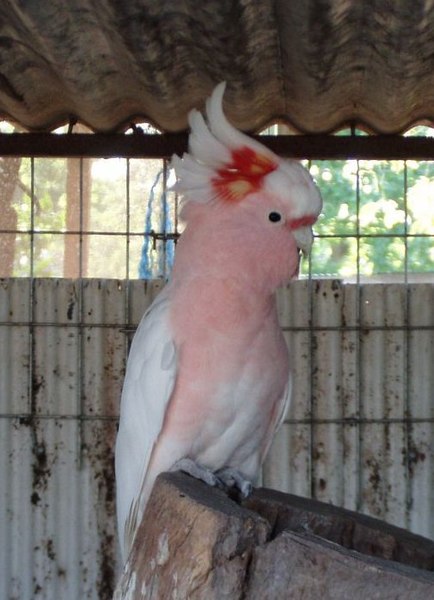
"The crest is a prominent feature exhibited by several bird and dinosaur [and pterosaur] species on their heads. Fleshy crests are called cockscombs; this article discusses feather crests.
Generally used for display purposes, crests can be fixed or erectile, depending on the species. For example, Cockatoos and cockatiels possess crests which may be raised or lowered at will. Their crests are used to communicate with fellow members of their species, or as a form of defence to frighten away other species that approach too closely.
The crest is made up of semiplume feathers: a long rachis with barbs on either side. These are plumulaceous feathers, meaning that they are soft and bendable. In birds, these semiplumes are common along the head, neck, and upper back, and may be used for buoyancy and sensing vibrations."


https://www.nature.com/articles/s41598-019-38780-8
The cassowary casque meets the characteristics of thermal windows: uninsulated and vascularised. Casques are keratinized, overlying a body crown and network of trabeculae surrounded by dorsoventrally aligned canals containing blood vessels making up an extensive vascular network2,6,9
https://tse1.mm.bing.net/th?id=AMMS_3faf40bb9c89aaa20fef64c0539c2da1&w=236&h=183&c=8&rs=1&o=5&pid=3.1&rm=2


https://en.wikipedia.org/wiki/Anchiornis
This fossil also showed evidence that Anchiornis had a feathered crest on its head, and was used to determine the animal's life coloration.

https://en.wikipedia.org/wiki/Corythoraptor

https://upload.wikimedia.org/wikipedia/commons/thumb/2/29/Casuarius_casuarius_-upper_body_-captive-8a-2c.jpg/170px-Casuarius_casuarius_-upper_body_-captive-8a-2c.jpg



The crest of Corythoraptor [oviraptorid] has been compared to the casques of cassowaries.
Cassowary:

Corythoraptor:
 Artistic reconstruction of Corythoraptor jacobsi (Image: Zhao Chuang)

Wednesday, May 19, 2010

Noise Reduction?

http://en.wikipedia.org/wiki/Jeholopterus
Jeholopterus pterosaur:
"The specimen is crushed into a slab and counterslab pair, so that parts of the specimen are preserved on one side of a split stone and some on the other. This includes exquisite preservation of carbonized skin fibers and, arguably, "hair" or "protofeathers"."

http://dragonsoftheair.wordpress.com/
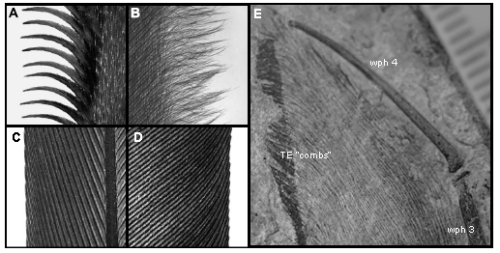
"I wanted to quickly draw attention to a part of the wing that often gets overlooked…..the hair-like [feather-like?] structures along the trailing edge. Kellner et al. 2009 published a small photograph of this

Combs along the trailing edge of the wing (or turbine when we enter the realm of man-made machines) are known to reduce the noise produced by the animal during flight by collapsing the vortex shed off the wing. There is quite a bit of literature on this subject but its function in biological flight could warrant further attention. Owls are certainly the most famous example where these structures are used to reduce the noise produced by the wings

The examples above show just how similar the trailing edge structures of the wing in Jeholopterus (E) are when compared to those of an owl (A, B) and the obvious differences they have with those of a noisy flier, in this case a pigeon (C, D). While I am in no way trying to compare the functionality of a feather with that of the pterosaur membrane, the presence of trailing edge structures would almost certainly function in a similar way to other noise reduction structures.

Jeholopterus shares a couple of similarities with that of the barn owl: they both use a slow flight while hunting and both were active during times of darkness or at least periods of low light, but there the similarities end. Jeholopterus was almost certainly an insectivore rather than hunting small vertebrates and so it is not immediately apparent how effective a noise reducing structure like this would have been (hearing range of insects anyone?). So could Jeholopterus have used its trailing edge structures to break down the vortex shed off its wing? If so it would have flapped and glided over the darkening Mesozoic landscape using a combination of slow flight speed, high maneouverability and specialised fibres to reduce the noise frequency of the wings, snapping up insects as it went. Certainly some food for thought regardless."

Sexual maturation

Current evolution opinion is that non-avian dinosaurs were the ancestors of modern birds. However, once again we see, that that idea does not stand up to scrutiny. "The life history of non-avian theropods differed substantially from extant [existing, modern] birds".

http://rsbl.royalsocietypublishing.org/content/3/5/558.full
"The timing of sexual maturation in non-avian dinosaurs is not known. In extant squamates and crocodilians it occurs in conjunction with the initial slowing of growth rates as adult size is approached. In birds [so called] living dinosaurs, on the other hand, reproductive activity begins well after somatic maturity. Here we used growth line counts and spacing in all of the known brooding non-avian dinosaurs to determine the stages of development when they perished. It was revealed that sexual maturation occurred well before full adult size was reached—the primitive reptilian condition. In this sense, the life history and physiology of non-avian dinosaurs was not like that of modern birds.
Our findings point to somatic and sexual maturity occurring simultaneously among brooding Deinonychosauria and Oviraptoridae, the two clades of non-avian dinosaurs considered most closely related to birds (Norell et al. 2006; figure 1). Viewed in a broader phylogenetic context it can be inferred that this condition probably characterized the non-avian dinosaur radiation as a whole.
Our findings also show that, despite the presence of many modern avian anatomical features such as hollow bones and feathers (Gauthier & Gall 2001; Currie et al. 2004), the life history of non-avian theropods differed substantially from extant [existing, modern] birds."
(Gregory M Erickson1,2,*,Kristina Curry Rogers3,David J Varricchio4,Mark A Norell2 andXing Xu5)

PTEROSAURS:
http://en.wikipedia.org/wiki/Pterosaur
"Growth rates of pterosaurs once they hatched varied across different groups. In more primitive, long-tailed pterosaurs ("rhamphorhynchoids") such as Rhamphorhynchus, the average growth rate during the first year of life was 130% to 173%, slightly faster than the growth rate of alligators. Growth in these species slowed after sexual maturity, and it would have taken more than three years for Rhamphorhynchus to attain maximum size. In contrast, the more advanced, large pterodactyloid pterosaurs such as Pteranodon grew to adult size within the first year of life. Additionally, pterodactyloids had determinate growth, meaning that the animals reached a fixed maximum adult size and stopped growing.[34]"

Tuesday, May 18, 2010

The "Flamingo Pterosaur"

Here is another interesting correspondence. For more examples, see the earlier post entitled Pterosaur and Modern Bird Correspondences.

http://dinosaurs.about.com/od/aviandinosaurs3/p/pterodaustro.htm
"About Pterodaustro:

The modern creature that's most often compared to this South American pterosaur is the flamingo, which it seems to have resembled. Although we may never know for sure, it's even possible that Pterodaustro had a similar pink hue, based on its likely diet.


And what diet was that? Well, based on its thousand or so distinctive, bristlelike teeth, paleontologists theorize that Pterodaustro dipped its curved beak into the water to filter out plankton, small crustaceans, and other tiny aquatic creatures. Since shrimp and plankton are predominantly pink, that's where Pterodaustro's presumably pink color would have come from."

http://en.wikipedia.org/wiki/Pterodaustro
"Pterodaustro probably waded in shallow water like flamingos, straining food with its tooth comb, a method called "filter feeding".[4] Once it caught its food, Pterodaustro probably mashed it with the small, globular teeth present in its upper jaw.
According to Robert Bakker, like with flamingos, this pterosaur's diet may have resulted in a pink hue. Thus, it is often dubbed the "flamingo pterosaur".[5]"

http://www.theanimalfiles.com/birds/flamingos/caribbean_flamingo.html
"The flamingo's characteristic pink colouring is caused by the beta carotene in their diet.
"


Trabeculae - the same right down to the bone


http://archosaurmusings.wordpress.com/category/pterosaurs/page/2/

"Time for another obscure word [characteristic] in the annals of vertebrate palaeontology and here is one that ties together birds and pterosaurs, if only in a nomenclatural sense. For those that do not know, both pterosaurs and birds have hollowed out, pneumatic bones which in life were filled with air sacs that were extensions of the lungs. However, this obviously could potentially weaken the bones and make them vulnerable to being broken and given the kinds of high forces that many of them would have to deal with (like the bones of the wing or legs for flight and landing respectively) you want to keep them strong.
Evolution has evolved an elegant way around the conflict here – keeping things hollow (and thus light) but strong with some biological scaffolding. The trabeculae are therefore the various small and often intricate little webs and buttresses and spars of bones that populate the insides of various bird and pterosaur bones, providing strength and support to the bone with the minimum of extra mass."

http://rsbl.royalsocietypublishing.org/content/4/3/282.full.pdf

"Although limited by the availability of different ontogenetic stages within single taxa, these studies provide important baseline information about pterosaur osteohistology and led to the deduction that Late Cretaceous pterodactyloids, with wingspans of 3–11 m, such as Montanazhdarcho, Pteranodon and Quetzalcoatlus had ‘typical dinosaurian and even typical bird-like bone growth’ (de Ricqle`s et al. 2000; Padian et al. 2004). These researchers further suggested that some smaller basal pterosaurs of the Triassic and Jurassic (with wingspans up to 1.5 m), especially Rhamphorhynchus, appear to have grown more like smaller birds (de Ricqle`s et al. 2000; Padian et al. 2004). The current study represents the first comprehensive assessment of osteohistological changes during ontogeny within a single pterosaur taxon."


http://svpow.com/2014/07/08/free-papers-you-should-read-martin-and-palmer-2014/


Cross-section of a bird wing bone, borrowed from http://platospond.com/WatsonsBlog/wp-content/uploads/2009/02/image_sci_animal0291.jpg.

Monday, May 17, 2010

Bird and Pterosaur Carpus (2)

BIRD CARPUS (WRIST)

http://en.wikipedia.org/wiki/Carpus
"The wing of a modern bird, for example, has only two remaining carpals; the radiale (the scaphoid of mammals) and a bone formed from the fusion of four of the distal carpals.[14]"


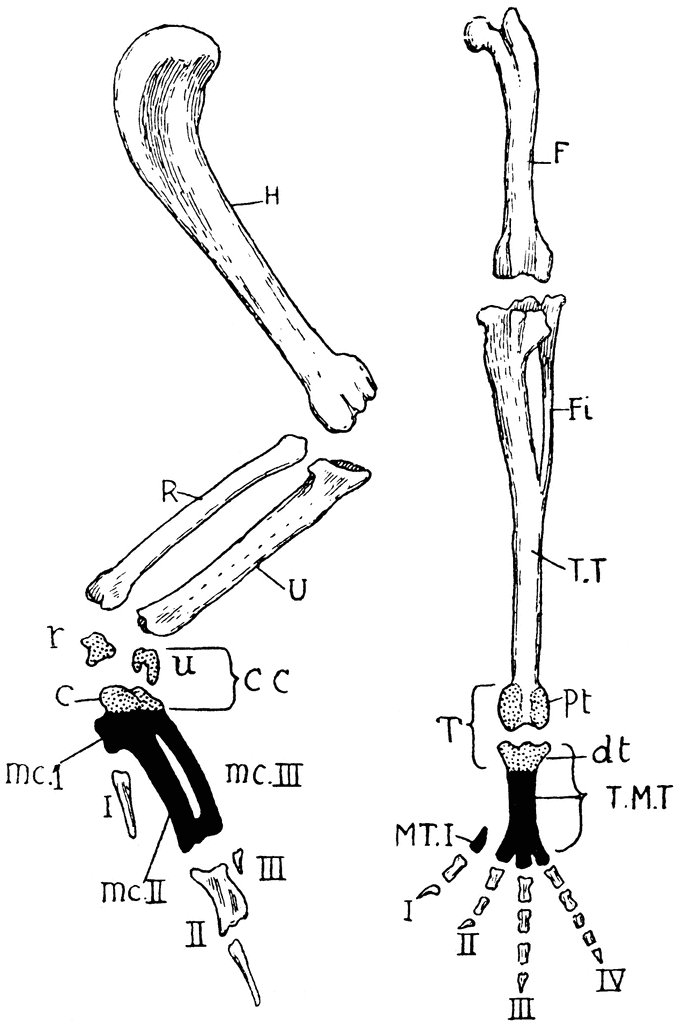
Modern Bird Carpus (diagram on the left)

Description: "Fore-limb and hind-limb compared. H., Humerus; R., radius; U., ulna; r., radiale; u., ulnare; C., distal carpals united to carpo-metacarpus; CC., the whole carpal region; MC.I., metacarpal of the thumb; I., phalanx of the thumb; MC.II., second metacarpus; II., second digit; MC.III., third metacarpus; III., third digit. F., femur; T.T., tibio-tarsus; Fi., fibula; Pt., proximal tarsals united to lower end of tibia; dt., distal tarsals united to upper end of tarso-metatarsus (T.MT.); T., entire tarsal region; MT.I., first metatarsal, free; I.-IV., toes."

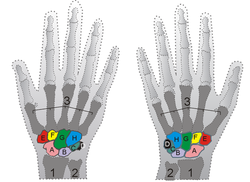
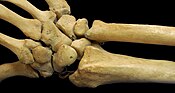
To put this in perspective here is a human carpus (wrist):


BONES OF HAND (from radial) (both images are of the right hand)
Proximal: A=Scaphoid, B=Lunate, C=Triquetral, D=Pisiform
Distal: E=Trapezium, F=Trapezoid, G=Capitate, H=Hamate
1= Radius, 2=Ulna, 3=Metacarpals
Posterior and anterior view of a human carpus


http://www.port.ac.uk/special/pterosaurs/pterosaurs/thepterosaurwing/

Bird and Pterosaur Carpus (1)


PTEROSAUR CARPUS
(WRIST)

http://www.ncbi.nlm.nih.gov/pmc/articles/PMC1560000/
"The pterosaur carpus consists of two proximal [closest to the forearm] and four distal [furthest from the forearm] carpals, excluding the pteroid, which may itself be a modified distal carpal (Unwin et al. 1996). The proximal carpals are fused into a proximal syncarpal in osteologically mature specimens, while three of the distal carpals fuse to form a distal syncarpal (Bennett 1993). The remaining distal carpal,  referred to here as the medial carpal (Padian 1984), but which has also been termed the distal lateral (Wellnhofer 1985), or pre-axial carpal (Bennett 2001), articulates on a vertically elongate biconvex facet on the anterior surface of the distal syncarpal. The medial carpal bears a deep concave fovea that opens anteriorly, ventrally and somewhat medially, within which the pteroid articulates (figure 1b)."


Skeletal reconstruction of A. santanae. (a) Reconstructed skeleton of the right wing and membrane outlines in dorsal view, adapted from Wellnhofer (1991b), showing the pteroid in the antero-ventral orientation, supporting a broad propatagium (solid line) and in the medial orientation, supporting a narrow propatagium (broken line): scale bar=200 mm. (b) Right medial carpal in distal view and right pteroid in proximal view, showing the articular surfaces of the carpal–pteroid joint: scale bar=20 mm. (c) Right wrist in antero-medial view, showing articular motion of the pteroid. Two planes have been superimposed, intersecting at the carpal–pteroid joint—one parallel to the wing spar, one normal to it. During the initial phase of flexion the pteroid (solid line) occupies the normal plane, and angulation thus takes the form of pure depression. During the second phase the articular head of the pteroid rotates laterally with respect to the medial carpal, and angulation therefore gradually shifts from depression to adduction. The pteroid swings out of the normal plane until at the limit of flexion (broken line) it comes to occupy the parallel plane. Abbreviations: ch, cheiropatagium; cr, cruropatagium; ds, distal syncarpal; f, femur; fov, fovea of the medial carpal; h, humerus; lf, lateral facet of the pteroid; mc, medial carpal; mf, medial facet of the pteroid; pro, propatagium; ps, proximal syncarpal; pt, pteroid; r, radius; t, tibiotarsus; u, ulna; wf, wing-finger; wm, wing-metacarpal.

http://www.jstor.org/pss/50448

"During ontogeny two bones in the proximal row, probably the radiale and ulnare (Wellnhofer. 1970), fused to form a proximal syncarpal (Bennett 1993)."

Let's think about this

Pterodactyloids evolved directly from Rhamphorhynchoidea.
http://en.wikipedia.org/wiki/Pterosaur
"Rhamphorhynchoidea is a paraphyletic group (since the pterodactyloids evolved directly from them and not from a common ancestor)"

Pterodactyloids evolved directly from Rhamphorhynchoidea. How do we know this? How can one make this kind of determination?
It isn't hard. You look at the Rhamphorhynchoide, and their characteristics, and then at the pterodactyls, and their characteristics, and you can see that it is the same creature type. The pterodactyl is the later version of the earlier version. This fact is completely recognized and accepted.
The Rhamphorhynchoidea are called primitive (basal") pterosaurs and the Pterodactyloids are called advanced ("derived") pterosaurs.
Nobody ignores all that and starts looking around for some other ancestor of pterodactyls. That would be absurd.

But oddly enough when it comes to modern birds, the case is conceived precisely the opposite. Even though modern birds are exceptionally similar to pterodactyls, everybody ignores that fact and they begin to look around for some other ancestry. And they come up with dinosaurs that are quite UNLIKE modern birds.
It is odd - very odd.
It is not necessary to look somewhere else. Just use the same reasoning as was correctly used in determining that pterodactyloids evolved directly from Rhamphorhynchoidea.

Modern birds developed from pterodactyls.

It is also worth mentioning that, in the same way that
Pterodactyloids are somewhat different than Rhamphorhynchoidea - modern birds are somewhat different than pterodactyls. That is to be expected.

Saturday, May 15, 2010

A Brand-New Brush

"I think the field is ripe for some young scientist who doesn't have any cemented views to come in and look at this and paint it with a brand-new brush."
Alan Feduccia

The "brand-new brush" is the idea that birds developed from pterosaurs.

Friday, May 14, 2010

Bird and Pterosaur Ankles (2)


Summary:
"Although birds and theropods have a long triangular ossification in front of the tibia and attached to the proximal tarsals, the morphological relationships of this bone are fundamentally different in the two groups."

http://www.jstor.org/pss/4085810
"The structure of the avian tarsus has recently been cited as evidence for the derivation of birds from theropod dinosaurs. Although birds and theropods have a long triangular ossification in front of the tibia and attached to the proximal tarsals, the morphological relationships of this bone are fundamentally different in the two groups. In modern birds and in all Mesozoic birds, this "pretibial" bone is a high, narrow structure associated primarily with the calcaneum, but independently ossified. The corresponding structure in dinosaurs is a broad extension [ascending process] of the astragalus" [The astragalus is also called the talus bone].
(L.D. Martin et al)

http://www.thewildclassroom.com/biodiversity/birds/aviantopics/birdsystematics.html
"The Neognathae represent the rest of the modern birds. Their palette is much smaller and their ankles have, instead of a process on the astragalus, it’s the calcaneum that has the process."


http://www.bioone.org/doi/abs/10.1206/0003-0090%282004%29285%3C0025%3AC%3E2.0.CO%3B2?journalCode=amnb

"The extremely well-preserved tarsus of the tapejarid Tapejara sp. and the anhanguerid Anhanguera piscator (Pterosauria, Pterodactyloidea) are described and regarded as representative of the ankle structure of Pterosauria. The pterosaur ankle joint (PAJ) shows the following features: astragalus mediolaterally elongated forming a hemicylinder; proximal part of the astragalocalcaneal contact characterized by a ridge bordered on each side by a depression on the astragalus that has a perfect counterpart in the calcaneum, and distal part that is concavo-convex, with the concavity present in the astragalus; calcaneum extremely reduced not reaching the posterior portion of the tarsus; absence of an astragalar posterior groove, perforating foramen, calcaneal tuber, and astragalar ascending process; proximal tarsals fusing very early in ontogeny, forming a tibiotarsus.
The main movement between the crus and foot in the PAJ occurs between the proximal and distal tarsals as in the advanced mesotarsal-reversed joint (AM-R). The main differences from the latter are the lack of an ascending process and the extreme reduction of the calcaneum that make the PAJ unique. The absence of an astragalar groove and the reduction of the calcaneum reinforce the hypothesis that pterosaurs are basal ornithodirans and closely related to the Dinosauromorpha. As has been demonstrated by this and other studies, the ankle structure (a complex of characters) is phylogenetically informative and, in the light of characters from other parts of the animal's body, can contribute to a better understanding of archosaur relationships."

http://bio.unc.edu/files/2011/04/Journal-of-Morphology-2005.pdf
Alan Feduccia:
It would not tax the imagination to engender a long list of obstacles for the now dominant model of a theropod origin of birds, including, but not limited to: the fact that early theropods (e.g., Triassic Herrerasaurus) are highly specialized obligate bipeds (with arms reduced to 1/2 the length of the hindlimbs); the fact that the stratigraphic sequence of bird-like theropods has been almost the reversal of the expected evolutionary sequence leading to birds; the fact that the earliest described “feathered dinosaur” is the unbird-like compsognathid Sinosauropteryx, devoid of any preserved structures that can be shown to be feather-like; the fact that any downy-like integumentary covering in a terrestrial theropod would be maladaptive; the fact that flight feathers arranged precisely on the hand as in modern birds are present in microraptors and the basal oviraptosaur Caudipteryx; the fact that many of the derived characters or synapomorphies linking birds and theropods are in question, including notably but not limited to: the sliding lower jaw joint of theropods (absent in birds), the theropod ascending process of the astragalus (distinctive from the avian pretibial bone), and the digital mismatch (1,2,3 theropod vs. 2,3,4 bird hand), etc., to mention a few" (Feduccia, et al., 2005, 266:126, emp. added).

http://www.bioone.org/doi/abs/10.1525/om.2009.66.1.1
In birds and theropods, a sheet of bone that braces the anterior face of the tibia is usually called the “ascending process of the astragalus” or simply the “ascending process.” It is less evident in adult neornithines than in juvenile (or embryonic) neornithines and Mesozoic birds. This sheet of bone is particularly conspicuous in basal birds, including Archaeopteryx. This common feature has consistently been regarded as one of the most striking homologies shared by birds and theropods (e.g., Paul 2002), but comparative anatomical research reveals that establishing the homologies of the ascending processes of theropods and birds is difficult.
In neornithines a triangular, late-developing cartilage appears, after fusion of the proximal tarsals, on the lateral face of the tibia, dorsal to the calcaneum (Martin et al. 1980, and references therein). Subsequently, this cartilage fuses with the calcaneum, with which it is primarily associated in both Mesozoic and modern birds (Martin et al. 1980; Fig. 6). Morse (1872) called this structure the “pretibial.” Ostrom (e.g., 1976a, 1985) argued that this structure is homologous with a similar structure in the tarsus of theropods (see also Paul 2002), but according to Martin et al. (1980:88) “differences in placement and (the pretibial's) late appearance during development suggest that it is a uniquely derived character for birds and is properly termed a pretibial bone, rather than an astragalar process.
In contrast to the situation in neornithine and Mesozoic birds, the ascending process of theropods is usually a broad sheet of bone, continuous and exclusively associated with the astragalus (compare Fig. 6A and B).
PTEROSAUR ANKLE JOINT
http://books.google.ca/books?id=idta6AVV-tIC&pg=PA11&lpg=PA11&dq=bird+metatarsus+pterosaur+metatarsal&source=bl&ots=2E_X9V4bPt&sig=0bLfNMhd8yejNSOafECEnBqKAyo&hl=en&ei=uOb6S_3OGsWclgeZ2oHdCg&sa=X&oi=book_result&ct=result&resnum=3&ved=0CB4Q6AEwAg#v=onepage&q&f=false
"The metamorphosis of the ankle joints of pterosaurs during development is interesting. In juvenile specimens, the proximal row consists of astragalus and calcaneum which are both reduced in length proximo-distally to become essentially only caps over the lower ends of the tibia, with the loss of the calcaneal tuber.
In adult [pterosaur] specimens, these two bones [the calcaneum and the astragalus] are fused with the tibia to form a rolling hinge joint at their distal condyles as seen in modern birds."
(Sankar Chatterjee, R. J. Templin)

Description: "Fore-limb and hind-limb compared. H., Humerus; R., radius; U., ulna; r., radiale; u., ulnare; C., distal carpals united to carpo-metacarpus; CC., the whole carpal region; MC.I., metacarpal of the thumb; I., phalanx of the thumb; MC.II., second metacarpus; II., second digit; MC.III., third metacarpus; III., third digit.
F., femur; T.T., tibio-tarsus; Fi., fibula; Pt., proximal tarsals united to lower end of tibia; dt., distal tarsals nited to upper end of tarso-metatarsus (T.MT.); T., entire tarsal region; MT.I., first metatarsal, free; I.-IV., toes." -Thomson, 1916Source: Thomson, J. Arthur Outlines of Zoology (New York: D. Appleton & Company, 1916) 650

http://books.google.ca/books?id=8QRKV7eSqmIC&pg=PA75&lpg=PA75&dq=pretibial+pterosaur&source=bl&ots=fqR5hPhEFg&sig=xdj1IoSLh3AX8At1DunGPoPXYQ8&hl=en&sa=X&ei=Ly9VVMjZDdGeyASIy4LABQ&ved=0CC0Q6AEwBA#v=snippet&q=pterosaurs%20are%20even%20more%20bird-like%20and%20have%20frequently&f=false
Page 75
Further complicating the issue, tibiotarsi of a variety of pterosaurs are even more bird-like and have been frequently misidentified as bird fossils. 

Something to sink your teeth into

http://www.jstor.org/pss/4085810
Avian dentitions also pose a problem for the dinosaur hypothesis. While theropod teeth are serrated and have straight roots, avian teeth, like those of crocodilians, are unserrated, with constricted bases and expanded roots.

http://www.pterosaur.co.uk/identify/teeth/teeth.htm

Most pterosaur teeth are relatively smooth with an oval section and no ridges. They tend to taper evenly to the tip and can be straight or gently curved along their length.

Bird and Pterosaur Ankles (1)

Let's look at bird and pterosaur ankles. The first thing to note is that both birds and pterosaurs have "advanced" mesotarsal ankles.

http://en.wikipedia.org/wiki/Archosaur

Since the 1970s scientists have classified archosaurs mainly on the basis of their ankles.[3] The earliest archosaurs had "primitive mesotarsal" ankles: the astragalus [also called the talus bone] and calcaneum were fixed to the tibia and fibula by sutures and the joint bent about the contact between these bones and the foot.
The earliest fossils of Ornithodira appear in the Carnian age of the late Triassic.... Ornithodires' "advanced mesotarsal" ankle had a very large astragalus and very small calcaneum, and could only move in one plane, like a simple hinge. This arrangement was only suitable for animals with erect limbs, but provided more stability when the animals were running. The ornithodires differed from other archosaurs in other ways: they were lightly-built and usually small, their necks were long and had an S-shaped curve, their skulls were much more lightly built, and many ornithodires were completely bipedal. The archosaurian fourth trochanter on the femur may have made it easier for ornithodires to become bipeds, because it provided more leverage for the thigh muscles. In the late Triassic the ornithodires diversified to produce pterosaurs and dinosaurs.[4]
Tibia Fibula Astragalus Calcaneum
Primitive mesotarsal ankle.

"Advanced" mesotarsal ankle


NOTE: The advanced mesotarsal ankle shown is that of a dinosaur and not that of a pterosaur (or modern bird).

 http://www.ucmp.berkeley.edu/diapsids/archomm.html

Archosaur ankle


To put this in context here is a human foot (both images are of the right foot):

The bones of the tarsus with A=calcaneus, B=talus bone [astragalus], C=cuboid bone, D=navicular bone, E=lateral cuneiform, F=intermediate cuneiform and G=medial cuneiform. In dark grey the metatarsals. Left image: seen from below. Right image: seen from above.


H., Humerus; R., radius; U., ulna; r., radiale; u., ulnare; C., distal carpals united to carpo-metacarpus; CC., the whole carpal region; MC.I., metacarpal of the thumb; I., phalanx of the thumb; MC.II., second metacarpus; II., second digit; MC.III., third metacarpus; III., third digit.

F., femur; T.T., tibio-tarsus; Fi., fibula; Pt., proximal tarsals united to lower end of tibia; dt., distal tarsals united to upper end of tarso-metatarsus (T.MT.); T., entire tarsal region; MT.I., first metatarsal, free; I.-IV., toes."

Thursday, May 13, 2010

Leg Similarities (1)

http://books.google.ca/books?id=idta6AVV-tIC&printsec=frontcover&source=gbs_v2_summary_r&cad=0#v=onepage&q&f=false
"In pterosaurs, the tibia is much longer and more slender than the femur, and the fibula is considerably reduced as in birds."

Pterosaur tibia (T) and fibula (F).
Femur
not shown.


Modern Bird Leg (diagram on the right)
Notice the tibia (T.T) and fibula (
Fi)
http://etc.usf.edu/clipart/48100/48103/48103_bird_limbs.htm
Description: "Fore-limb and hind-limb compared. H., Humerus; R., radius; U., ulna; r., radiale; u., ulnare; C., distal carpals united to carpo-metacarpus; CC., the whole carpal region; MC.I., metacarpal of the thumb; I., phalanx of the thumb; MC.II., second metacarpus; II., second digit; MC.III., third metacarpus; III., third digit. F., femur; T.T., tibio-tarsus; Fi., fibula; Pt., proximal tarsals united to lower end of tibia; dt., distal tarsals nited to upper end of tarso-metatarsus (T.MT.); T., entire tarsal region; MT.I., first metatarsal, free; I.-IV., toes." -Thomson, 1916
Source: Thomson, J. Arthur Outlines of Zoology (New York: D. Appleton & Company, 1916) 650

http://onlinelibrary.wiley.com/doi/10.1111/evo.12882/full
In fact, besides birds, distal fibular reduction also occurred independently within at least three other lineages of Ornithodira: Alvarezsauridae (Chiappe et al. 2002), Oviraptorosauria (Vickers-Rich et al. 2002), and Pterosauria (Dalla Vecchia 2003; Bonaparte et al. 2010; Fig. 7).

More genetic (genome) similarities

More similarities at the genome level between pterosaurs and birds.

http://rsbl.royalsocietypublishing.org/content/5/1/47.abstract

"The two living groups of flying vertebrates, birds and bats, both have constricted genome sizes compared with their close relatives. But nothing is known about the genomic characteristics of pterosaurs, which took to the air over 70 Myr before birds and were the first group of vertebrates to evolve powered flight. Here, we estimate genome size for four species of pterosaurs and seven species of basal archosauromorphs using a Bayesian comparative approach. Our results suggest that small genomes commonly associated with flight in bats and birds also evolved in pterosaurs, and that the rate of genome-size evolution is proportional to genome size within amniotes, with the fastest rates occurring in lineages with the largest genomes."

This research and conclusion are very interesting. Birds and pterosaurs both had "small genomes".

Wednesday, May 12, 2010

Timing (2)

So let me be more specific about the timing. To appreciate this, let's look back at the transition from Rhamphorhynchoidea to Pterodactyloidea.

http://en.wikipedia.org/wiki/Pterosaur

"Classification
of pterosaurs has historically been difficult, because there were many gaps in the fossil record. Many new discoveries are now filling in these gaps and giving us a better picture of the evolution of pterosaurs. Traditionally, they are organized into two suborders:
  • Rhamphorhynchoidea (Plieninger, 1901): A group of early, basal ("primitive") pterosaurs, many of which had long tails and short metacarpal bones in the wing. They were small, and their fingers were still adapted to climbing[citation needed]. They appeared in the Late Triassic period, and lasted until the late Jurassic. Rhamphorhynchoidea is a paraphyletic group (since the pterodactyloids evolved directly from them and not from a common ancestor), so with the increasing use of cladistics it has fallen out of favor in most technical literature.

Pterodactyls evolved directly from Rhamphorhynchoidea. So of course, Rhamphorhynchoidea began to phase out (disappear) as they gave rise to pterodactyls.
That is the pattern.
The Rhamphorhynchoidea appeared in the Late Triassic period, and lasted until the late Jurassic. Pterodactyls appeared in the middle Jurassic period, and lasted until the late Cretaceous. This makes perfect sense - an overlap period - a transition.

Moving to the disappearance of pterodactyls and the appearance of modern birds we see the exact same pattern. "The gradual decline of pterosaurs at the same time modern birds radiate."
Pterodactyls began to disappear (phase out) in the late Cretaceous as they gave rise to modern birds which began to appear at that time, with an overlap period.
The Cretaceous-Tertiary extinction event DID NOT WIPE OUT THE PTERODACTYLS at the end of the Cretaceous. The pterodactyls phased out as they gave rise to modern birds.