Feduccia and Czerkas article:
ORIGINAL ARTICLE
Jurassic archosaur is a non-dinosaurian bird
Stephen A. Czerkas •Alan Feduccia
Received: 17 April 2014 / Revised: 4 June 2014 / Accepted: 13 June 2014 / Published online: 9 July 2014
ÓDt. Ornithologen-Gesellschaft e.V. 2014
Abstract Re-examination utilizing Keyence 3D digital
microscopy and low angled illumination of the fossil
Scansoriopteryx, a problematic sparrow-size pre-Archae-
opteryx specimen from the Jurassic Daohugou Biotas, pro-
vides new evidence which challenges the widely accepted
hypothesis that birds are derived from dinosaurs in which
avian flight originated from cursorial forms. Contrary to
previous interpretations in which S
The re-examination of a sparrow-sized fossil [Scansoriopteryx] from China challenges the commonly held belief that birds evolved from ground-dwelling theropod dinosaurs that gained the ability to fly. The birdlike fossil is actually not a dinosaur, as previously thought, but much rather the remains of a tiny tree-climbing animal that could glide, say American researchers Stephen Czerkas of the Dinosaur Museum in Blanding, Utah, and Alan Feduccia of the University of North Carolina. The study appears in Springer’s Journal of Ornithology.
Feduccia added, “Instead of regarding birds as deriving from dinosaurs, Scansoriopteryx reinstates the validity of regarding them as a separate class uniquely avian and non-dinosaurian.”
ELONGATE OUTER FINGER
Jurassic archosaur is a non-dinosaurian bird
Stephen A. Czerkas, Alan Feduccia
Re-examination utilizing Keyence 3D digital microscopy and low angled illumination of the fossil Scansoriopteryx, a problematic sparrow-size pre-Archaeopteryx specimen from the Jurassic Daohugou Biotas, provides new evidence which challenges the widely accepted hypothesis that birds are derived from dinosaurs in which avian flight originated from cursorial forms. Contrary to previous interpretations in which Scansoriopteryx was considered to be a coelurosaurian theropod dinosaur, the absence of fundamental dinosaurian characteristics demonstrates that it was not derived from a dinosaurian ancestry and should not be considered as a theropod dinosaur. Furthermore, the combination in which highly plesiomorphic non-dinosaurian traits are retained along with highly derived features, yet only the beginnings of salient birdlike characteristics, indicates that the basal origins of Aves stemmed from outside the Dinosauria and further back to basal archosaurs. Impressions of primitive elongate feathers on the forelimbs and hindlimbs suggest that Scansoriopteryx represents a basal form of “tetrapteryx” in which incipient aerodynamics involving parachuting or gliding was possible. Along with unique adaptations for an arboreal lifestyle, Scansoriopteryx fulfills predictions from the early twentieth century that the ancestors of birds did not evolve from dinosaurs, and instead were derived from earlier arboreal archosaurs which originated flight according to the traditional trees-down scenario.
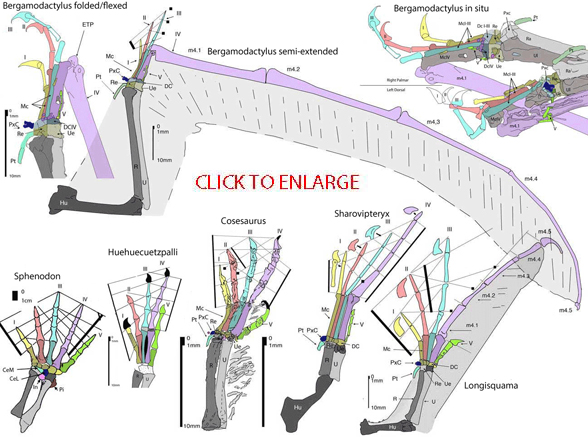
The most unusual feature is the extremely elongate outer finger, considered here to be digit IV as in Aves (Capek et al. 2013). It is the longest manual digit whereas the middle digit in theropods is the longest.
http://dinosaur-museum.org/featheredinosaurs/arboreal_maniraptoran.pdf
Scansoriopteryx heilmanni is the only knownhttp://www.labnews.co.uk/news/new-finding-challenges-belief-dinosaurs-evolved-from-birds
saurischian, or theropod, which has the third digit of the manus elongated to nearly twice that of the second digit.
The investigations – published in Journal of Ornithology – found a combination of plesiomorphic or ancestral non-dinosaurian traits along with highly derived unambiguous birdlike features. The researchers specifically note the primitive elongated feathers on the fore- and hind limbs, suggesting Scansoriopteryx is an ancestral form of early birds that had mastered basic aerodynamic manoeuvres of parachuting or gliding from trees.Pterosaur fingers:
These findings fulfil a prediction first made in the 1900s that the ancestors of birds didn’t evolve from dinosaurs, but instead from earlier arboreal archosaurs which originated flight according to the tree-down scenario. These small tree-dwelling archosaurs had improved ability to fly, with feathers that enabled them to at least glide. This ‘tree-down’ view is in contrast with the ‘ground-up’ view many palaeontologists side with.
“Instead of regarding birds as deriving from dinosaurs, Scansoriopteryx reinstates the validity of regarding them as a separate class uniquely avian and non-dinosaurian,” said Alan Feduccia.
http://www.reptileevolution.com/pterosaur-wings.htm
CAUDAL RODS
http://www.sci-news.com/paleontology/science-scansoriopteryx-hypothesis-birds-evolved-dinosaurs-02059.html
The techniques made it possible to interpret the natural contours of the bones. Many aspects of the [Scansoriopteryx] fossil’s pelvis, forelimbs, hind limbs, and tail were confirmed, while it was discovered that it had elongated tendons along its tail vertebrae similar to Velociraptor.http://onlinelibrary.wiley.com/doi/10.1111/1755-6724.12009/abstract
In the tails of dromaeosaurids dinosaurs and rhamphorhynchid pterosaurs, elongate osteological rods extend anteriorly from the chevrons and the prezygapophyses. These caudal rods are positioned in parallel and are stacked dorsoventrally.
http://pterosaur-net.blogspot.ca/2013/01/guest-post-dragon-tails-what-pterosaurs.html
The tail of Deinonychus and its raptor relatives is bizarre, but it is not (as Professor Ostrom himself realized) unique. Among all known vertebrates, a similar tail anatomy has evolved in one other group [rhamphorhynchid pterosaurs].
Consider the below images of a tail of a Bambiraptor and of a Velociraptor. Both are dromaeosaurids with caudal-rod bearing tails and both are fully articulated.
ACETABULUM
http://www.aoucospubs.org/doi/full/10.1525/auk.2013.130.1.1
A partially closed acetabulum is seen in basal archosaurs andhttp://en.wikipedia.org/wiki/Scansoriopteryx
is characteristic of the scansoriopterids and Jurassic feathered
forms such as Anchiornis initially described as near Aves by Xu et al. (2009).
Scansoriopteryx also lacks a fully perforated acetabulum, the hole in the hip socket which is a key characteristic of Dinosauria and has traditionally been used to define the group.http://dinosaur-museum.org/featheredinosaurs/arboreal_maniraptoran.pdf
Scansoriopteryx is clearly more primitive
than Archaeopteryx in many respects such as its
saurischian-style pelvis which has remarkably short
pubes; elongate and robust ischia; and
comparatively small pubic peduncles. These
primitive features further suggest that the nearly
closed acetabulum is not a reversal, but a true
plesiomorphic condition.
http://en.wikipedia.org/wiki/Pterosaur
Pterosaur's hip sockets are oriented facing slightly upwards, and the head of the femur (thigh bone) is only moderately inward facing, suggesting that pterosaurs had a semi-erect stance. It would have been possible to lift the thigh into a horizontal position during flight as gliding lizards do.
GENERAL
http://en.wikipedia.org/wiki/Scansoriopterygidae
Scansoriopteryx (and its likely synonym Epidendrosaurus) was the first non-avian dinosaur found that had clear adaptations to an arboreal or semi-arboreal lifestyle–it is likely that they spent much of their time in trees. Both specimens showed features indicating they were juveniles, which made it difficult to determine their exact relationship to other non-avian dinosaurs and birds. It was not until the description of Epidexipteryx in 2008 that an adult specimen was known.
The scansoriopterygids would have lived alongside synapsids such as the aquatic Castorocauda and arboreal gliding mammal Volaticotherium, the rhamphorhynchoid pterosaurs Jeholopterus and Pterorhynchus, as well as a diverse range of insect life (including mayflies and beetles) and several species of salamander.[14][15]
A monophyletic Scansoriopterygidae was recovered by Godefroit et al. (2013); the authors found scansoriopterygids to be basalmost members of Paraves and the sister group to the clade containing Avialae and Deinonychosauria.[9] Agnolín and Novas (2013) recovered scansoriopterygids as non-paravian maniraptorans and the sister group to Oviraptorosauria.[10]
http://dinosaur-museum.org/featheredinosaurs/arboreal_maniraptoran.pdf
Scansoriopteryx heilmanni is the only known
saurischian, or theropod, which has the third digit
of the manus elongated to nearly twice that of the
second digit. Scansoriopteryx closely resembles
Archaeopteryx, but differs in the following: a
definite contact between an elongate ventral process
of the postorbital and the ascending process of the
jugal; the lower jaw is equipped with a large
fenestra; the tail has a greater development in the
articulation of the zygapophyses. The pelvis is
similar to that of Archaeopteryx in having the same
number of sacrals and general shape of the ilia, but
differs in having a small, unexpanded pubic
peduncle; a significantly short pubis which is not
retroverted; longer ischia; and an acetabulum which
is not entirely perforated.
Scansoriopteryx is clearly more primitive
than Archaeopteryx in many respects such as its
saurischian-style pelvis which has remarkably short
pubes; elongate and robust ischia; and
comparatively small pubic peduncles. These
primitive features further suggest that the nearly
closed acetabulum is not a reversal, but a true
plesiomorphic condition.
http://www.researchgate.net/publication/259438884_Agnoln_and_Novas._2013._Avian_ancestors
It is important to mention that scansoriopterygids retained a caudoventrally oriented glenoid, a subrectangular coracoid with reduced biceps tubercle, and a distally fan-shaped scapular blade, all representing plesiomorphic character states in respect to paravians.Agnolin and Novas provide no support for their assertion that scansoriopterygids had a caudoventrally oriented glenoid.
http://www.researchgate.net/publicat...vian_ancestors
In Figure 5.2 they diagram other taxa but not scansoriopteryids.
In the published material by those who have analyzed the fossils, I see no mention of a caudoventrally oriented glenoid. (If anyone does see a mention, please give us the link and copy and paste please).
https://bio.unc.edu/files/2011/04/Jo...logy-20141.pdf
http://www.dinosaur-museum.org/feath...niraptoran.pdf
Zhang et al. also noted that the foot of Epidendrosaurus is unique among non-avian theropods. While the Epidendrosaurus specimen does not preserve a reversed hallux, the backward-facing toe seen in modern perching birds, its foot was very similar in construction to more primitive perching birds like Cathayornis and Longipteryx. These adaptations for grasping ability in all four limbs makes it likely that Epidendrosaurus spent a significant amount of time living in trees.
Riddle of the Feathered Dragons
Page 150
The [Scansoriopteryx] pelvis is still like that of a reptile (as opposed to a theropod)
http://link.springer.com/article/10.1007%2Fs10336-014-1098-9#page-1
the head of [Scansoriopteryx] femur lacks a distinctive neck and is instead more proximally oriented as in reptiles with sprawling limbs

The reason that the dino to bird folk are confused about this, is that they see the "correction" made at the knee (to make the stance "erect") in basal paraves and birds, and equate this "erect" stance with the quite different "erect" stance of dinosaurs.
http://books.google.ca/books?id=Z0YWn5F9sWkC&pg=PA46&lpg=PA46&dq=parasagittal+gait&source=bl&ots=5IpEhI42X4&sig=zVn7UBHxK7EYwqz95O7uGIjrIuI&hl=en&sa=X&ei=vLxsVO3cIsOOiwK3mICYBw&ved=0CDwQ6AEwBQ#v=onepage&q=parasagittal%20gait&f=false
He also pointed out the distinction between a parasagittal gait and a sprawling gait, later understood in terms of fundamentally different mechanics.Note the two different meanings:
http://en.wikipedia.org/wiki/Sagittal_plane
The term parasagittal is used to describe any plane parallel to the sagittal plane.http://evolutionwiki.org/wiki/Parasagittal
Parasagittal refers to a gait in which the legs are oriented entirely under the body, like columns. Seen in mammals, and birds.
http://dml.cmnh.org/2008Sep/msg00563.html
http://theropoda.blogspot.ca/2012/07/il-ritorno-del-paraviano-pterosauro.html
http://phenomena.nationalgeographic.com/2015/04/29/chinese-dinosaur-had-bat-like-wings-and-feathers/
http://dinosaur-museum.org/featheredinosaurs/Are_Birds_Really_Dinosaurs.pdf
http://dinosaur-museum.org/featheredinosaurs/arboreal_maniraptoran.pdf
http://www.nature.com/nature/journal/v498/n7454/full/nature12168.html

Three main references:
http://www.ivpp.ac.cn/qt/papers/201206/P020120604508520389814.pdf (2002)
http://link.springer.com/article/10.1007/s10336-014-1098-9/fulltext.html (2014)
Epidexipteryx
http://en.wikipedia.org/wiki/Epidexipteryx
Avialan characters of scansoriopterygids include- - Hyposphene -hypantrum articulations in trunk vertebrae absent (according to Senter).Very interesting thoughts from Andrea Cau:
http://theropoda.blogspot.ca/2012/07/il-ritorno-del-paraviano-pterosauro.html
In an old post, I have argued, along with Lukas Panzarin, the hypothesis that the highly unorthodox Scansoriopterygidae are of theropodi "pterosaur-like" , converging with small pterosaurs grade rhamphorhynchoide, as they have a short skull, tall and with teeth prominent and projected rostrally, forelegs stretched, the outer finger of the hand hypertrophic but apparently unsuitable to prehension (the penultimate phalanx is not significantly longer than the other), the possible (even if you need a confirmation) of a track patagium nell'olotipo of Scansoriopteryx , attached to the third finger of the hand instead of showing the obvious feathering inserted the second finger as in other maniraptori. The recently described rhamphorhynchoide German Bellubrunnus (Hone et al. 2012) shows a tail very similar to that of Scansoriopteryx . Randomness? Or yet another evidence of convergent evolution? It should be emphasized that the tail of rhamphorhynchidi derivatives is very similar to that of dromaeosauridi derivative, while that of Bellubrunnus is more similar to that of the basal paraviani, such as scansoriopterygidi. Perhaps, the two lineages developed their tails like follow similar evolutionary trajectories, which Scansoriopteryx and Bellubrunnus are both intermediate stages. Although I agree that it is very risky to postulate such a narrow adaptive convergence between baseline and dromaeosauridi rhamphorhynchidi (but Microraptor is potentially arboreal and planatore , then ecologically similar, if not to a flying animal, at least in the same region adaptive in that would place the scansoriopterygidi planatori) I consider it possible that the still little-known faunas of the Middle Jurassic basal paraviani might reserve surprises in the future.http://scienceblogs.com/tetrapodzoology/2008/10/23/epidexipteryx-at-last/
If the third finger of hypertrophic Scansoriopteryx is already so stretched in the sample holotype, which is very immature, why not imagine that in the adult finger that was even longer? And if so, what good would such an extended finger? Perhaps to support a patagium, especially if it was confirmed the absence of flight feathers in the wing of Epidexipteryx ?
I admit the many "ifs", but also the many enigmatic aspects of scansoriopterygidi, which probably require explanations heterodox: the assumptions are born so reckless ...
In my large-scale analysis of theropods (in preparation), Scansoriopterygidae are placed sligtly more basal than Avialae: they’re basal paravians, sister-group of Eumaniraptora (Avialae+Deinonychosauria). This different position explains more the “incisivosaur-like” skull and the absence of some pelvic features widespread among basal avialans, dromaeosaurids and troodontids (in particular the scapular, ischial and pubic features).2015:
In my blog, I suggested an alternative and very heterodox interpretation of Scansoriopterygids: given the absence of evidence for remiges in Epidexipteryx, is it possible that the “feather impressions” seen in the forelimb of the “Scansoriopteryx heilmanni specimen” are not feathers, but a different tegument: it is interesting to note that in remige-bearing maniraptorans, the remiges are inserted on the second finger, whereas in Scasoriopteryx these impression are close to the hyper-elongated third finger. This very long lateral finger is similar to the pterosaurian fourth digit. So, it is possible that the “feather impressions” of Scansoriopteryx were remnant of a patagium. In my opinion, the presence of this structure may explain the elongation of the lateral digit in these small theropods better than the Aye-Aye hypothesis.
http://phenomena.nationalgeographic.com/2015/04/29/chinese-dinosaur-had-bat-like-wings-and-feathers/
These wings were mutually exclusive: dinosaur or pterosaur, feathery or leathery. But Yi went for both options! It had membrane wings with a feathery covering on the leading edge. It shows that at least some dinosaurs had independently evolved the same kind of wings as pterosaurs—an extraordinary example of convergent evolution.http://blogs.scientificamerican.com/tetrapod-zoology/2015/05/05/yi-qi-is-neat/
Membranous-winged scansoriopterygids were predicted in 2008. Moving on, there are several neat things that I think should be discussed here (scarcely none of which have been mentioned in existing online discussions of this find). The first one is that the concept of a scansoriopterygid with gliding membranes is (while radical and shocking) not novel if you’ve been paying attention.Exactly such a creature was predicted by my colleague Andrea Cau (and illustrated by excellent palaeoartist Lukas Pankarin) way back in October 2008 after the publication of Epidexipteryx* (Zhang et al. 2008). Like Yi qi and other scansoriopterygids, Epidexipteryx lacks vaned feathers yet has a hyper-long digit that looks suitable – Andrea proposed – for the support of a patagial membrane. Yi qi is, therefore, yet another of those fossil animals predicted to exist prior to its discovery. SpecBio fans might like to know that C. M. Kosemen took this suggestion and ran with it, but that’s a story for another time.
http://dinosaur-museum.org/featheredinosaurs/Are_Birds_Really_Dinosaurs.pdf
Had Scansoriopteryx been discovered before the use of cladistics became so prevalent some two decades ago, the cursorial theory of how birds evolved from theropod dinosaurs could not have progressed as it has. Scansoriopteryx is known from strata believed to be from the Middle Jurassic, possibly 165 to 180 million years ago, and much older than when Archaeopteryx is known to have lived during the Late
Jurassic. So there is no time paradox in its being ancestral to birds, as there is for dromaeosaurs of other bird-like dinosaurs. Scansoriopteryx simply does not represent a ground dwelling dinosaur, but it clearly does have a significant ability for climbing while at the same time is not as well developed for flight as was Archaeopteryx. The shoulder/chest complex of the scapula and coracoid are more primitive than
that of Archaeopteryx. The furcula is not present, but is instead represented by separate clavicles.
http://dinosaur-museum.org/featheredinosaurs/arboreal_maniraptoran.pdf
The systematic description of ScansoriopteryxThe passage above is very good, but there is no reason to think the ancestor was a saurischian dinosaur. It was not any kind of dinosaur. It was actually a pterosaur.
depends upon whether certain characters are
considered as truly plesiomorphic, or as derived
reversals that only resemble primitive conditions
secondarily. The main distinction between the two
interpretations is that Scansoriopteryx was derived
either from a pre-theropod saurischian [archosaur] ancestor, or
from a theropod. The first scenario suggests that
the ancestral forms which led to Scansoriopteryx
were basal saurischians from the Middle Triassic,
or earlier, before theropods had appeared. The
second option would suggest that Scansoriopteryx
appeared much later in time from a theropod lineage
which, in becoming arboreal, developed massive
reversals secondarily resembling primitive
characteristics. The basal saurischian relationship
is seen here as being the more parsimonious
interpretation.
http://www.nature.com/nature/journal/v498/n7454/full/nature12168.html

Three main references:
http://www.ivpp.ac.cn/qt/papers/201206/P020120604508520389814.pdf (2002)
A juvenile coelurosaurian theropod [Epidendrosaurus] from China indicates arboreal habitshttp://dinosaur-museum.org/featheredinosaurs/arboreal_maniraptoran.pdf
http://link.springer.com/article/10.1007/s10336-014-1098-9/fulltext.html (2014)
Epidexipteryx
| The skull of Epidexipteryx is also unique in a number of features, and bears an overall similarity to the skull of Sapeornis, oviraptorosaurs and, to a lesser extent, therizinosauroids. It had teeth only in the front of the jaws, with unusually long front teeth angled forward, a feature only seen in Masiakasaurus among other theropods. The rest of the skeleton bore an overall similarity to the possibly closely related Scansoriopteryx, including a hip configuration unusual among other dinosaurs: the pubis was shorter than the ischium, and the ischium itself was expanded towards the tip. The tail of Epidexipteryx also bore unusual vertebrae towards the tip which resembled the feather-anchoring pygostyle of modern birds and some oviraptorosaurs.[2] |