Monday, January 20, 2014

The development of wing feathers

There are fibres on the pterosaur wing that are close (proximal) to the arm called pycnofibres. (These pycnofibres also cover the body of the pterosaur).


PTEROSAURS

Czerkas, S.A., and Ji, Q. (2002). A new rhamphorhynchoid with a headcrest and complex integumentary structures.
"A new rhamphorhynchoid is described with a headcrest that is unprecedented among the long-tailed pterosaurs. The preservation of the headcrest presents significant implications regarding the physical appearance and aerodynamics of all pterosaurs. Also, "hair-like" [pycnofibre] integumentary structures of this pterosaur are shown to be complex multi-strand structures which presents evidence on the origin of feathers and the possibility of a remarkably early ancestral relationship between pterosaurs and birds."

http://rspb.royalsocietypublishing.org/content/early/2009/07/31/rspb.2009.0846.full
The soft tissue preserved in the holotype of J. ningchengensis indicates that the wing membrane is attached to the body until reaching the ankle. It also concurs with the general notion that the plagiopatagium can be divided into two distinct functional parts: the more distal actinopatagium that contains extensive actinofibrils and a softer, perhaps more flexible, proximal tenopatagium. The Chinese specimen further shows that the plagiopatagium of this pterosaur is formed by an external epidermis, followed by several layers (at least three) with closely packed actinofibrils. Part of the plagiopatagium, particularly the region closer to the body (the tenopatagium), was extensively covered by elongated and thick fibres here called pycnofibres. Individual pycnofibres are formed by fibrils of a different diameter, the nature of which is unknown. Regarding other pterosaur specimens, at least S. pilosus has a similar extensive integumental covering as noted in the original description.

http://en.wikipedia.org/wiki/Pterosaur
At least some pterosaurs had hair-like filaments known as pycnofibres on the head and body, similar to, but not homologous (sharing a common structure) with, mammalian hair. Though a fuzzy "integument" (natural covering/outer coat) "was first reported in 1831" by Goldfuss,[29] recent pterosaur finds and the technology for histological and ultraviolet examination of pterosaur specimens have provided incontrovertible proof: pterosaurs had pycnofibre coats. Pycnofibres were not true hair as seen in mammals, but a unique structure that developed a similar appearance. Although, in some cases, actinofibrils (internal structural fibres) in the wing membrane have been mistaken for pycnofibres or true hair, some fossils such as those of Sordes pilosus (which translates as "hairy demon") and Jeholopterus ninchengensis do show the unmistakable imprints of pycnofibres on the head and body, not unlike modern-day bats, another example of convergent evolution.[21] The head-coats do not cover the pterosaur's large jaws in many of the specimens found so far.[29]
Some (Czerkas and Ji, 2002) have speculated that pycnofibers were an antecedent of proto-feathers, but the available impressions of pterosaur integuments are not like the "quills" found on many of the bird-like maniraptoran specimens in the fossil record.[35]Pterosaur pycnofibers were structured similarly to theropod proto-feathers.[18] Pycnofibers were flexible, short filaments, "only 5-7mm in some specimens" and rather simple, "apparently lacking any internal detail aside from a central canal".[35] Pterosaur "pelts" found "preserved in concentrated, dense mats of fibers, similar to those found surrounding fossilized mammals" suggest coats with a thickness comparable to many Mesozoic mammals,[35] at least on the parts of the pterosaur covered in pycnofibers. The coat thickness, and surface area covered, definitely varied by pterosaur species.
The presence of pycnofibres (and the demands of flight) imply that pterosaurs were endothermic (warm-blooded). The absence of pycnofibres on pterosaur wings suggests that the coat didn't have an aerodynamic function, lending support to the idea that pycnofibres evolved to aid pterosaur thermoregulation, as is common in warm-blooded animals, insulation being necessary to conserve the heat created by an endothemic metabolism.[29]Pterosaur "hair" was so unique, so obviously distinct from mammalian fur and other animal integuments, it required a new, separate name. The term "pycnofibre", meaning "dense filament", was first coined in a paper on the soft tissue impressions of Jeholopterus by palaeontologist Alexander W.A. Kellner and colleagues in 2009.[14]

http://rspb.royalsocietypublishing.org/content/277/1679/321.full
Two other Chinese specimens were reported with integumental covering, coming from the same stratum (the Daohugou Bed) as Jeholopterus. So far we have not had the opportunity to examine this material. The first one is a small unnamed anurognathid with extensive preservation of soft tissue, including fibres that have been interpreted as protofeathers (Ji & Yuan 2002). The published pictures show that the soft tissue interpreted as protofeathers is of the same nature as the pycnofibres of Jeholopterus. 

http://en.wikipedia.org/wiki/Sordes
Sordes was a small basal pterosaur from the Late Jurassic (Oxfordian - Kimmeridgian) Karabastau Svita of Kazakhstan.The genus is based on holotype PIN 2585/3, a crushed relatively complete skeleton on a slab. It was found in the sixties at the foothills of the Karatau in Kazakhstan. The fossil shows remains of the soft parts, such as membranes and hair. This was the first unequivocal proof that pterosaurs had a layer of fur [pycnofibres]. The integument served as insulation, an indication the group was warm-blooded, and provided a streamlined flight profile. The hairlike structures (pycnofibres) are present in two main types: longer at the extreme part of the wing membrane and shorter near the body. In the 1990s, David Unwin argued that both types were essentially not hairs but reinforcing fibres of the flight membranes. Later he emphasized that "hair" in the form of fur was indeed present on the body, after the find of new specimens clearly showing this.

http://en.wikipedia.org/wiki/Pterodactylus
In 1998, the discovery of one specimen assigned to P. kochi shed light on the life appearance of Pterodactylus, as it preserved unique soft-tissue traits not present in previous fossil skeletons, including long, bristly pycnofibres (a fur-like body covering known only in pterosaurs) on the neck, details of an urpatagium (hind wing membrane between the legs and tail) that also stretched between the toes as webbing, and a pelican-like throat pouch.[6] An additional specimen, studied using ultra-violet light, revealed even more information on the soft anatomy of Pterodactylus. This specimen (catalog number JME SOS 4784) showed that like many other pterosaurs, Pterodactylus had a striated soft-tissue crest on the skull. Soft tissue impressions also showed unusually long, sharp, and recurved keratin sheaths on its claws. This specimen was also covered in hair-like pycnofibres, with unusually long pycnofibres covering the back of its neck. The remains of a small, hooked beak were preserved at the tips of the jaws between its upper and lower front teeth.[5]

BIRDS


http://icb.oxfordjournals.org/content/40/4/631.full
It is likely that feathers evolved from a conical shaped tubercle rather than a plate-like structure. Although the morphology of the presumably most primitive feather is unknown, minimal conditions for its production include the cellular capacity to synthesize feather proteins (=ϕ-keratin) which provides the molecular phenotype, and a follicular mechanism for production and assembly of molecular and gross structure. Once the minimal structural element, presumably recognizable as a barb, existed, a variety of phenotypes followed rapidly. A tubercular growth center of appropriate size could produce a simple barb-like element, with cortex and medulla. This might be recognized externally as a bristle, but need never existed as a separate morphological unit. Rather, if individual placodes gave rise to multiple barb ridges that fused proximally, a structure resembling natal down would have resulted. Subsequent differentiation is controlled by the follicular symmetry, and the feather shape is regulated by barb length. Barb length is directly related to growth period. As feathers appear to grow at roughly similar, size independent rates, shape is determined by individual barb growth periods. The simple fusion of individual proto-barbs would produce a morphology identifiable as natal down. Although this might be the simplest feather structure, others could emerge quickly, perhaps simultaneously, a consequence of the same redundant processing. Once the machinery existed, broad phenotypic plasticity was possible. I constructed a feather phylogram based on these conditions, the fossil record, and ontogeny. I organized the subsequent changes in morphology by perceived complexity. The changes are simply individual responses to similar processes that might be time (when in ontogeny) and space (where on body) dependent.


Also there were filoplumes:

http://www.reinhold-necker.de/seite4.html
Feathers are equipped with a variety of sensors which are able to detect both position and movements. There are hair-like feathers (filoplumes) associated with most feathers which play a special role as sensory "hairs". Interestingly the information of these sensors is transmitted directly to the cerebellum of the brain which is very important for the control of locomotion.


http://en.wikipedia.org/wiki/Feather
There are two basic types of feather: vaned feathers which cover the exterior of the body, and down feathers which are underneath the vaned feathers. The pennaceous feathers are vaned feathers. Also called contour feathers, pennaceous feathers arise from tracts and cover the whole body.A third rarer type of feather, the filoplume, is hairlike and (if present in a bird) grows along the fluffy down feathers. In some passerines, filoplumes arise exposed beyond the contour feathers on the neck.[1]

http://www.paulnoll.com/Oregon/Birds/feather-filoplume.html
Filoplumes are always situated beside other feathers. They are simple, hairlike structures that grow in circles around the base of contour or down feathers. They usually stand up like hairs, and are made up of a thin rachis with a few short barbs of barbules at the tip. Filoplumes are generally smaller than semiplumes and are on half to three fourths of the length of the covering contour feathers.
The origins of filoplumes is currently under debate. Some ornithologists disagree with the theory that filoplumes are degenerate contour feathers and believe instead that they are sensitive structures that assist in the nerve endings in the follicle. It is therefore quite possible the filoplumes play a key role in keeping contours in place during preening, display, and flight.
http://en.wikipedia.org/wiki/Patagium
Similarly the fleshy pad that houses the follicles of the remiges (primary and secondary feathers) caudal to the hand and the ulna is also often referred to as a patagium.[2]

Tuesday, January 14, 2014

Mandibular Fenestra


Here is an accumulation of info about mandibular fenestra. Since this character varies within the various groups we cannot establish ancestry based on it.

https://archosaurmusings.wordpress.com/2010/12/15/the-not-missing-mandibular-fenestra-of-eudimorphodon/
Right, so back to the [mandibular] fenestra itself, what’s going on? Given that the evolution of pterosaurs is essentially one of ever lighter constructions and better flight capabilities, one would expect a hole to be kept as long as a possible. Getting rid of any excess bone, no matter how small will make a bit of a difference to the mass, and lowering it is always good so one would expect the fenestra not just to be retained in pterosaurs, but in fact to get bigger, not disappear.
The obvious answer to this is that pterosaurs actually reduced their jaws as a whole making the bones relatively low and thin. Sticking a hole in a very thin set of bony plates might make them incredibly weak, and so if you close up that fenestra you can reduce the weight of the jaw overall and keep the jaw relatively strong, than keeping a normal jaw and putting a hole in it. So it makes sense for pterosaurs to close it up, but in that case how? There is absolutely no evidence of it anywhere.
In 2003 pterosaur supremo Peter Wellnhofer described an isolated jaw of the basal (ish) pterosaur Eudimorphodon from the Late Triassic of Austria that had, yes, wait for…wait a bit longer…a mandibular fenestra.
https://archosaurmusings.wordpress.com/2010/12/16/the-pterosaur-mandibular-fenestra-part-2/
This [mandibular fenestraat least suggests that this really is a hang over from the ancestral archosaurian condition and that it was then lost several times in various pterosaur clades, though probably quite quickly given how rare it seems to be.

http://www.ivpp.ac.cn/qt/papers/201403/P020140314389417822583.pdf
All taxa recovered as basal avialans by our analysis, such as the scansoriopterygids, Sapeornis and Jeholornis, resemble oviraptorosaurs and to a lesser degree therizinosaurs4 but differ from deinonychosaurs including archaeopterygids in having such cranial and dental characteristics as a dorsoventrally high premaxilla that is significantly larger than the maxilla, a dorsally positioned external naris, a dorsoventrally tall antorbital fossa, a jugal with a relatively vertical postorbital process and a long quadratojugal process, a quadrate with a large pterygoid ramus, a relatively long parietal, an anteriorly downturned and strongly dorsally convex mandible, a large external mandibular fenestra, and enlarged anterior teeth. Some of these features are optimized by our analysis as synapomorphies of a clade containing the Oviraptorosauria, the Therizinosauroidea, the Avialae and the Deinonychosauria, but are lost in the last group.
367. External mandibular fenestra, size: small (0) or large (1). 

http://books.google.ca/books?id=kZqJAAAAQBAJ&pg=PA21&lpg=PA21&dq=bird+do+not+have+a+mandibular+fenestra&source=bl&ots=RKECi0EJ9I&sig=nu_aJkNH73up_XL_x5JmK_LZoWs&hl=en&sa=X&ei=6ER-VKfoKpHuaKi4gIAJ&ved=0CDYQ6AEwBQ#v=onepage&q=bird%20do%20not%20have%20a%20mandibular%20fenestra&f=false
It [Archaeopteryx] does not appear to have had a mandibular fenestra
http://www.ncbi.nlm.nih.gov/pmc/articles/PMC3259976/
Elsewhere within Theropoda, mandibular fenestrae are absent in compsognathids but are otherwise ubiquitous in non-avian theropods and only absent in certain avian lineages [9–11]
http://www.palaeodiversity.org/pdf/03/Palaeodiversity_Bd3_Nesbitt.pdf
Pterosauria, a successful clade of extinct flying vertebrates, possesses a radical body plan that offers few clues about their origin and closest relatives. Whereas most researchers hypothesize an origin within Archosauria as the sister-group to Dinosauromorpha, others favor a position among non-archosauriform archosauromorphs. Here we present evidence that supports a placement within Archosauriformes: the presence of an external mandibular fenestra in two basal pterosaur taxa, Dimorphodon macronyx and a specimen referred to Eudimorphodon cf. ranzii (= ‘Seefeld Eudimorphodon’; BSP 1994 I 51). Furthermore, the arrangement of the mandibular bones surrounding the mandibular fenestra and the presence of a posterior process of the dentary that laterally overlaps the angular in the mandible of Dimorphodon and BSP 1994 I 51 are identical to those of Erythrosuchus, Euparkeria, and Archosauria.
When mapped on a cladogram, presence or absence of an external mandibular fenestra in basal pterosaurs possibly indicates that the feature is primitive for Pterosauria but later lost. The presence of an external mandibular fenestra, along with morphological evidence elsewhere in the body of pterosaurs (serrated teeth, antorbital fossa present, fourth trochanter on the femur present), supports a placement of Pterosauria within Archosauriformes and is consistent with a position within Archosauria.

file:///C:/Users/Owner/Downloads/B352%20(47).pdf
Pterosaurs have been cited as lacking a lateral (or external) mandibular fenestra (Bennett, 1996). A lateral mandibular fenestra is clearly absent in the holotype of Eudimorphodon (Wild 1978). However, a mandibular fenestra is clearly present in a specimen referred to Eudimorphodon sp. (BPS 1994 I 51; Wild, 1993) and Dimorphodon (BMNH R1034) (S.J.N., personal obs.). 

ANTORBITAL FENESTRA

http://en.wikipedia.org/wiki/Pterosaur
Unlike most archosaurs, which have several openings in the skull in front of the eyes, in pterodactyloid pterosaurs the antorbital opening and the nasal opening was merged into a single large opening, called the nasoantorbital fenestra. This likely evolved as a weight-saving feature to lighten the skull for flight.
https://en.wikipedia.org/wiki/Darwinopterus
Darwinopterus, like its closest relatives, is characterized by its unique combination of basal and derived pterosaurian features. While it had a long tail and other features characteristic of the 'rhamphorhynchoids', it also had distinct pterodactyloid features, such as long vertebrae in the neck and a single skull opening in front of the eyes, thenasoantorbital fenestra (in most 'rhamphorhynchoids', the antorbital fenestra and the nasal opening are separate).[5]

In most 'rhamphorhynchoids', the antorbital fenestra and the nasal opening are separate. 
In the Monofenestra pterosaurs the nasal opening was merged into a single large opening, called the nasoantorbital fenestra.


https://en.wikipedia.org/wiki/Monofenestrata
The Monofenestrata are an unranked group of pterosaurs that includes the family Wukongopteridae and the suborder Pterodactyloidea.[1]
The clade Monofenestrata was in 2009/2010 defined as the group consisting of Pterodactylus and all species sharing with Pterodactylus the synapomorphy, shared derived trait, of an external nostril confluent with the antorbital fenestra, the major skull opening on the side of the snout.

https://en.wikipedia.org/wiki/Antorbital_fenestra
An antorbital fenestra (plural: fenestrae) is an opening in the skull that is in front of the eye sockets. This skull character is largely associated with archosaurs, first appearing during the Triassic Period. Among extant archosaurs, birds still possess antorbital fenestrae, whereas crocodylians have lost them.
In theropod dinosaurs, the antorbital fenestra is the largest opening in the skull. Systematically, the presence of the antorbital fenestra is considered a synapomorphy that unites tetanuran theropods as a clade

Thursday, December 26, 2013

Opportunity

I am willing to pay $500 for a cladistic analysis on the relationship of birds to pterosaurs..
If you are interested, please submit a comment including a reference link to a site where I can evaluate your qualifications. 

Monday, December 16, 2013

Respiratory cycle of a bird (aspiration pump)

Birds have and pterosaurs had the same breathing system.

BIRDS
http://www.peteducation.com/article.cfm?c=15+1829&aid=2721


  1. During the first inspiration, the air travels through the nostrils, also called nares, of a bird, which are located at the junction between the top of the upper beak and the head. The fleshy tissue that surrounds them, in some birds, is called the cere. As in mammals, air moves through the nostrils into the nasal cavity. From there it passes through the larynx and into the trachea. Air moves through the trachea to the syrinx, which is located at the point just before the trachea divides in two. It passes through the syrinx and then the air stream is divided in two as the trachea divides. The air does not go directly to the lung, but instead travels to the caudal (posterior) air sacs. A small amount of air will pass through the caudal air sacs to the lung.
  2. During the first expiration, the air is moved from the posterior air sacs through the ventrobronchi and dorsobronchi into the lungs. The bronchi continue to divide into smaller diameter air capillaries. Blood capillaries flow through the air capillaries and this is where the oxygen and carbon dioxide are exchanged.
  3. When the bird inspires the second time, the air moves to the cranial air sacs.
  4. On the second expiration, the air moves out of the cranial air sacs, through the syrinx into the trachea, through the larynx, and finally through the nasal cavity and out of the nostrils.

http://svpow.com/2013/12/11/unidirectional-airflow-in-the-lungs-of-birds-crocs-and-now-monitor-lizards/


PTEROSAURS
http://www.ncbi.nlm.nih.gov/pmc/articles/PMC2637988/

Respiratory Evolution Facilitated the Origin of Pterosaur Flight and Aerial Gigantism (2009)
(Leon P. A. M. Claessens1*, Patrick M. O'Connor2, David M. Unwin3)
In this report we present various lines of skeletal evidence that indicate that pterosaurs had a highly effective flow-through respiratory system, capable of sustaining powered flight, predating the appearance of an analogous breathing system in birds by approximately seventy million years.
The skeletal breathing pump of pterosaurs, including the vertebral and sternal ribs, sternum, gastralia and prepubes, likely formed a highly integrated functional complex. The persistence of the basic components of this system in all pterosaur clades suggests that our inferences related to ventilatory mechanics, and primarily based upon Rhamphorhynchus and Pteranodon, can be safely assumed to have generally applied to the group.
"The aspiration pump of pterosaurs maximised trunk expansion in the ventrocaudal region, while at the same time limiting the degrees of freedom of movement of the trunk in other directions. This provided greater control over the location, amount and timing of trunk expansion, thereby enabling precisely-timed localized generation of pressure gradients within the pulmonary system, a trait that is also present in living birds where it is of paramount importance for the generation of air flow patterns in the lungs [27], [36].

The following references confirm that birds have an "avian aspiration pump" but dinosaurs did not.

http://www.plosone.org/article/info%3Adoi%2F10.1371%2Fjournal.pone.0003303
Evidence for Avian Intrathoracic Air Sacs in a New Predatory Dinosaur from Argentina
Paul C. Sereno et al
Research on the gastral cuirass in archosaurs led to the suggestion that it may have functioned as an accessory aspiration pump in nonavian dinosaurs [81][83]. Although Claessens drew attention to the relationship between the gastral cuirass and abdominal air sacs, he concluded that “it appears impossible to ascertain exactly when lung diverticula stretching throughout the whole body cavity or unidirectional airflow originated” [83:102]. Later a “caudal origin model” for air sacs and flow-through lung ventilation (either uni- or bidirectional) was proposed [33: 255] based on (1) the presence of abdominal air sacs (inferred from posterior dorsal and sacral pneumaticity), (2) a dynamic gastral cuirass, and (3) vertebrocostal articulations in the posterior ribcage that allow greater excursion during aspiration (inferred from the more horizontal arrangement of posterior rib articulations). An independent study of rib morphology, in contrast, concluded that nonavian dinosaurs were characterized by an “anteriorly ventilated bellows lung[84: 47].

Tuesday, July 9, 2013

Questions?

If anyone has questions, I will do my best to answer them.
Please use a name other than "anonymous". It need not be your actual name.

Friday, June 28, 2013

Further focus (2)


Continuing with the hypothesis that:
Long tailed pterosaurs developed into Paraves which then developed into short tailed Pygostylia (Avialae).


Time-calibrated phylogeny showing the temporal range of the main pterosaur clades; basal clades in red, pterodactyloids in blue; known ranges of clades indicated by solid bar, inferred ‘ghost’ range by coloured line; footprint symbols indicate approximate age of principal pterosaur track sites based on Lockley et al. (2008); stratigraphic units and age in millions of years based on Gradstein et al. (2005). 1, Preondactylus; 2, Dimorphodontidae; 3, Anurognathidae; 4, Campylognathoididae; 5, Scaphognathinae; 6, Rham- phorhynchinae; 7, Darwinopterus; 8, Boreopterus; 9, Istiodactylidae; 10, Ornithocheiridae; 11, Pteranodon; 12, Nyctosauridae; 13, Pterodactylus; 14, Cycnorhamphus; 15, Ctenochasmatinae; 16, Gnathosaurinae; 17, Germanodactylus; 18, Dsungaripteridae; 19, Lonchodectes; 20, Tapejaridae; 21, Chaoyangopteridae; 22, Thalassodromidae; 23, Azhdarchidae. Abbreviations: M, Mono- fenestrata; P, Pterodactyloidea; T, Pterosauria; ca, caudal vertebral series; cv, cervical vertebral series; mc, metacarpus; na, nasoantorbital fenestra; r, rib; sk, skull; v, fifth pedal digit.
Darwinopterus is in there, too—it’s the small purple box numbered “7″.

https://htmlcdn.scribd.com/1an1ip6u2o31z1jb/images/6-03e44a94d2.jpg


Thursday, June 27, 2013

Further focus (1)


Let us examine a more detailed hypothesis that:
Long-tailed pterosaurs developed into basal Paraves which later developed into short-tailed Pygostylia .

 http://en.wikipedia.org/wiki/Deinonychosauria
The teeth of deinonychosaurs were curved and serrated, but not blade-like except in some advanced species such as Dromaeosaurus albertensis. The serrations on the front edge of deinonychosaur teeth were very small and fine, while the back edge had serrations which were very large and hooked.[3] Deinonychosaurs generally had long, winged forelimbs, though these were smaller in some troodontids. The wings usually bore three large, flexible claws.[3]

http://en.wikipedia.org/wiki/Pygostylia
Pygostylia is a group of birds which includes Confuciusornis and all of the more derived birds; the Ornithothoraces[2]The pygostylians fall into two distinct groups with regard to the pygostyle. The Ornithothoraces have a ploughshare-shaped end, while the more primitive members have a longer, rod-shaped pygostyle.
http://en.wikipedia.org/wiki/Avialae
Avialans diversified into a wide variety of forms during the Cretaceous Period.[25] Many groups retained primitive characteristics, such as clawed wings and teeth, though the latter were lost independently in a number of bird groups, including modern birds (Neornithes). While the earliest forms, such as Archaeopteryx and Jeholornis, retained the long bony tails of their ancestors,[25] the tails of more advanced birds were shortened with the advent of the pygostyle bone in the clade Pygostylia. In the late Cretaceous, around 95 million years ago, the ancestor of all modern birds also evolved better olfactory senses.[26]
http://en.wikipedia.org/wiki/Ornithurae
Ornithurae (meaning "bird tails" in Greek) is the name of a natural group which includes the common ancestor of IchthyornisHesperornis, and all modern birds as well as all other descendants of that common ancestor.

Thursday, February 21, 2013

Significant separation


http://en.wikipedia.org/wiki/Coelurosauria
The two most significant separations between subgroups are those between the Paraves and other coelurosaurs and between the paravian clades Avialae and Deinonychosauria.
The reason that there is a "significant separation" between Paraves and coelurosaur dinosaurs is because they are not related. 

Tuesday, February 19, 2013

Paraves existed at the same time as the earliest coelurosaur dinosaurs

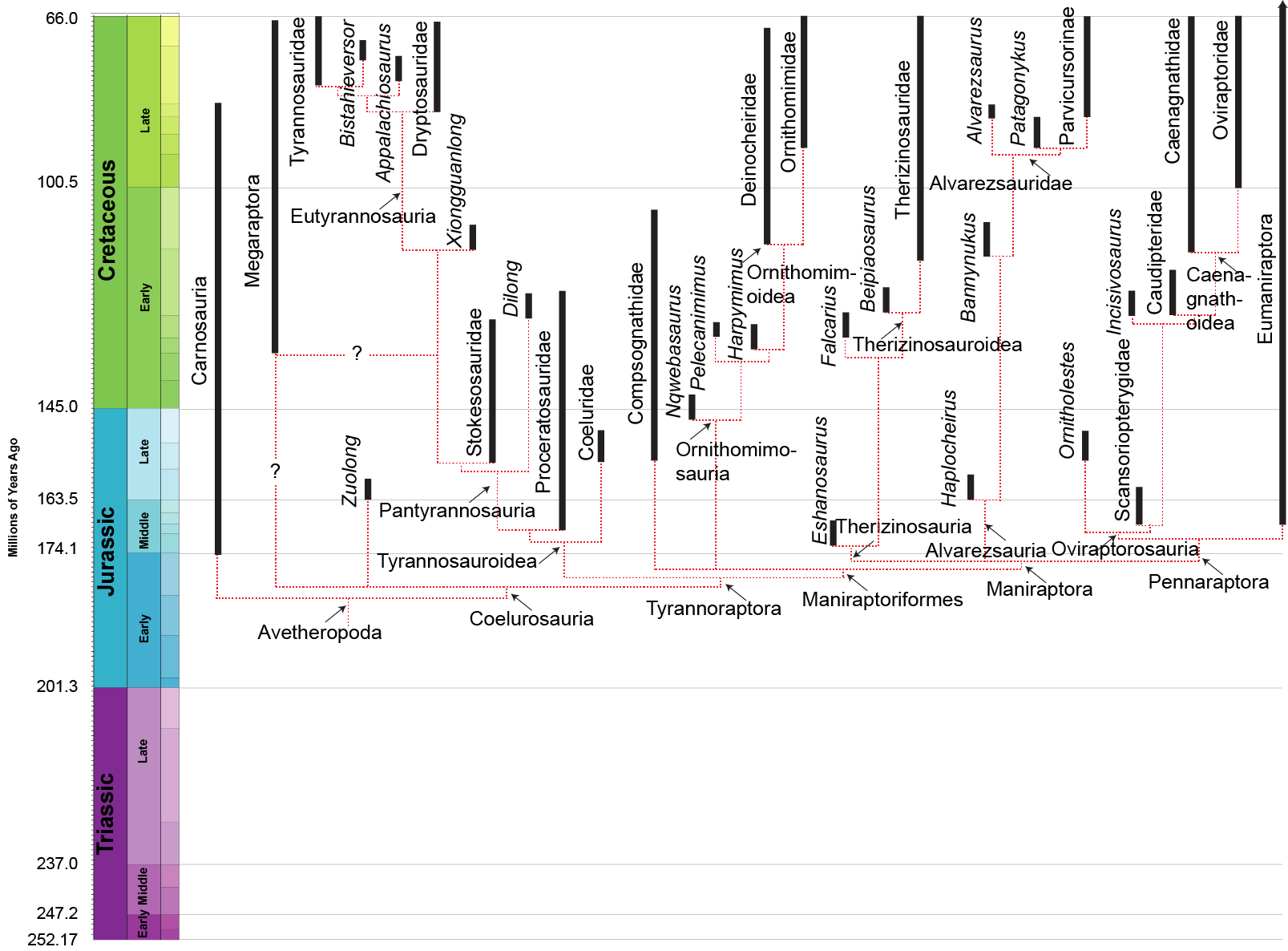
Note that Paraves (Eumaniraptora) existed at the same time as the earliest coelurosaur dinosaurs. Paraves were primitive birds with pennaceous feathers. Paraves could not have descended from coelurosaur dinosaurs.
(Click to enlarge).


Note Eumaniraptora in the chart above. It is on the far right. You can see that it extends back to the time of the very earliest found coelurosaur dinosaurs.

Friday, February 15, 2013

Pterosaurs taken as birds

Here are pterosaurs that have been taken as birds. This again shows that pterosaurs and primitive birds are very similar.


http://en.wikipedia.org/wiki/Palaeocursornis
Palaeocursornis is a monotypic genus of pterosaurs. The only known species, P. corneti, was described in 1984 based on a single bone (MTCO-P 1637) interpreted as the distal part of a left femur, found in Early Cretaceous (Berriasian rocks (dating to around 143 mya) from a mine at Cornet near Oradea in northwestern Romania. It was initially assumed to be a flightless paleognathe bird, possibly a ratite, and later as a more primitive ornithuromorph or non-avialan theropod (Benton et al., 1997). However, re-evaluation of the specimen suggested that it was not a femur at all, but the upper arm bone (humerus) of a pterodactyloid pterosaur similar to Azhdarcho.[1]

http://en.wikipedia.org/wiki/Piksi
Piksi is a genus of pterosaurs containing the single species Piksi barbarulna (meaning "strange elbowed big bird ", from Blackfoot piksi, "big bird" or, specifically, "chicken" and Latin barbarus "strange, outlandish" + ulnaelbow[1]). It lived roughly 75 million years ago in what is now MontanaUSA. Known from parts of a right wing – the humerusulna and radius bones – the only specimens found so far are housed in the Museum of the Rockies(collection number MOR 1113). The genus Piksi is monotypic at present.
The bones are fragmentary and represent roughly the elbow area. Comparing the fossils' size to the wing bones of other ground birds, P. barbarulna seems to have been about as large as a Common Pheasant, i.e. some 15 in (35–40 cm) long excluding tail, and with a wingspan of perhaps 30 in (80 cm) or somewhat less. It would thus have weighed maybe 1 – 2 pounds (some 500 g – 1 kg).[2]The original description of the fossils found its affinities unresolvable except that it was probably an ornithothoracine bird. Agnolin and Varricchio (2012) reinterpreted Piksi barbarulna as a pterosaur rather than a bird, most likely a member of Ornithocheiroidea.[3]
Original article::
http://journals2.scholarsportal.info/details.xqy?uri=/12809659/v34i0004/883_sropbvaprtab.xml
Varricchio (2002 ) described some forelimb bones from the Late Cretaceous (Campanian) Two Medicine Formation, Glacier County, Montana (USA), as the holotype of Piksi barbarulna, a supposed ornithothoracine bird. However reevaluation of Piksi Varricchio, 2002 instead recognizes this genus as belonging to Pterosauria Kaup, 1834 and not Aves Linnaeus, 1758. Piksi exhibits the following derived humeral traits of pterosaurs: 1) very large ectepicondyle; 2) large trochlea; 3) with a deep, wide and poorly deliminated brachial depression that is proximodistally extended; 4) a wide and deep olecranal fossa not marked dorsally by a ridge; and 5) lacking a distal depression of the groove for the m. humerotricipitalis. Moreover, the putative Early Cretaceous birds Eurolimnornis Jurcsák & Kessler, 1986 and Palaeocursornis Jurcsák & Kessler, 1986 , based on distal humeri, are also regarded as pterosaurs. The record of Piksi constitutes an important addition to the Latest Cretaceous pterosaurian record.

Sunday, February 3, 2013

Flight Stroke

The basal Paraves used the same flight stroke as Pterosaurs which is sufficient for flapping flight. The following references correctly show that neither pterosaurs nor basal paraves used their m. supracoracoideus as a pulley. But they are wrong in asserting that that precluded flapping flight.

PTEROSAURS

http://press.princeton.edu/witton/sampler-pterosaurs.pdf
At one stage, it was thought that the flight muscles of
pterosaurs were very birdlike, with the arm lifted by
a muscle, m. supracoracoideus, anchoring on the sternum
rather than the shoulders. In birds, this muscle
arcs over the glenoid to attach on the dorsal surface
of the humerus, elevating the wing with a pulley-like
system (e.g., Kripp 1943; Padian 1983a; Wellnhofer
1991a). Detailed reconstruction of the proximal arm
musculature of pterosaurs shows that this is not
the case, however, and that the [pterosaur] arm was more likely
lifted by large muscles anchored on the scapula and
back, and lowered by those attached to the sternum
and coracoid (fig. 5.8; Bennett 2003a). Unlike [modern] birds,
where two vastly expanded muscles are mainly used
to power flight, it appears that pterosaurs used several
muscle groups to form their flapping strokes.
http://eurekamag.com/research/019/478/morphological-evolution-pectoral-girdle-pterosaurs-myology-role.php (2003)
The musculature of the pectoral region of representative rhamphorhynchoid (Campylognathoides) and large pterodactyloid (Anhanguera) pterosaurs was reconstructed in order to examine the function of various muscles and the functional consequences of the evolution of the advanced pectoral girdle of large pterodactyloids. The reconstructions suggest that m. supracoracoideus was not an elevator of the wing, but instead depressed and flexed the humerus. m. latissimus dorsi, m, teres major, m. deltoides scapularis, and m. scapulohumeralis anterior were wing elevators. 
BASAL PARAVES

http://biology.kenyon.edu/courses/biol241/bird%20flight%202003%20Chatterjee_Sankar.pdf
Its lack of a supracoracoideus (SC)
pulley, the primary elevator of the wing, would prevent
Archaeopteryx from executing humeral rotation on the
glenoid during the upstroke,
For example, Archaeopteryx could not
position its wing high in an upstroke position, since it
lacked a modern avian supracoracoideus (SC) pulley, the
primary elevator of the wing (Poore et al. 1997). 
http://www.ncbi.nlm.nih.gov/pmc/articles/PMC1780066/
Anatomical evidence indicates that Microraptor was not capable of ground or running takeoff, because it lacked the supracoracoideus pulley to elevate the wings.
http://en.wikipedia.org/wiki/Confuciusornis
The first of these regarded problems to attain a steep flight path due to a limited wing amplitude. In the interpretation of Senter (2006) of the position of the shoulder joint, a normal upstroke would be impossible precluding flapping flight entirely. Less radical is the assessment that due to the lack of a keeled sternum and a high acrocoracoid, the [Confuciusornis] Musculus pectoralis minor could not serve as a M. supracoracoideus lifting the humerus via a tendon running through a foramen triosseum. This, coupled with a limited upstroke caused by a lateral position of the shoulder joint, would have made it difficult to gain altitude.
http://jeb.biologists.org/content/200/23/2987.full.pdf
The lack of a morphologically derived SC in Late
Jurassic and Early Cretaceous birds precluded a high velocity
recovery stroke which undoubtedly limited
powered flight in these forms. Subsequent evolution of the
derived SC capable of imparting a large rotational force to
the humerus about its longitudinal axis was an important
step in the evolution of the wing upstroke and in the ability
to supinate (circumflex) the manus in early upstroke, a
movement fundamental to reducing air resistance during
the recovery stroke.
The highly derived morphology of the SC,
a characteristic of modern birds capable of powered flight, was
not present in Archaeopteryx (Ostrom, 1976a,b; Wellnhofer,
1988, 1993), nor is there firm evidence for its presence in
recently described Mesozoic species (Chiappe, 1995; Sanz et
al. 1996).
Pterosaurs and basal paraves flapped their wings in the same way. 

Scansoriopterygidae are basal paraves with flight feathers on the arms and legs.
Scansoriopterygidae (or a group very much like it) is the ancestor of the later Paraves such as Microraptor, Archaeopteryx etc.
Rhamphorhynchidae (or a group very much like it) is the ancestor of Scansoriopterygidae.

Rhamphorhynchidae pycnofibres are homologous to Scansoriopterygidae feathers.
The Rhamphorhynchidae acetabulum is homologous to the Scansoriopterygidae acetabulum.
The Rhamphorhynchidae caudal rods are homologous to the Scansoriopterygidae caudal rods.
The Rhamphorhynchidae long bony tail is homologous to the Scansoriopterygidae long bony tail.
The Scansoriopterygidae outermost digit is transitional between Rhamphorhynchidae and later Paraves.
Basal paraves inherited their characteristics from their pterosaur ancestor and evolved feathers to replace the skin membranes. 
They continued to use the same flight stroke from their pterosaur ancestor.
Basal Paraves are feathered pterosaurs.


The evidence strongly supports the transition from pterosaur to basal paraves, with Scansoriopterygidae (or a taxon much like it) as being transitional between pterosaur and basal paraves
We have seen evidence that Scansoripteryx is one of the most basal members of paraves. 
It could splay its hind limbs like pterosaurs. It used the same muscles as pterosaurs for flight. 
Scansoriopterygidae (or a taxon much like it) is an excellent candidate for transitional between pterosaurs and later basal paraves.


SPLAYED HINDLIMBS

There is a reference to the splayed posture of Scansoriopterids here (page 154):
Riddle of the Feathered Dragons
http://books.google.ca/books?id=SihlpQTlVdAC&pg=PA154&lpg=PA154&dq=parasagittal+stance+for+Archaeopteryx.&source=bl&ots=jTl0YCn6be&sig=B9WKpEcJJ8Xr3U4_haeHeZFUToE&hl=en&sa=X&ei=xHMYVMWbAsGOyAT3loGQDg&ved=0CDwQ6AEwAw#v=snippet&q=in%20a%20splayed%20posture&f=false

There is a reference to the splayed posture of Archaeopteryx here (page 399):
The Origin and Evolution of Birds
http://books.google.ca/books?id=8QRKV7eSqmIC&pg=PA399&lpg=PA399&dq=archaeopteryx+femur+angle&source=bl&ots=fqR1hR9GAi&sig=7grokjyLDiND0WyvJNaAJC8e0Ko&hl=en&sa=X&ei=p1UYVJW0H5OtyATf5YCYCA&ved=0CB0Q6AEwAA#v=onepage&q=archaeopteryx%20femur%20angle&f=false


http://dml.cmnh.org/2010Feb/msg00281.html
A dynamic, modular flight system (as in birds) required a chaotic, unstable system to operate in, and modulating the body to compensate. Nonexistent or gently controlled air flow is not a good way to determine performance of a glide path, especially since NO living glider today maintains an absolutely fixed physical posture during its trajectory, and this goes triple for parachuting animals.
In their conclusion, Alexander et al. state: "Obviously, the living animal
was capable of active control, but we suggest that the tandem wing
configuration may have been advantageous because it requires less active
stabilizing ability."
I am not quite sure how one can develop a system of
unstable flight control from a passively stable system. Abilities to develop
control over the wing and perform a dynamic powered operation seem to require a
powered operation to precede it
In fact flying pterosaurs did precede them. 

The feathered pterosaur hindwings replace the function of the uropatagium of their pterosaur ancestor just as the wings replace the function of the patagium
And of course the feathered pterosaur propatagium is simply the pterosaur propatagium.

http://www.aou.org/auk/content/130/1/0001-0013.pdf
Feduccia
Microraptors have been reconstructed in two distinctive models, the four-winged gliding model with sprawled hindlimb wings, by which it was originally described in Nature (Xu et al. 2003), and a dinosaurian bipedal model, or biplane model, by which it is reconstructed with the hindlimbs held beneath the body, incapable of sprawling, in other words, like a tiny T. rex. The problem,of course, is that there is absolutely no reason the hindlimbs could not have been sprawled, as is the case in flying squirrels (Glaucomys spp.), flying lemurs (Dermoptera), etc., and even falling cats. Too, the sprawled model performs superiorly inwind-tunnel experiments (Alexander et al. 2010), most specimensare preserved with a sprawled posture, and the wingclaws are adapted for trunk climbing (Burnham et al. 2011). In addition, it would be difficult to imagine how selection could produce elongate, asymmetric hindlimb flight remiges by the most current paleontological reconstructions, in which the hindlimbs are held in flight beneath the body in obligate bipedal fashion, with elongate hindlimb wing feathers trailing behind, simply slicing through the air (Balter 2012)
http://www.pnas.org/content/107/7/2972.full.pdf+html
Alexander et al
Fossils of the remarkable dromaeosaurid Microraptor gui and relatives clearly show well-developed flight feathers on the hind limbs as well as the front limbs. No modern vertebrate has hind limbsfunctioning as independent, fully developed wings; so, lacking a living example, little agreement exists on the functional morphologyor likely flight configuration of the hindwing. Using a detailed reconstruction based on the actual skeleton of one individual, cast in the round, we developed light-weight, three-dimensional physical models and performed glide tests with anatomically reasonable hindwing configurations. Models were tested with hindwings abducted and extended laterally, as well as with a previously described biplane configuration. Although the hip joint requiresthe hindwing to have at least 20° of negative dihedral (anhedral),all configurations were quite stable gliders. Glide angles rangedfrom 3° to 21° with a mean estimated equilibrium angle of 13.7°,giving a lift to drag ratio of 4.1:1 and a lift coefficient of 0.64. The abducted hindwing model’s equilibrium glide speed corresponds to a glide speed in the living animal of 10.6m·s−1. Although the biplane model glided almost as well as the other models, it was structurally deficient and required an unlikely weight distribution (very heavy head) for stable gliding. Our model with laterally abducted hindwings represents a biologically and aerodynamically reasonable configuration for this four-winged gliding animal. M. gui’s feathered hindwings, although effective for gliding, would have seriously hampered terrestrial locomotion.
Primitively, early archosaurs are sprawling, with the legs set
laterally and elevated at around 75° (6), a preadapted posture for
gliding. Modern birds normally have the thigh elevated and
sprawled to the side in different degrees; for example, it is nearly
perpendicular to the midline in loons and grebes (7).
This variation
shows that the degree of splaying needed to use the
hindlegs in gliding is not unusual when compared with that in
modern birds. The absence of an antitrochanter and a supraacetabular
acetabular shelf (SAC) in the eumaniraptorans, including dromaeosaurids,
would make elevation and splaying of the legs even
easier (8). Air pressure could have provided most of the force
needed to elevate the leg into a gliding position similar to that in
gliding mammals. This simple positioning was originally assumed
for the four-winged Microraptor gui (5); but later, workers hoping
to recover an upright posture proposed arrangements of the
hindlimbs that would have required complicated systems of locks
and muscles to hold the leg in an only partially elevated position,
e.g., the “biplane” model (9). New anatomical information based
on the discovery of several hundred specimens similar to the
four-winged glider M. gui (and related taxa) has produced converging
lines of evidence demonstrating that the original
describers of M. gui (5) were correct in their interpretation of the
flight posture.
We postulate, based on examination of this new
material, that M. gui was capable of abducting the hind limbs at
least 65–70° to achieve a gliding posture.

"Tent" model:
http://icb.oxfordjournals.org/content/early/2011/09/21/icb.icr112.full


Also chicks can have a problem with legs that are splayed too much.
https://www.google.ca/webhp?sourceid=chrome-instant&rlz=1C1SKPL_enCA423CA423&ion=1&espv=2&ie=UTF-8#q=birds%20splay%20their%20legs 


http://en.wikipedia.org/wiki/Microraptor
Some paleontologists have doubted the biplane hypothesis, and have proposed other configurations. A 2010 study by Alexander et al. described the construction of a lightweight three-dimensional physical model used to perform glide tests. Using several hind leg configurations for the model, they found that the biplane model, while not unreasonable, was structurally deficient and needed a heavy-headed weight distribution for stable gliding, which they deemed unlikely. The study indicated that a laterally abducted hindwing structure represented the most biologically and aerodynamically consistent configuration for Microraptor.[3] A further analysis by Brougham and Brusatte, however, concluded that Alexander's model reconstruction was not consistent with all of the available data on Microraptor and argued that the study was insufficient for determining a likely flight pattern for Microraptor. Brougham and Brusatte criticized the anatomy of the model used by Alexander and his team, noting that the hip anatomy was not consistent with other dromaeosaurs. In most dromaeosaurids, features of the hip bone prevent the legs from splaying horizontally; instead, they are locked in a vertical position below the body. Alexander's team used a specimen of Microraptor which was crushed flat to make their model, which Brougham and Brusatte argued did not reflect its actual anatomy.[15] Later in 2010, Alexander's team responded to these criticisms, noting that the related dromaeosaur Hesperonychus, which is known from complete hip bones preserved in three dimensions, also shows hip sockets directed partially upward, possibly allowing the legs to splay more than in other dromaeosaurs.[16]
Related references:

http://www.app.pan.pl/archive/published/app59/app20111109.pdf
Pterosaur pelvis

http://www.pnas.org/content/107/7/2733.full.pdf+html
John Ruben

http://www.pnas.org/content/106/13/5002.abstract?ijkey=b80c6cec04b5f05bcbf67870ea44df19a403ed62&keytype2=tf_ipsecsha
Hesperonychus

http://www.pnas.org/content/107/40/E155.full
Counter-argument (Brougham and Brusatte)

http://www.pnas.org/content/107/40/E156.full
Reply to Brougham and Brusatte


FOR REFERENCE:
MODERN BIRD

 http://en.wikipedia.org/wiki/Bird_anatomy
The supracoracoideus works using a pulley like system to lift the wing while the pectorals provide the powerful downstroke