Friday, October 7, 2011

Waterfowl

WATERFOWL (Presbyornithid line)
  • Pterosaur (eg. Pterodactylidae/Ctenochasmatidae ) --->
  • Presbyornithid subgroup--> 
  • Modern Anseriformes (eg. Duck, Geese , Swan)
AND
  • Pterosaur (Ctenochasmatidae) Pterodaustro   --->
  • Presbyornithid subgroup--> 
  • Primitive bird, Palaelodidae (Phoenicopteriformes)  --> 
  • Flamingo (Phoenicopteriformes)

    http://en.wikipedia.org/wiki/Presbyornithidae
    Presbyornithidae were a family of waterbirds with an apparently global distribution that lived until the Earliest Oligocene, but are now extinct. Initially, they were believed to present a mix of characters shown by waterbirds,shorebirds and flamingos and were used to argue for an evolutionary relationship between these groups (Feduccia 1976), but they are now generally accepted to be "wading ducks", the sister taxon [actually the ancestor] of the Anatidae, and thus essentially modern waterbirds. They were generally long-legged, long-necked birds, standing around one meter high, with the body of a duck, feet similar to a wader but webbed, and a flat duck-like bill adapted for filter feeding.  Apparently, at least some species were very social birds that lived in large flocks and nested in colonies.


    As the "wading duck" moniker implies, they were waterfowl whose elongated legs enabled them to live a lifestyle similar to the "proto-flamingos" (e.g., Palaelodus) - which were not really ancestors of the modern flamingos, but a group that evolved in parallel with them and in fact seems to have taken over part of the presbyornithid's ecological niche after the latter became extinct. Thus, while probably somewhat capable of swimming, they would have preferred to strain the shallow waters of their habitat for food and were also able to snatch up insects and small crustaceans on dry land, just like some species of modern ducks, e.g., the Laysan Duck, hunt for brine flies.

    Presbyornithids
    Temporal range: Late Cretaceous? - Oligocene


    http://en.wikipedia.org/wiki/Presbyornis
    Presbyornis is an extinct genus of anseriform bird. It contains two unequivocally accepted species; the well-known P. pervetus and the much lesser-known P. isoniP. pervetus was approximately the size and shape of a goose, but with longer legs; P. isoni, known from a few bones, was much larger, more than swan-sized. Other fossils, more doubtfully assigned to this genus, are also known.
    Judging from numerous fossil findings, Presbyornis is presumed to have lived in colonies around shallow lakes. Its broad, flat bill was used to filter food (small plants and animals) from the water, in the manner of today's dabbling ducks.[3]

    http://en.wikipedia.org/wiki/Galloanserae
    "Fowl were the first neognath lineages to evolve. From the limitedfossils that have to date been recovered, the conclusion that they were already widespread - the predominant group of modern birds - by end of the Cretaceous is generally accepted nowadays.Fossils such as Vegavis indicate that essentially modern waterfowl - albeit belonging to a nowadays extinctlineage - were contemporaries of the (non-avian)dinosaurs.

    Note: 
    It says "albeit belonging to a nowadays extinct lineage". It should say that the Vegavis developed into modern waterfowl. 

    http://en.wikipedia.org/wiki/Vegavis

    "Vegavis
     is a genus of extinct bird that lived during the Late Cretaceous (Maastrichtian stage) of Antarctica, some 65 mya. It belonged to the clade Anseriformes
    Among modern birds,Vegavis is most closely related to ducks and geese (Anatidae), but it is not considered to be a direct ancestor of them." [However it possibly should be considered a direct ancestor of them].
    The discovery of the type speciesVegavis iaai, demonstrates that the major groups of bird alive today had already diversified in the Cretaceous. This supports the longstanding phylogenetic inferences of paleornithologists.[citation needed] It has been hailed as the first definitive physical proof that representatives of some of the groups of modern birds lived in theMesozoic.[1]"
    "We have more data than ever to propose at least the beginnings of the radiation of all living birds in the Cretaceous," Clarke says. "We now know that duck and chicken relatives coexisted with non-avian dinosaurs. This does not mean that today's chicken and duck species lived with non-avian dinosaurs, but that the evolutionary lineages leading to today's chicken and duck species did." (Julia A. Clarke1,2, Claudia P. Tambussi3, Jorge I. Noriega4,
    Gregory M. Erickson5,6,7 & Richard A. Ketcham8)


    FLAMINGOS
    http://en.wikipedia.org/wiki/Flamingo
    Relationships to the waterfowl were considered as well,[3] especially as flamingos and waterfowl are parasitized by feather lice of the genus Anaticola, which are otherwise exclusively found on ducks and geese.[4]


    Pterosaurs lasted till late Cretaceous
    Presbyornithids spanned from late Cretaceous? to Early Oligocene
    Palaelodidae spanned from early Oligocene to Middle Pleistocene
    Modern flamingos span from 30 mya to the present day


    http://www.flamingos-world.com/flamingo-evolution.html
    There is evidence to indicate the Flamingo evolved at least 30 million years ago, perhaps longer. 


    "Our investigation of skeletal and ontogenetic variation in Pterodaustro gives insights into the
    developmental growth dynamics of this unusual ctenochasmatid pterodactyloid from early
    ontogeny through to adulthood and also pro vides information pertaining to histological variability within and between bones of individuals. This study also documents the presence of what appears to be medullary bone tissue within the medullary cavity of a large femur of Pterodaustro. This  suggests that,  like  birds,  reproductively  active female  pterosaurs  may have deposited a special bone tissue (medullary bone) to cope with  the demand of  calcium  during  eggshelling."

    Aquatic Birds

    AQUATIC BIRDS (Hesperornithes line) 

    • Pterosaur (Pterodactylidae/Ctenochasmatidae) eg. Pterodactylus --> 
    • Baptornithidae (Hesperornithes) --> 
    • (primarily foot-propelled) WEB FOOT diving bird orders, eg. Cormorants (Phalacrocoracidae), Loons (Gaviidae),   Penguins  (Sphenisciformes)
    AND

    • Pterosaur (Pterodactylidae/Ctenochasmatidae) eg. Pterodactylus -->
    • Hesperornithidae (Hesperornithes) --> 
    • (primarily foot-propelled) LOBE FOOT diving bird orders eg. Grebes (Podicipedidae).


    Baptornis (Baptornithidae)
    http://oceansofkansas.com/Hesperornis/martin60.jpg


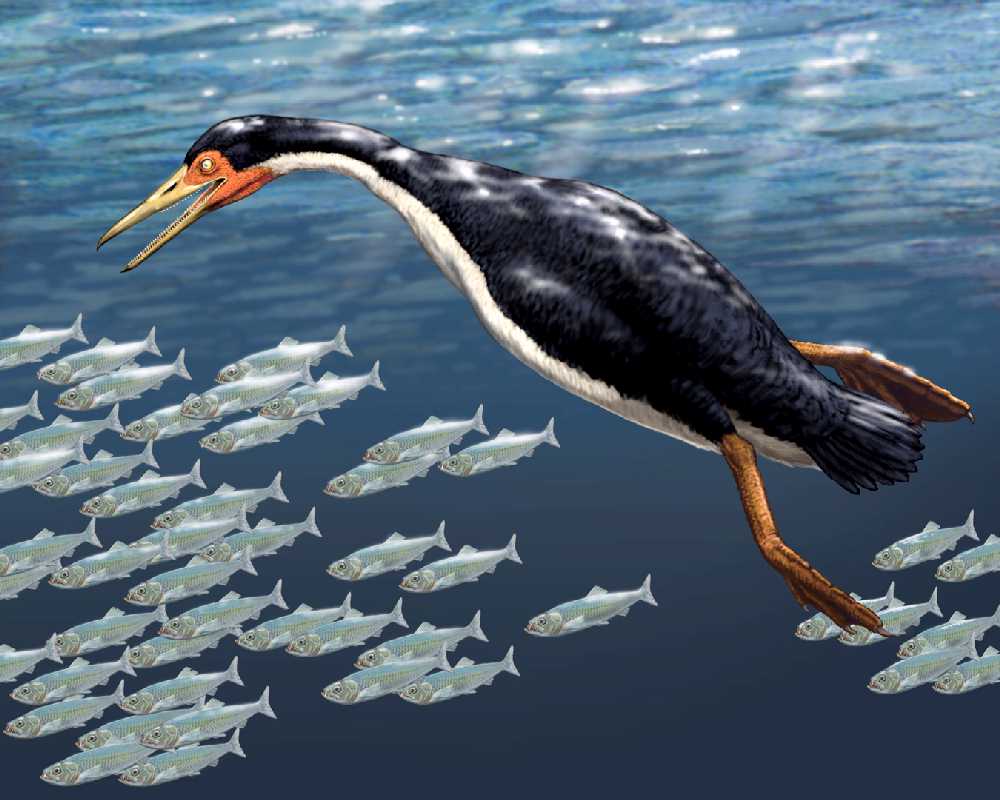
    Hesperonis (Hesperornithidae)
    http://oceansofkansas.com/Hesperornis/hespercb.jpg


    Loon
    http://bwfov.typepad.com/birders_world_field_of_vi/images/2007/07/18/loon_2.jpg


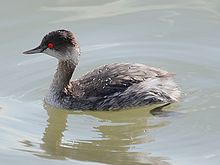
    Grebe
    http://upload.wikimedia.org/wikipedia/commons/thumb/6/66/Podiceps_nigricollis_001.jpg/220px-Podiceps_nigricollis_001.jpg

    http://cdn2.arkive.org/media/EB/EB8E3CC3-0C9B-4CDB-BFCA-D997ED9BB29D/Presentation.Large/Great-Crested-Grebe-diving-under-water-for-fish.jpg


    Example of "web foot"


    Example of "lobe foot"


    Videos:
    http://www.youtube.com/watch?v=iQya_S0oFx8
    http://www.youtube.com/watch?v=ZIOTp8b1b2U
    www.youtube.com/watch?v=FQme1IrGlEU
    www.youtube.com/watch?v=QOXMfe2SAWA
    www.youtube.com/watch?v=vDG_e2IgrFc


    http://en.wikipedia.org/wiki/Hesperornis
    "Hesperornis
     is an extinct genus of flightless aquatic birds that lived during the Santonian to Campanian sub-epochs of the Late Cretaceous (89–65 mya).
    Although some of the smaller species might have been able to fly,Hesperornis and Baptornis had only vestigial wings. Like living foot-propelled diving birds, the femur and metatarsus were short, whereas the tibia was long. The legs were also set far back on the body, as in loonsgrebes or penguins."

    http://en.wikipedia.org/wiki/Grebe
    "The cladistics vs. phenetics debate of the mid-20th century revived scientific interest in generalizing comparisons. As a consequence, the discredited grebe-loon link was discussed again. This even went as far as proposing monophyly for grebes, loons, and the toothed Hesperornithiformes "

    http://en.wikipedia.org/wiki/Hesperornithidae
    These birds were originally combined with Ichthyornis in the paraphyletic "Odontornithes" by Othniel Charles Marsh, in 1873. In 1875, they were separated as Odontolcae. The group was often considered to be allied to loons and grebes,[4]or to the Paleognathae.[5] These similarities, however, as the more recently determined fact that the osteons of their bones - at least in Hesperornis - were arranged in a pattern similar to that in Neognathae,[6] are today considered to be due to convergent evolution.[7]


    http://archive.peabody.yale.edu/scipubs/bulletins_postillas/ypmP207_1991.pdf

    "The skull of Hesperornis proves to be neognathous in the majority of diagnostic
    characters including the presence of the intrapterygoid joint."

    http://www.jstor.org/pss/2413412
    "A cladistic analysis of the skeletons of loons (Gaviidae), grebes (Podicipedidae), and the Cretaceous diving birds, Hesperornisand Baptornis, supports the hypothesis that they form a monophyletic group (here called the Gaviomorphae) within the class Aves. Two lineages within the gaviomorphs can be delineated: (1) loons + grebes, and (2) Hesperornis + Baptornis. The Early Cretaceous Enaliornis and the Late Cretaceous Neogaeornis are related to the second lineage; the Late Cretaceous Lonchodytes, often placed near loons, is apparently not a gaviomorph but perhaps a charadriiform. Skeletal evidence also suggests that penguins (Spheniscidae) are the sister-group of the Gaviomorphae. Arguments that similarities of gaviomorph taxa represent convergence are not well founded. First, morphological differences among taxa do not constitute valid evidence against their monophyly, as many previous workers have argued. Second, in no case has anyone supporting convergence presented a corroborated alternative phylogenetic hypothesis. A close relationship among gaviomorphs, penguins, and apparently also the Procellariiformes and Pelecaniformes implies that a lineage of aquatic birds was established very early in avian history, presumably in the Early Cretaceous or Late Jurassic." (Joel Cracraft 1982)


    Looks like Joel Cracraft was on the right track!
    (Note the issue here is not whether grebes and loons go together but that hesperornithiformes is linked to modern birds such as grebes and/or loons.)


    I was quite surprised/pleased to see this:
    http://en.wikipedia.org/wiki/Modern_birds
    "In traditional classification, the Neornithes also included a third superorder, the Odontognathae, containing advanced toothed birds from the Cretaceous, like Hesperornis and Ichthyornis.[5] This superorder is likely paraphyletic [ANCESTRAL], and fall outside [ancestral to] the crown group birds. It is not entirely clear whether the Palaeognathae too are paraphyletic, or represent a primitve grade of birds.[6]"

    This seems to be saying exactly what I have been saying. 
    Modern bird taxa developed from such taxa as Hesperornithes and Ichthyornithes etc.


    http://en.wikipedia.org/wiki/Diving_bird

    Diving birds are birds which plunge into water to catch fish or other food. They may enter the water from flight, as does the brown pelican (Pelecanus occidentalis), or they may dive from the surface of the water. More than likely they evolved from birds already adapted for swimming that were equipped with such adaptations as lobed or webbed feet forpropulsion.

    Foot-propelled diving birds

    Some diving birds - for example, the extinct Hesperornithes of the Cretaceous Period - propelled themselves with their feet. They were large, streamlined, flightless birds with teeth for grasping slippery prey. Today, Cormorants (familyPhalacrocoracidae), Loons (Gaviidae), and Grebes (Podicipedidae) are the major groups of foot propelled diving birds.


    Wing-propelled diving birds

    Other diving birds are wing - propelled, most notably the Penguins (Sphenisciformes), Dippers (Cinclus) and Auks(Alcidae).

    "Thus the toes of Baptornis were probably webbed as in loons or ducks, rather than lobed as in grebes and Hesperornis: for birds with lobed toes, rotating the toes is necessary to reduce drag when pulling the foot forward for a new stroke."

    http://en.wikipedia.org/wiki/Hesperornithes
    Loss and/or fusion of caudal vertebrae in pygostyle-like structures was a general trend in Cretaceous avian evolution, and a full pygostyle and associated structures may have evolved more than once to similar shapes. The fact that Gansus had non-pneumatized, dense bones, like those of hesperornithines, although it was not a specialized diver, is interesting to note. Similarly, the bone structure of Hesperornis indicates that as opposed to Enantiornithes and in line with other Ornithurae it showed rapid, uninterrupted growth to adult size.[5]

    http://en.wikipedia.org/wiki/Cormorant
    They [cormorants] are coastal rather than oceanic birds, and some have colonised inland waters - indeed, the original ancestor of cormorants seems to have been a fresh-water bird, judging from the habitat of the most ancient lineage. They range around the world, except for the central Pacific islands.

    http://www.sciencedirect.com/science/article/pii/S0195667197901026
    We report on the bone microstructure of the Cretaceous birds Hesperornis regalis and Ichthyornis victor. Thin sections of representative elements of both these ornithurine birds show a rapid, sustained bone deposition without any pauses or interruptions in bone formation. This growth pattern contrasts sharply with the cyclical pattern of bone deposition previously reported for the Cretaceous non-ornithurine birds Patagopteryx and representatives of the enantiornithines. These findings suggest physiological advancement in Cretaceous ornithurine birds. The bone microstructure of the diving Hesperornis shows similarities to the bone structure of modern penguins, and to that of a loon from the Cretaceous of Antarctica.

    Waders/Shorebirds

    WADERS/SHOREBIRDS 

    • Pterosaur (eg. Azhdarchoidea) --->
    • Primitive shorebird (eg. Graculavus) --> 
    • Modern shorebirds - eg. plovers, oystercatchers, sandpipers (Charadriiformes/Charadrii)  and storks (Ciconiidae)

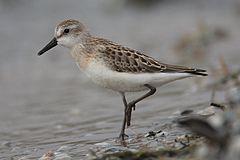
    Shorebirds
    http://upload.wikimedia.org/wikipedia/commons/thumb/0/00/Calidris-pusilla-001.jpg/240px-Calidris-pusilla-001.jpg

    http://t3.gstatic.com/images?q=tbn:ANd9GcSti0mLreJDIJf4JDMrbXj6kw943T638pvojNtaXc_1V41DNMfR4g


    Shorebird video:
    http://www.youtube.com/watch?v=c44H8KTSMDU&feature=related

    http://en.wikipedia.org/wiki/Graculavus
    68–62 Ma
    Graculavus is a prehistoric bird genus that was described by O. C. Marsh.
    Graculavus is the namesake for the form taxon "Graculavidae", a plesiomorphic assembly of unrelated birds that were believed to hold a key position in avian evolution as "transitional shorebirds." Two species are known: Graculavus augustus from the Western Interior Seaway and Graculavus velox from the Atlantic Seaboard.[1]

    http://www.plosone.org/article/info%3Adoi%2F10.1371%2Fjournal.pone.0002271
    "However, azhdarchid footprints show that their feet were relatively small, padded and slender, and thus not well suited for wading. We argue that azhdarchids were stork- or ground hornbill-like generalists, foraging in diverse environments for small animals and carrion".

    Seabirds

    SEABIRDS (Ichthyornithes line)

    • Pterosaur (eg. Ornithocheiroidea) eg. Pteranodon --> 
    • An Ichthyornithes subgroup --> 
    • Gulls, Skimmers (Charadriiformes/Lari)
    AND

    • Pterosaur (eg. Ornithocheiroidea) eg. Pteranodon --> 
    • An Ichthyornithes subgroup --> 
    • Petrels, Albatross (Procellariiformes)

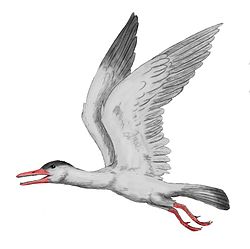
    Pteranodon

    http://t1.gstatic.com/images?q=tbn:ANd9GcRELWfZfbBLyUpBPZEkcMkeV9w4thn2BmbN82bMHnP1QamZ5RZbnw


    Ichthyornis
    http://upload.wikimedia.org/wikipedia/commons/thumb/f/f2/Ichthyornis_BW.jpg/250px-Ichthyornis_BW.jpg


    Gull
    http://t0.gstatic.com/images?q=tbn:ANd9GcR2UeyXGupzzv6pOMmTX32mpZH3gxh_U--uwtGIIJZYogntzqnK


    Albatross
    http://t2.gstatic.com/images?q=tbn:ANd9GcRKRgWuWMW9NV8vBRkOs5biyoO2nEPrsV5WqWEQRUqJ3rK_xtHNqA


    http://en.wikipedia.org/wiki/Seabird
    "There exists no single definition of which groups, families, and species are seabirds, and most definitions are in some way arbitrary. In the words of two seabird scientists, "The one common characteristic that all seabirds share is that they feed insaltwater; but, as seems to be true with any statement in biology, some do not."[2] However, by convention all of theSphenisciformes and Procellariiformes, all of thePelecaniformes except the darters, and some of the Charadriiformes (the skuasgullsternsauks andskimmers) are classified as seabirds. The phalaropes are usually included as well, since although they are waders("shorebirds" in North America), two of the three species are oceanic for nine months of the year, crossing the equator to feed pelagically.
    Loons and grebes, which nest on lakes but winter at sea, are usually categorized as water birds, not seabirds.Although there are a number of sea ducks in the family Anatidae which are truly marine in the winter, by convention they are usually excluded from the seabird grouping. Many waders (or shorebirds) and herons are also highly marine, living on the sea's edge (coast), but are also not treated as seabirds."


    http://en.wikipedia.org/wiki/Pteranodon
    "The wing shape of Pteranodon suggests that it would have flown rather like a modern-day albatross. This is based on the fact that Pteranodon had a high aspect ratio (wingspan to chord length) similar to that of the albatross — 9:1 for Pteranodon, compared to 8:1 for an albatross. Albatrosses spend long stretches of time at sea fishing, and use a flight pattern called "dynamic soaring" which exploits the vertical gradient of wind speed near the ocean surface to travel long distances without flapping, and without the aid of thermals (which do not occur over the open ocean the same way they do over land).[11] While most of a Pteranodon flight would have depended on soaring, like long-winged seabirds, it probably required an occasional active, rapid burst of flapping, and studies of Pteranodon wing loading (the strength of the wings vs. the weight of the body) indicate that they were capable of substantial flapping flight, contrary to some earlier suggestions that they were so big they could only glide.[3]"


    http://onlinelibrary.wiley.com/doi/10.1002/ar.20990/pdf
    "Interestingly, a Lesser Black-Backed Gull and an unrelated charadriiform seabird
    with similar flight modes also showed histological similarity to the Procellariiiformes [eg. albatross] studied."

    http://en.wikipedia.org/wiki/Procellariidae 
    "According to the famous DNA hybridization study into avian phylogenetic relationships by Sibley and Ahlquist, the split of the Procellariiformes into the four families occurred around 30 million years ago; a fossil bone often attributed to the order, described as the genus Tytthostonyx, has been found in rocks dating around the Cretaceous-Tertiary boundary (70-60 mya), but the remains are too incomplete for placement within the Procellariiformes to be certain.[2] The molecular evidence suggests that the [swimming] storm-petrels were the first to diverge [develop] from the ancestral stock [I propose ichthyornithes], and the albatrosses next, with the procellariids and diving petrels splitting [developing] most recently. Many taxonomists used to retain the diving petrels in this family also, but today their distinctiveness is considered well supported."
    http://en.wikipedia.org/wiki/Ichthyornis
    "It is thought that Ichthyornis was the Cretaceous ecological equivalent of modern seabirds such as gullspetrels, and skimmers. It was the size of a pigeon, 24 centimetres (9.4 in) long, with a skeletal wingspan (not taking feathers into account) of around 43 centimetres (17 in).[3]"
    The jaw tips had no teeth and were covered in a beak. The beak of Ichthyornis, like the hesperornithids and other primitive birds, was compound and made up of several distinct plates, similar to the beak of an albatross, rather than a single sheet of keratin as in most modern birds.[4]
    Although the wings and breastbone were very modern in appearance (suggesting strong flight ability and placing it with modern birds in the advanced group Carinatae), the jaws had numerous small, sharp teeth.


    http://dinogoss.blogspot.com/2011/01/theropods-that-fit-bill.html
    Interestingly, studies of ichthyornithines and hesperornithine bone structure shows that they likely had "compound rhamphotheca", and this may have been the ancestral condition for modern birds (Heironymous & Witmer, 2010). While the quintessential bird beak is made up of a single keratin sheet covering the jaw, in species with compound beaks, the keratin is arranged in discrete plates on the jaws. This can best be seen in some modern seabirds like the Albatross.


    http://en.wikipedia.org/wiki/Bird
    "The first large, diverse lineage of short-tailed birds to evolve were the Enantiornithes, or "opposite birds", so named because the construction of their shoulder bones was in reverse to that of modern birds. Enantiornithes occupied a wide array of ecological niches, from sand-probing shorebirds and fish-eaters to tree-dwelling forms and seed-eaters.[22] More advanced lineages also specialised in eating fish, like the superficially gull-like subclass of Ichthyornithes (fish birds)."[23]

    http://www.miketaylor.org.uk/tmp/i0003-0090-286-01-0001.pdf
    Five unambiguous autapomorphies of Ichthyornis dispar are identified in the phylogenetic
    analysis (i.e., 52, 66, 103, 132, 152;
    each is discussed in the Taxonomic Revision
    of Part I): (52:0) amphicoelous cervical vertebrae,
    (66:1) proximal free caudal vertebrae
    with well-developed prezygapophyses clasping
    the dorsal surface of preceding vertebra,
    (103:1) unprojected acromion on scapula,
    (132:1) subequal posterior and distal dimensions
    of the distal articular surface of ulna,
    and (152:1) internal index process present.
    Of these characters, two (i.e., 66, 152) are
    also seen in Charadriiformes and some other
    neoavians but not in the included Aves. This
    distribution, and the absence of these morphologies
    in other basal avialans, is consistent
    with the hypothesis (e.g., Marsh, 1880)
    that several derived aspects of the anatomy
    of Ichthyornis dispar may be convergent [actually homologous] on
    charadriiform morphologies. It does not,however, support these structures, or ‘‘shorebird’’morphologies generally, as ancestral toAves, as has often been argued (Feduccia,1995, 1999).
    [The last sentence is an unsupported assertion.]

    http://si-pddr.si.edu/dspace/bitstream/10088/6553/1/VZ_167_Fossil_Record_of_Birds.pdf
    Unlike Hesperornis, the species of Ichthyornis were obviously flying
    birds. They were the size of gulls or terns and may have had somewhat
    similar habits, as Marsh (1880) suggested long ago. It was probably this
    allusion that prompted many authors (see those cited by Lambrecht, 1933,
    p. 581) to place Ichthyornis near the Charadriiformes. This is certainlyunjustified, as it is likely that Ichthyornis is a relict of an earlier radiation ona line quite apart from modern birds, The enormous deltoid crest in
    Ichthyornis is unique among birds in size, shape, and orientation, as noted
    by the original describer and later redundantly by Harrison (1973). Thepalate is unknown in Ichthyornis and there is no reason to suppose that thesebirds were even neognathous."
    Note: If the palate is unknown then there is no reason NOT to suppose these birds were neognathous.

    http://en.wikipedia.org/wiki/Modern_birds

    "In traditional classification, the Neornithes also included a third superorder, the Odontognathae, containing advanced toothed birds from the Cretaceous, like Hesperornis and Ichthyornis.[5] This superorder is likely paraphyletic [ANCESTRAL], and fall outside [is ancestral to]  the crown group birds. It is not entirely clear whether the Palaeognathae too are paraphyletic [ancestral], or represent a primitve grade of birds.[6]"
    This seems to be saying exactly what I have been saying.
    Some of the modern birds developed from such primitive bird taxa as Hesperornithes and Ichthyornithes.


    Sapeornis
    http://link.springer.com/article/10.1007%2Fs12052-009-0133-4/fulltext.html
    "The contemporaneous and much larger Sapeornis had longer and narrower wings, superficially resembling those of albatrosses (Zhou and Zhang 2002)."