Friday, October 7, 2011

Flightless Birds


FLIGHTLESS BIRDS (Ratites)


    Flightless birds
    • Pterosaur -->
    • Primitive flightless birds -->
    • Modern ratites - Ostrich (Struthio), Rhea (Rheidae), Cassowary, Emu (Casuariidae), Kiwi (Apteryx) 


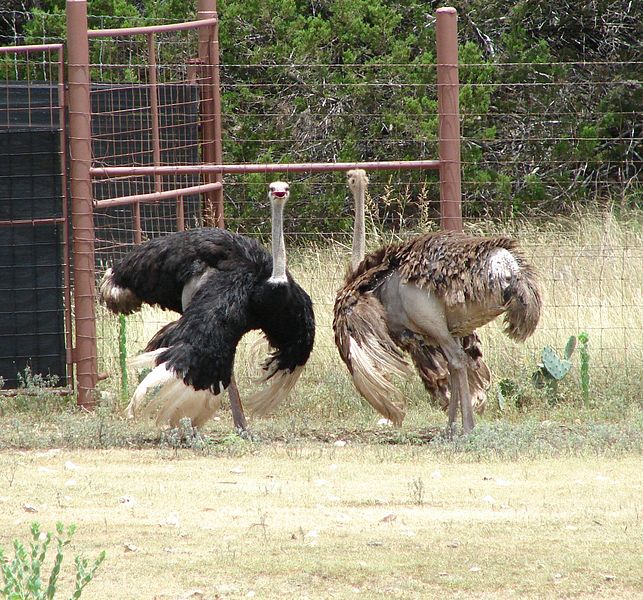
Ostrich
http://upload.wikimedia.org/wikipedia/commons/thumb/8/87/FlappingOstriches.jpg/643px-FlappingOstriches.jpg
Emu
https://blogger.googleusercontent.com/img/b/R29vZ2xl/AVvXsEjJOB6sqrDJ7eQCQY0nES5INj2HPAWUMQ2dRPXulHAcsQMqaZqsSR7ihu1zvebmn-nlhY5Dj0F02HPWOWSAsbT9DTROUH-Dpg_RpvQINzSX-roBcz43RQGFTQPns0Z0805W70gVmYmHhWo/s1600/Emu2.jpg


Cassowary
http://upload.wikimedia.org/wikipedia/commons/thumb/9/9a/Casuarius_casuarius_-Brevard_Zoo-8a.jpg/250px-Casuarius_casuarius_-Brevard_Zoo-8a.jpg


Kiwi
http://0.tqn.com/d/goaustralia/1/0/9/i/kiwi.jpg


Plucked ostrich


http://en.wikipedia.org/wiki/Deinonychus
"Ostrom compared Deinonychus to the ostrich and cassowary. He noted that the bird species can inflict serious injury with the large claw on the second toe.[1]"

http://en.wikipedia.org/wiki/Avimimus
Avimimus meaning "bird mimic", was a genus of bird-like maniraptoran dinosaur [Oviraptor] that lived in the late Cretaceous in what is now Mongolia, around 70 million years ago.

A cassowary's three-toed feet have sharp clawsThe second toe, the inner one in the medial position, sports a dagger-like claw that is 125 millimetres (5 in) long.[6] This claw is particularly fearsome since cassowaries sometimes kick humans and animals with their enormously powerful legs.

See here also concerning neotony:

See also here for more info:

Some general info:
"Maniraptora is the only dinosaur group known to have included flying members, though how far back in this lineage flight extends is controversial. Powered and/or gliding flight is believed to have been present in some types of dromaeosaurid, such as Rahonavis and Microraptor.[5] Other groups, like the Oviraptorosauria, are not known to have been capable of flight, but some scientists have suggested that they could be descended from ancestors which flew. Paul has suggested that this might be the case. Paul has gone as far as to propose that Therizinosauria, Alvarezsauroidea, and the non-maniraptoran group Ornithomimosauria descended from flying ancestors as well.[6]"

Oviraptors as flightless birds:
http://en.wikipedia.org/wiki/Oviraptorosauria
"Analyses like those of Osmólska et al. (2004) suggest that they [Oviraptors] may in fact represent primitive flightless birds".[2]
"Evidence for feathered oviraptorosaurs exists in several forms. Most directly, four species of primitive oviraptorosaurs (in the genera Caudipteryx, Protarchaeopteryx, and Similicaudipteryx) have been found with impressions of well developed feathers, most notably on the wings and tail, suggesting that they functioned at least partially for display. Secondly, at least two oviraptorosaur specimens (Nomingia and Similicaudipteryx) preserved tails ending in something like a pygostyle, a bony structure at the end of the tail that, in modern birds, is used to support a fan of feathers.[5] Similarly, quill knobs (anchor points for wing feathers on the ulna) have been reported in the oviraptorosaurian species Avimimus portentosus.[7] Additionally, a number of oviraptorid specimens have famously been discovered in a nesting position similar to that of modern birds. The arms of these specimens are positioned in such a way that they could perfectly cover their eggs if they had small wings and a substantial covering of feathers.[8]""


Concerning alvarezsaurs a case could be made that they are flightless birds:
http://en.wikipedia.org/wiki/Alvarezsauridae
"... assignments of alvarezsaurs to birds were caused primarily by features that are strikingly, or even uniquely, avian. The sternum, for example, is elongated and deeply keeled for an enlarged pectoralis muscle, as it is in neognathous birds and volant ratites. One bone in the skull of Shuvuuia appeared to be an ectethmoid fused to a prefrontal. The ectethmoid is an ossification known only in Neornithes. Other birdlike characters included the palatine, foramen magnum, cervical and caudal vertebrae, and many others".[9]


Also see these links:
http://pterosaurnet.blogspot.com/2011/10/origin-of-flightlessness.html
and
http://pterosaurnet.blogspot.com/2010/07/flying-first-then-secondarily.html
and
http://pterosaurnet.blogspot.com/2010/08/more-on-flying-to-flightless.html

It is interesting to analyze the dromaeosaurids and the troodontids.
Let's begin with the dromaeosaurids.
The dromaeosuarids fall into two groups. One group includesdeinonychusmicroraptorgraciliraptor and utahraptor etc. This group dates to around 125 mya. If we look at the characteristics of this group we find flying bird characteristics such as aerodynamic flight (asymmetric) feathers.
The other group of dromaeosuarids includes dromaeosaurus,saurornitholestesbambiraptormahakalaunenlagia andvelociraptor etc. This group dates to around 75 mya. In this second group we find flightless bird characteristics, such as only symmetric feathers.
Turning to troodontids we see the same pattern.
We find anchiornissinovenatormei, and sinornithoides etc from around 125 mya with flying bird characteristics.
And we find troodon and saurornithoides etc from around 75 mya with flightless bird characteristics.
The fossil record (even if incomplete) tells a clear story. Flying birds were from very early on, with flightless birds later (closer to today).

Organizing the material

There is a huge amount of material in this blog and it is a challenge to organize it.
I will try organizing it by type of bird such as those from my Dec 17, 2010 post (which I have updated a bit recently). I will set up a separate thread for each and then add info to each thread.

Categories:
Flightless birds
Seabirds (Ichthyornithes line)
Waders/shorebirds
Aquatic birds (Hesperornithes line) 
Waterfowl (Presebyornithid line)
Landfowl
Landbirds (general)
Landbirds (Owl)


Visualizing the idea


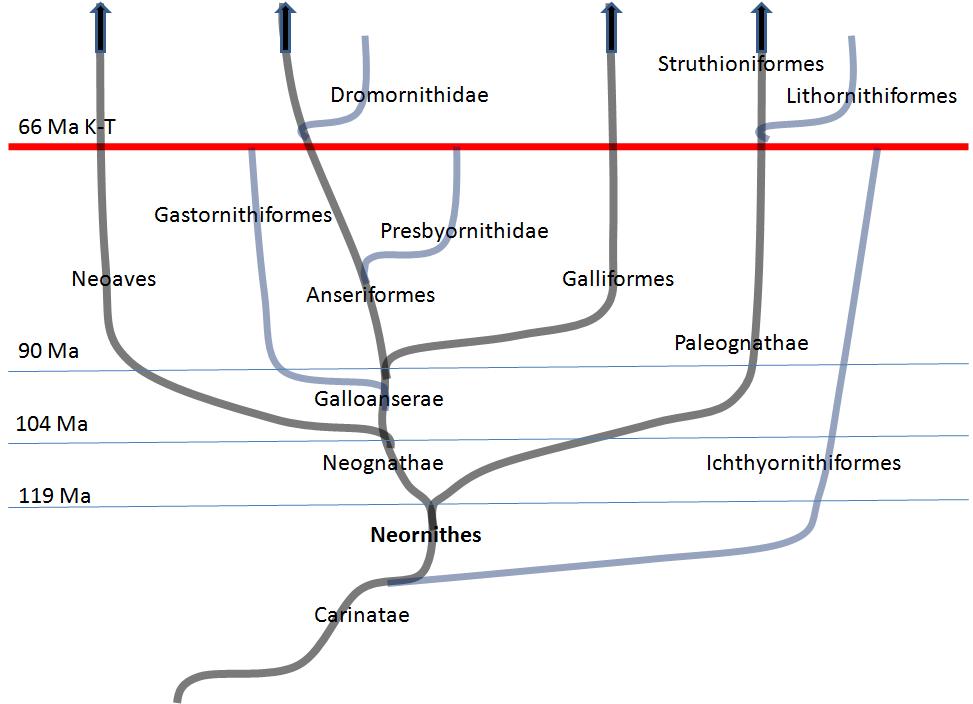
http://upload.wikimedia.org/wikipedia/commons/f/f3/Neornithes.jpg


This chart is far from being correct but it does give the idea of separate branches leading to specific kinds of modern birds. For example visualize the line entitled Ichthyornithiformes continuing into a modern bird line and also Presbyornithidae continuing into a modern bird line - then you are getting closer to visualizing what I am saying.
This would be more complete if it had a line for Hesperornithes (which would lead to another line of modern birds). 
Please note that I am not endorsing this chart in total, but it does present the idea of separate lines leading to lines of modern birds. 


For example, you can see from this diagram that anseriformes and galliformes are branches that run "parallel" to the other lines up to the current time.
Those are two of the lines I am talking about.

You can also see that the diagram includes presbyornithidae and ichthyornithiformes but has them ending at 66 mya. I am proposing that like the other "parallel lines" those lines continued to modern bird lines.

There is more to it than that but this diagram shows how current thinking accepts parallel lines and with almost no change, it is what I am proposing.

Thursday, October 6, 2011

Something to Note

We saw in the earlier posts the similarity between:
Baptornithidae (Hesperornithes) AND  (primarily foot-propelled) WEB FOOT diving bird orders, eg. Cormorants (Phalacrocoracidae), Loons (Gaviidae)
AND BETWEEN
Hesperornithidae (Hesperornithes)  AND  (primarily foot-propelled) LOBE FOOT diving bird orders eg. Grebes (Podicipedidae)
AND BETWEEN
Presbyornithids AND duck, geese and swan (Anseriformes)


Currently these similarities are considered  to be due to convergence (evolutionary relay).  I am suggesting they are ancestral.
This is something to note: 
Cladists decline to identify* the ancestors of these birds (cormorants, loons, grebes, duck, geese and swan). But they are not ruling out that the ancestors may in fact be the ones I just listed. They are just not taking a position on that. 


*They decline to identify the ancestors of any and all birds.

Tuesday, October 4, 2011

Waterfowl

Let's look a little deeper at the waterfowl (waterbird) line:
This is what we have to this point:


WATERFOWL (Anatidae)

  • Pterosaur --->
  • A Dromaeosaurid subgroup --> 
  • An Enantiornithes waterbird subgroup --> 
  • Presbyornithids--> 
  • Modern Anseriformes (eg. Duck, Geese , Swan)

http://en.wikipedia.org/wiki/Presbyornithidae

Presbyornithidae were a family of waterbirds with an apparently global distribution that lived until the Earliest Oligocene, but are now extinct. Initially, they were believed to present a mix of characters shown by waterbirds,shorebirds and flamingos and were used to argue for an evolutionary relationship between these groups (Feduccia 1976), but they are now generally accepted to be "wading ducks", the sister taxon [actually the ancestor] of the Anatidae, and thus essentially modern waterbirds. They were generally long-legged, long-necked birds, standing around one meter high, with the body of a duck, feet similar to a wader but webbed, and a flat duck-like bill adapted for filter feeding.  Apparently, at least some species were very social birds that lived in large flocks and nested in colonies.


http://en.wikipedia.org/wiki/Presbyornis
Presbyornis is an extinct genus of anseriform bird. It contains two unequivocally accepted species; the well-known P. pervetus and the much lesser-known P. isoniP. pervetus was approximately the size and shape of a goose, but with longer legs; P. isoni, known from a few bones, was much larger, more than swan-sized. Other fossils, more doubtfully assigned to this genus, are also known.
Judging from numerous fossil findings, Presbyornis is presumed to have lived in colonies around shallow lakes. Its broad, flat bill was used to filter food (small plants and animals) from the water, in the manner of today's dabbling ducks.[3]

Enantiornithes Taxonomy

http://en.wikipedia.org/wiki/Enantiornithes

Taxonomy

Subclass Enantiornithes

Enantiornithes Timing

Let's look at some material about the timing of Enantiornithes.
http://en.wikipedia.org/wiki/Enantiornithes
"Enantiornithines have been found in North AmericaSouth AmericaEuropeAsia, and Australia. Known fossils attributable to this group are exclusively Cretaceous and it is believed that enantiornithines became extinct at the same time as their non-avian dinosaur relatives. One biogeographic study in the 1990s[citation needed] suggested that the distribution of enantiornithines implies a Middle Jurassic origin for the clade, but this theory has not been widely accepted by paleoornithologists; a Late Jurassic/Early Cretaceous origin is more in line with the fossil record. The earliest known enantiornithines are from the Early Cretaceous) of Spain (e.g. Noguerornis, a basal genus) and China (e.g. Protopteryx) and the latest from the Late Cretaceous of North and South America (e.g. Avisaurus)."


A bit more detail on a few lines

Here is the work in progress to this point, on a few of the bird lines. Since this is a work in progress I  am certainly open to suggestions and improvements.

SEABIRDS (Ichthyornithes line)

Pterosaur (Ornithocheiroidea) eg 
Pteranodon -->
A Dromaeosaurid subgroup* -->
An Enantiornithes seabird subgroup -->
An Ichthyornithes subgroup --> Gulls, Skimmers (Charadriiformes/Lari)

AND

Pterosaur (Ornithocheiroidea) eg Pteranodon -->
A Dromaeosaurid subgroup* -->
An Enantiornithes seabird subgroup -->
An Ichthyornithes subgroup --> Petrels, Albatross (Procellariiformes), Sphenisciformes


AQUATIC BIRDS (Hesperornithes line) 

 Pterosaur (Ctenochasmatoidea) eg. 
Pterodactylus --> 
A Dromaeosaurid subgroup* -->
An Enantiornithes aquatic subgroup --> Baptornithidae (Hesperornithes) --> (primarily foot-propelled) WEB FOOT diving bird orders, eg. Cormorants (Phalacrocoracidae), Loons (Gaviidae).

AND

 Pterosaur (Ctenochasmatoidea) eg. Pterodactylus -->
A Dromaeosaurid subgroup* -->
An Enantiornithes aquatic subgroup --> Hesperornithidae (Hesperornithes) --> (primarily foot-propelled) LOBE FOOT diving bird orders eg. Grebes (Podicipedidae).

See Comments below for more details. 


WADERS/SHOREBIRDS 

Pterosaur (Azhdarchoidea) --->
A Dromaeosaurid subgroup* -->
An Enantiornithes shorebird subgroup --> Primitive shorebird (eg. Graculavus) --> Modern shorebirds - eg. plovers, oystercatchers, sandpipers (Charadriiformes/Charadrii)


LANDBIRDS

Pterosaur (
Dsungaripteridae) ->
A Dromaeosaurid subgroup* -->
An Enantiornithes landbird subgroup -->
Primitive Landbird -->
Modern landbird


* Possibilities include: Microraptorinae (eg. Microraptor) and Unenlagiinae (eg. Rahonavis) 

Ornithocheiroids known from the earliest Early Cretaceous

http://www.sciencedirect.com/science/article/pii/S019566711100125X
Abstract

"The assignment of a fragment of the anterior tip of a pterosaur rostrum from the Cenomanian Cambridge Greensand of eastern England to the ornithocheirid Coloborhynchus capito (Seeley, 1870) is confirmed. The fragment represents partial left and right fused premaxillae and retains broken teeth within alveoli. A width across the palate of 56 mm, a height at the anterior rostrum in excess of 95 mm and a tooth with a diameter of 13 mm at the base of the crown indicates a remarkably large individual, tentatively estimated to have had a skull length in excess of 0.75 m and a wing span of up to 7 m. This fragment represents the largest toothed pterosaur yet reported. This find, and several other large postcranial fragments from the Cambridge Greensand, suggest that ornithocheirids, toothed ornithocheiroids known from the earliest Early to early Late Cretaceous (Valanginian–Cenomanian) achieved very large, but not giant size. Pteranodontids, edentulous ornithocheiroids currently known only from the mid Upper Cretaceous (Coniacian–early Campanian), reached similar dimensions (up to 7.25 m in wing span) but, contrary to popular myth, did not attain the giant sizes (wing spans of 10 m or more) achieved by azhdarchids in the late Late Cretaceous (Campanian–Maastrichtian)."


Flying Ornithocheiroids in the "earliest Early Cretaceous" developed into some of the primitive flying bird taxa later in the Cretaceous.


Tuesday, September 27, 2011

* The Missing SERIES

By the way, it is not just ONE hypothetical most recent common ancestor that is missing in the dino to bird purported lineage - it is a whole series of them along the purported lineage line. Cladistics has not discovered or described ANY of them!

Luckily there are other more common-sense approaches to establishing phylogeny, that includes the effort to determine ancestors and descendants.


Sunday, September 25, 2011

Cladistics - a missing link that is always missing

http://www.kheper.net/evolution/systematics/evolutionary.htm
"Also, unlike Cladistics, with it's reliance on a hypothetical Most Recent Common Ancestor that is never actually described or discovered (a missing link that is always missing), Evolutionary systematics gives illustrations of the actual evolution of one species or higher taxon into another."

I am certainly not the only one who has seen the problems with cladistics .

Friday, September 23, 2011

* Dino to bird problem

Here is something noteworthy concerning the dino (non-maniraptor coelurosaur) to bird idea:
There are fossils for a number of taxa in the fossil record. But none of those work out as ancestors. 
Thus it strains credulity that the dino to bird enthusiasts fall back on the story that there is a lack of fossils. 

THERE IS A COMPLETE LACK OF FOSSILS ON THE PURPORTED DINO* TO BIRD LINEAGE.
That is the dino to bird problem.

But as folks must know by now, my main interest is in presenting the case for  pterosaurs as the ancestors of birds, not hashing and re-hashing the problems with the dino to bird idea. .


*Note again that by "dino" I mean non-maniraptor coelurosaurs. They are not ancestral to birds.

Wednesday, September 21, 2011

Jackie Evancho

To take a break from pterosaurs, I want to bring to your attention Jackie Evancho (if you are not already familiar with this angel).

http://www.youtube.com/watch?NR=1&v=H6N_JyDMQf4

http://www.youtube.com/watch?v=a5YPC0-gHVo&feature=related


We cannot understand the total of reality with just our intellect and senses. We need the inspiration and insight of emotion. Then we see more deeply.

Tuesday, September 20, 2011

The significance of the Senter studies

It may be that Senter still does not realize what he has done inadvertently.
He set out to make fun of "creationists" but he has highlighted the Achilles heel of the dino to bird theory.
Generally, articles on the dino to bird theory focus on how maniraptors are birds. And because the writers call maniraptors "dinosaurs", readers are left with the impression that birds evolved from dinosaurs.
But using baraminology, Senter brings to light the separation between dinosaurs (non-maniraptor coelurosaurs) and maniraptors. He calls them the "tyrannosaur cluster" and the "bird-like cluster".
No evidence has EVER been produced for a connection between dinosaurs (non-maniraptor coelurosaurs) and manirpators.
And now Senter documents that they are not connected.
It is too late for Senter to now deny what his data and analysis have shown.

Thursday, September 15, 2011

Which one of these is not like the others?


Which one of these is not like the others? Actually there are two, if you look carefully.

Notice also the size depicted for the bird in the top right. It is as big as a tyrannosaurus. This chart is wrong in so many ways.

Wednesday, September 7, 2011

Pterosaur Bird Correspondences (2)

The Jablonski article is not itself on the topic of pterosaurs to birds. But there are a few points of interest:
1. Jablonski has noted the similarities between specific pterosaurs and specific categories of modern birds. That is something I had noted as well.
2. Jablonski says that pterosaurs "vacated".
In line with what I am saying, the pterosaurs developed into primitive birds -  either through anagenesis or cladogenesis followed by extinction of the pterosaurs.
3. It is worth noting that primitive pterosaurs (Rhamphorhynchus) developed into the advanced pterosaurs (Pterodactylus) presumably in the same way.

Tuesday, September 6, 2011

Pterosaur Bird Correspondences (1)

http://www.pnas.org/content/98/10/5393.full.pdf

"Over the course of Cenozoic diversification,
other birds did assume modes of life similar to those
vacated by pterosaurs: skimmers may roughly correspond to
Tropeognathus with its keeled jaws, swallows and swifts to
Pterodactylus with its similar size and wing proportions, flamingos
to Pterodaustro with its bristling array of fringe-like teeth, and
perhaps even condors to the enormous Quetzlcoatlus".

More on Facilitated Variation and Wing Development

http://www.pnas.org/content/104/suppl.1/8582.full
Adaptable robust processes can support nonlethal phenotypic variation in other processes, a situation called “accommodation” by West-Eberhard (14). A specific example is the evolution of the tetrapod  [pterosaur] forelimb to a bird or bat wing. Not only did the length and thickness of bones change, but also the associated musculature, nerve connections, and vasculature. Did many regulatory changes occur in parallel, coordinated by selection, to achieve the coevolution of all these tissues in the limb evolving to a wing? The answer comes from studies of limb development showing that muscle, nerve, and vascular founder cells originate in the embryonic trunk and migrate into the developing limb bud, which initially contains only bone and dermis precursors. Muscle precursors are adaptable; they receive signals from developing dermis and bone (17) and take positions relative to them, wherever they are. Then, as noted previously, axons in large numbers extend into the bud from the nerve cord; some fortuitously contact muscle targets and are stabilized, and the rest shrink back. Finally, vascular progenitors enter. Wherever limb cells are hypoxic, they secrete signals that trigger nearby blood vessels to grow into their vicinity (18). 

Monday, September 5, 2011

Pterosaur Wing to Bird Wing

The development of the pterosaur wing to the bird wing requires fewer changes than one might think due to "facilitated variation".

http://www.pnas.org/content/104/suppl_1/8582.full
"The adaptability and robustness of normal muscle, nerve, and vascular development have significant implications for evolution, for these processes accommodate to evolutionary change as well. In the case of the evolving wing, if bones undergo regulatory change (driven by genetic change) in length and thickness, the muscles, nerves and vasculature will accommodate to those changes without requiring independent regulatory change. Coevolution is avoided. Selection does not have to coordinate multiple independently varying parts. Hence, less genetic change is needed, lethality is reduced, larger phenotypic changes are viable, and phenotypic variation is facilitated.(John Gerhart and Marc Kirschner 2007)