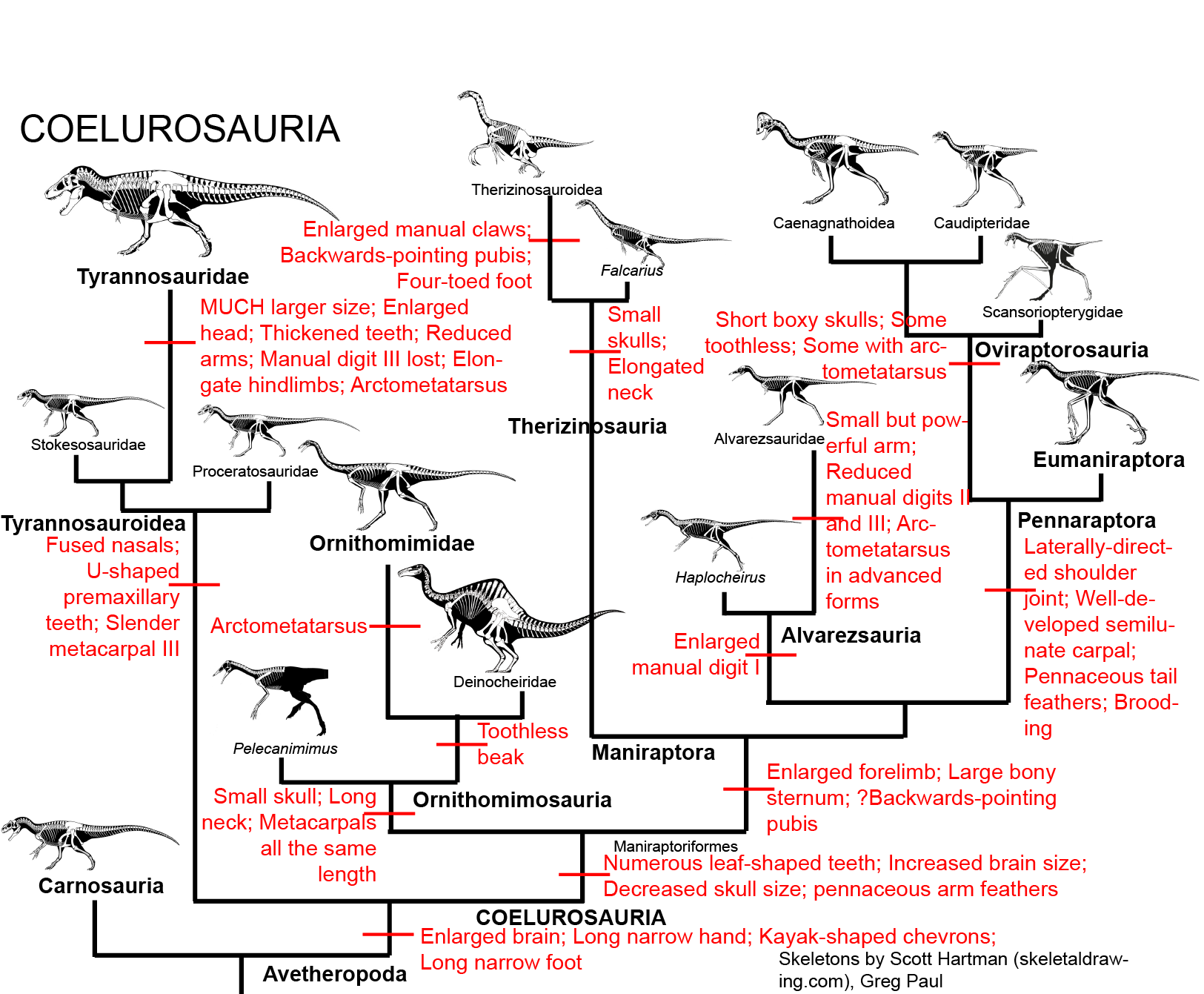
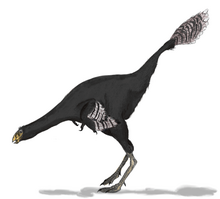
Here is some basic info on Caudipteryx (a member of
Oviraptorosauria). I will analyze it in the next post.
http://en.wikipedia.org/wiki/Caudipteryx
"
Caudipteryx (which means "tail feather") is a
genus of
peacock-sized
theropod dinosaurs that lived in the
Aptian age of the early
Cretaceous Period (about 124.6
million years ago). They were
feathered and
remarkably birdlike in their overall appearance.[1]
Caudipteryx had uncinate processes on the ribs, birdlike teeth, a first toe which may or may not be partially reversed and overall body proportions that are
comparable to those of modern flightless birds.
The hands of
Caudipteryx supported symmetrical, pennaceous feathers that had vanes and barbs, and that measured between 15–20 centimeters long (6–8 inches). These primary feathers were arranged in a wing-like fan along the second finger,
just like primary feathers of birds and other maniraptorans.
"Because
Caudipteryx has clear and unambiguously pennaceous feathers, like modern birds, and because several cladistic analyses have consistently recovered it as a nonavian, oviraptorid, dinosaur, it provided, at the time of its description, the clearest and most succinct evidence that birds evolved from dinosaurs.
Lawrence Witmer stated: “The presence of unambiguous feathers in an unambiguously nonavian theropod has the rhetorical impact of an atomic bomb, rendering any doubt about the theropod relationships of birds ludicrous.”
[3] (Witmer 2005)
"However, not all scientists agreed that
Caudipteryx was unambiguously non-avian, and some of them continued to doubt that general consensus. Paleornithologist
Alan Feduccia sees
Caudipteryx as a
flightless bird evolving from earlier archosaurian dinosaurs [actually pterosaurs] rather than from late theropods.
[8] Jones
et al. (2000)
found that Caudipteryx was a bird based on a mathematical comparison of the body proportions of flightless birds and non-avian theropods. Dyke and Norell (2005) criticized this result for flaws in their mathematical methods, and produced results of their own which supported the opposite conclusion.
[6][9]
Other researchers not normally involved in the debate over bird origins, such as Zhou, acknowledged that the true affinities of
Caudipteryx were debatable.
[5]
"The consensus view, based on several
cladistic analyses, is that
Caudipteryx is a basal (primitive) member of the
Oviraptoridae, and the oviraptorids are nonavian theropod dinosaurs.
[10] Incisivosaurus is the only oviraptorid that is more primitive.
[11]
"Halszka Osmólska
et al. (2004) ran a cladistic analysis that came to a different conclusion. They found that the most birdlike features of oviraptorids actually place the whole clade within Aves itself, meaning that
Caudipteryx is both an oviraptorid and a bird.
In their analysis, birds evolved from more primitive theropods, and one lineage of birds became flightless, re-evolved some primitive features, and gave rise to the oviraptorids. This analyis was persuasive enough to be included in paleontological textbooks like Benton's
Vertebrate Paleontology (2005).
[12] The view that
Caudipteryx was
secondarily flightless is also preferred by
Gregory S. Paul,
[13] Lü et al.,
[14] and
Maryańska et al.[15]
"Others, such as Stephen Czerkas and
Larry Martin have concluded that
Caudipteryx is not a theropod dinosaur at all.[16] They believe that Caudipteryx, like all maniraptorans, is a flightless bird, and that birds evolved from non-dinosaurian archosaurs [eg. pterosaurs]."