Friday, January 25, 2013

Alula Summary

Here is a summary of material about the bird alula.

ALULA


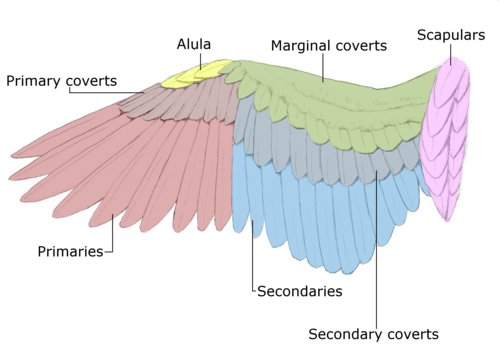
The alula, or bastard wing, is a small projection on the anterior edge of the wing of modern (and some ancient) birds. The word is Latin and means "winglet"; it is the diminutive of ala, meaning "wing". The alula is the freely moving first digit, a bird's "thumb," and is typically covered with three to five small feathers, with the exact number depending on thespecies. Like the larger flight feathers found on the wing's trailing edge, these alula feathers are asymmetrical, with the shaft running closer to anterior edge.

http://www.sciencedaily.com/releases/2011/09/110904140359.htm
What is the origin of digits in birds? The question has long puzzled evolutionary biologists. Using genomic analysis, researchers have now solved a key part of this mystery.

Evolution adds and subtracts, and nowhere is this math more evident than in vertebrates, which are programmed to have five digits on each limb. But many species do not. Snakes, of course, have no digits, and birds have three.

Yale scientists now have a good handle on how these developmental changes are orchestrated in the embryo. But there is still one outstanding debate on birds: Which digits are they? A thumb with index and middle fingers, or the index, middle and ring fingers?
In five-digit vertebrates, the thumb comes from the precursor stem cells labeled pa. While birds have a digit that looks like a thumb, pa precursor cells die off during development and never produce a digit in adults. As a result, scientists have wondered whether precursor cells in pb can make a thumb.
Yale scientists have completed a genomic analysis of birds that reveals the answer. It is a hands-down "yes" -- even though the first bird digit develops where the index finger on a five-finger vertebrae should be.

Also interesting info here:
http://www.featheredphotography.com/blog/2013/12/17/a-different-look-at-the-alula-bastard-wing

Thursday, January 24, 2013

Feather tracts


Here is some general info on bird feather tracts:

http://www.birds.cornell.edu/AllAboutBirds/studying/feathers/feathers
Feather Tracts:
Feathers are not attached to birds in a random manner over the entire body of the bird. Instead they are usually found in often linear tracts celled pterylae. The spaces on the bird's body without feather tracts are referred to as apteria. The densest area for feathers is often on the bird's head and neck.


Propatagium and Patagium Summary

PROPATAGIUM

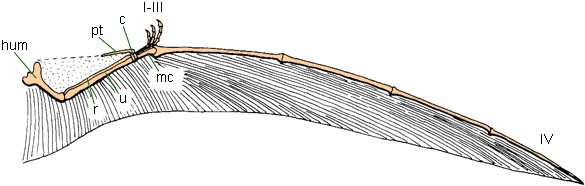
Here is a summary of material about the connection between the pterosaur propatagium and the bird propatagium. The pterosaur propatagium developed into the bird propatagium.

http://en.wikipedia.org/wiki/Pterosaur

"The pterosaur wing membrane is divided into three basic units. The first, called the propatagium ("first membrane"), was the forward-most part of the wing and attached between the wrist and shoulder, creating the "leading edge" during flight."


http://onlinelibrary.wiley.com/doi/10.1002/jmor.1052190209/abstract
"The [bird] propatagium is variably deployed, relative to elbow extension, in flight; support for its cambered shape is maintained by multilayered collagenous and elastic tissue networks suspended between leading edge and dorsal antebrachium." 


http://www.brendanbody.co.uk/flight_tutorial/index.html
The elbow is set back from the leading edge and the bend in the arm is hidden by the Propatagium, a fold of skin inside the front part of the wing which connects to the shoulder and the wrist."


Through flight experiments with live birds and computer modeling we define the aerodynamic contributions of the propatagium in avian flight.  
We conclude that the cambered propatagium is the major lift generating component of the wing proximal to the wrist.

 http://en.wikipedia.org/wiki/Microraptor
This possibly advanced shoulder anatomy, combined with the presence of a propatagium linking the wrist to the shoulder (which fills the space in front of the flexed wing and may support the wing against drag in modern birds) and an alula or "bastard wing" may indicate that Microraptor was capable of true, powered flight.[13]
Cambered:
a. A slightly arched surface, as of a road, a ship's deck, an airfoil, or a snow ski.b. The condition of having an arched surface. 

RELATED LINKS:


PATAGIUM:

Note that the word "patagium is used in two different ways.

http://en.wikipedia.org/wiki/Patagium
In the flying pterosaurs, the patagium is also composed of the skin forming the surface of the wing. In these ornithodirans, the skin was extended to the tip of the elongated fourth finger of each hand.
The patagium of a pterosaur had three distinct parts:
Propatagium: the patagium present from the shoulder to the wrist
Brachiopatagium: the portion stretching from the fourth finger to the hindlimbs.
Uropatagium or cruropatagium: the anterior portion between the two hindlimbs, depending on whether it did or did not include the tail
In birds, the propatagium is the elastic fold of skin extending from the shoulder] to the carpal joint, making up the leading edge of the inner wing. Many authors use the term to describe the fold of skin between the body (behind the shoulder) and the elbow that houses the outer segments of the latissimus dorsi caudalis and triceps scapularis muscles.[1] Similarly the fleshy pad that houses the follicles of the remiges (primary and secondary feathers) caudal to the hand and the ulna is also often referred to as a patagium.[2] The interremigial ligament that connects the bases all the primary and secondary feathers as it passes from the tip of the hand to the elbow is thought to represent the caudal edge of the ancestral form of this patagium.
https://bio.unc.edu/files/2011/04/FeducciaCzerkas2015.pdf
The importance of a propatagium to the evolution of the avian wing is significant, as it has no apparent function other than contributing to the aerodynamics of the animal. Therefore, its presence in flightless forms lends support to the neoflightless hypothesis (Olshevsky 1992; Paul 2002; Feduccia 2012). The discovery of a propatagium in members of all clades of core maniraptorans, including Caudipteryx (oviraptorosaurs), Microraptor (dromaeosaurs), Anchiornis (a putative troodontid; Chatterjee and Templin 2012), Archaeopteryx (a basal urvogel; Martin and Lim 2005), and the basal avian Scansoriopteryx (Czerkas and Feduccia 2014), is additional evidence that flight was basal in Aves. Similarly, four-winged tetrapteryx wings can best be interpreted in a flight context.

Patagium and Bird Feather Summary

Here is a summary of material about actinofibrils.

ORIENTATION

http://www.springerlink.com/content/v8434087565413kk/fulltext.pdf?page=1
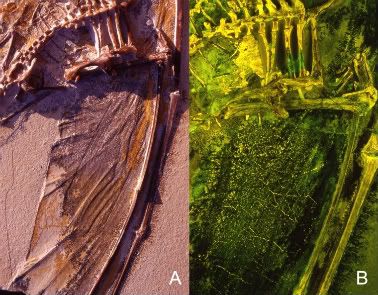
"Wellnhofer [4, 5] and Padian [6, 7], following von Zittel [8],described a system of fine structural fibers investing the [pterosaur] wing membrane, in a pattern similar to the orientation of the feather shafts of birds and the wing fingers of bats, both principal structural elements supporting the patagium and responsible for the transmission of aerodynamic force." 

http://www.jstor.org/pss/2400656
The wing membrane was supported and controlled through a system of stiffened, intercalated fibers, which were oriented like the main structural elements in the wings of birds and bats.


MEMBRANE INERNAL STRUCTURE


http://www.ncbi.nlm.nih.gov/pmc/articles/PMC2842671/
"There are presently four competing models for the internal structure of the pterosaur wing membrane.Wellnhofer (1987) suggested that the actinofibrils were structural fibres embedded in the wing membrane.Pennycuick (1988) disagreed with this interpretation and regarded the ‘fibres’ as wrinkles caused by the inner elastic fibres contracting after the animal's death. In a review of pterosaur wing membrane, Padian & Rayner (1993) argued for the presence of structural fibres on the surface of the ventral part of the wing membrane, closely associated with the epidermis. Lastly, Tischlinger & Frey (2002) and Frey et al. (2003), based on a Rhamphorhynchus specimen from Solnhofen and an exceptionally well-preserved material from the Romualdo Formation (DGM 1475-R) of Brazil (Martill & Unwin 1989; Kellner 1996), interpreted the pterosaur plagiopatagium as consisting of five layers from dorsal to ventral: a thin and ‘hairless’ epidermis, a spongy subdermis, a layer of actinofibrils, a layer of dermal muscles and a vascular layer. Regarding the last model, it should be noted that Kellner (1996) regarded the soft tissue present in the specimen of the Romualdo Formation as closely associated with the body."


MATERIAL


http://en.wikipedia.org/wiki/Pterosaur
"The actual function of the actinofibrils is unknown, as is the exact material from which they were made. Depending on their exact composition (keratin, muscle, elastic structures, etc.), they may have been stiffening or strengthening agents in the outer part of the wing.[6] The wing membranes also contained a thin layer of muscle, fibrous tissue, and a unique, complex circulatory system of looping blood vessels.[7]"

http://books.google.ca/books?id=idta6AVV-tIC&pg=PA20&lpg=PA20&dq=actinofibrils&source=bl&ots=2E-08Z7eLr&sig=rkiJwNwSZCbYJ9MtkYQDfQ9HDE0&hl=en&ei=0ureTJSDKMienAe_3pXtDw&sa=X&oi=book_result&ct=result&resnum=3&ved=0CCUQ6AEwAg#v=onepage&q=actinofibrils&f=false
"Since they [actinofibrils] were external, they were probably epidermal structures composed of keratin as in scales and feathers."


LAYERS


http://en.wikipedia.org/wiki/Pterosaur
"research has since shown that the wing membranes of pterosaurs were actually highly complex and dynamic structures suited to an active style of flight. First, the outer wings (from the wing to the elbow) were strengthened by closely spaced fibers called actinofibrils.[5] The actinofibrils themselves consisted of three distinct layers in the wing, forming a crisscross pattern when superimposed on one another."

http://rspb.royalsocietypublishing.org/content/early/2009/07/31/rspb.2009.0846.full
"The plagiopatagium can be divided into the distal, comparatively more rigid actinopagatium and a proximal, more tensile tenopatagium. The actinopatagium extends from the wing finger to the articulation between the humerus and the forearm, and shows the presence of at least three layers containing actinofibrils. In each layer, the actinofibrils are parallel to subparallel, but this direction diverges from layer to layer." 


Modern bird:


UROPATAGIUM

http://rspb.royalsocietypublishing.org/content/early/2009/07/31/rspb.2009.0846.full
The uropatagium is not well preserved. Most of this membrane is encased in the bottom slab (plate I, fig. 2 in Wang et al. 2002), but traces can also be found in the top slab (figures 1 and 2). The shape of the uropatagium cannot be determined owing to the lack of a distinct posterior edge and the medially displaced feet. Two sets of fibres are observed: one running parallel to the longitudinal axis of the body and the second running perpendicular to the tibiae. This pattern is not as well developed as in the actinopatagium but, based on the thickness of the fibres, they are of the same nature as the actinofibrils. Integumental covering is also found.


Monday, January 21, 2013

Layers


http://www.sciencedirect.com/science/article/pii/S0960982212011943
Primitive bird:
In modern birds (Neornithes), the wing is composed of a layer of long, asymmetrical flight feathers overlain by short covert feathers [1-3]. It has generally been assumed that wing feathers in the Jurassic bird Archaeopteryx [4-9] and Cretaceous feathered dinosaurs [10, 11] had the same arrangement. Here, we redescribe the wings of the archaic bird Archaeopteryx lithographica [3-5] and the dinosaur Anchiornis huxleyi [12, 13] and show that their wings differ from those of Neornithes in being composed of multiple layers of feathers. In Archaeopteryx, primaries are overlapped by long dorsal and ventral coverts. Anchiornis has a similar configuration but is more primitive in having short, slender, symmetrical remiges. Archaeopteryx and Anchiornis therefore appear to represent early experiments in the evolution of the wing. This primitive configuration has important functional implications: although the slender feather shafts of Archaeopteryx [14] and Anchiornis [12] make individual feathers weak, layering of the wing feathers may have produced a strong airfoil. Furthermore, the layered arrangement may have prevented the feathers from forming a slotted tip or separating to reduce drag on the upstroke. The wings of early birds therefore may have lacked the range of functions seen in Neornithes, limiting their flight ability.
Longrich NR, Vinther J, Meng Q, Li Q, Russell AP.


Modern bird feather layers:


Saturday, January 19, 2013

The significant propatagium


http://onlinelibrary.wiley.com/doi/10.1002/(SICI)1097-010X(19961001)276:2%3C112::AID-JEZ4%3E3.0.CO;2-R/abstract
Through flight experiments with live birds and computer modeling we define the aerodynamic contributions of the propatagium in avian flight. From flight trials we found that in House Sparrows, with all flight feathers removed except for the distal six primaries, the loss of approximately 50% of the propatagium's projected area and its cambered profile produced a significant reduction in the distance a bird was able to cover in flight. Removal of the secondary feathers, leaving six distal primaries and an intact propatagium, did not have a noticeable affect upon flight. From the computer model which is representative of the bird wing's mid-antebrachial chord (cambered propatagium, symmetrical musculoskeletal elements, and flat secondary flight feathers), we found that the propatagium: (1) produced the majority of the lift; (2) had a higher (relative to secondary feathers) production of lift in relation to its angle of attack, i.e., steeper lift-curve slope; and (3) produced more lift with a chord only 1/5 that of the feather subsection. We conclude that the cambered propatagium is the major lift generating component of the wing proximal to the wrist.

Cambered:
http://www.thefreedictionary.com/cambered
a. A slightly arched surface, as of a road, a ship's deck, an airfoil, or a snow ski.b. The condition of having an arched surface. 

Chicken Police

For fun - the chicken police!


Tuesday, January 15, 2013

Categories Updated

NOTE that I am now working with a simplified version of all this. This is for documentation of a more complicated hypothesis:
Here is the list of updated categories (proposed lineages). 
(Click the links to view details).

Categories:

LANDBIRDS

  • Landbirds (General)
    • Pterosaur (eg. Dsungaripteroidea)  eg. Nemicolopterus -->
    • Enantiornithes/Confuciusornithids landbird subgroups -->
    • Modern landbird groups  (eg. Passerines, Falconiformes etc)
  • Landbirds (Owl)
    • Pterosaur (eg. Dsungaripteroidea)  eg. Nemicolopterus -->
    • Enantiornithes/Confuciusornithids landbird subgroup -->
    • Primitive owls, (eg. Sophiornithidae?) --> 
    • Strigiformes (eg. owls), Caprimulgiformes (eg. nighthawks)
  • Landfowl
    • Pterosaur (eg.  Dsungaripteroidea)  eg. Nemicolopterus -->
    • Enantiornithes/Confuciusornithids landbird subgroup -->
    • Modern "Galliformes"(eg. Chicken, Turkey, Pheasant, Quail) and Tinamiformes (Tinamou)

WATERBIRDS
  • Waterfowl (Presbyornithid line)
    • Pterosaur (eg. Ctenochasmatidae ) --->
    • Presbyornithid subgroup--> 
    • Modern Anseriformes (eg. Duck, Geese , Swan)
       AND
    • Pterosaur (eg.  Ctenochasmatidae) eg. Pterodaustro   -->
    • Presbyornithid subgroup--> 
    • Primitive bird, Palaelodidae (Phoenicopteriformes)  --> 
    • Flamingo (Phoenicopteriformes)
  • Aquatic birds (Hesperornithes line)
    • Pterosaur (eg.  Ctenochasmatidae)    eg. Pterodactylus --> 
    • Baptornithidae  (Hesperornithes) --> 
    • (primarily foot-propelled) WEB FOOT diving bird orders, eg. Cormorants (Phalacrocoracidae), Loons (Gaviidae),  Penguins  (Sphenisciformes)
         AND
    • Pterosaur (eg.  Ctenochasmatidae)    eg. Pterodactylus -->
    • Hesperornithidae (Hesperornithes) --> 
    • (primarily foot-propelled) LOBE FOOT diving bird orders eg. Grebes (Podicipedidae).
  • Seabirds (Ichthyornithes line)
    • Pterosaur (eg. Ornithocheiroidea) eg. Pteranodon, Anhanguera -> 
    • An Ichthyornithes subgroup --> 
    • Gulls, Skimmers (Charadriiformes/Lari)
      AND 
    • Pterosaur (eg. Ornithocheiroidea ) eg. Pteranodon,  Anhanguera -> 
    • An Ichthyornithes subgroup --> 
    • Petrels, Albatross (Procellariiformes)

SHOREBIRDS
  • Waders/shorebirds
    • Pterosaur (eg. Azhdarchoidea) --->
    • Primitive shorebird (eg. Graculavus) --> 
    • Modern shorebirds - eg. plovers, oystercatchers, sandpipers (Charadriiformes/Charadrii) and storks (Ciconiidae)

FLIGHTLESS BIRDS
  • Flightless birds
    • Pterosaur -->
    • Primitive flying birds? -->
    • Modern (flightless) ratites - Ostrich (Struthio), Rhea (Rheidae), Cassowary, Emu (Casuariidae), Kiwi (Apteryx) 


For reference:


Cladogram showing the most recent classification of Neoaves, based on several phylogenetic studies.


http://en.wikipedia.org/wiki/Evolution_of_birds
The Cretaceous saw the rise of more modern birds with a more rigid ribcage with a carina and shoulders able to allow for a powerful upstroke, essential to sustained powered flight. They also had a more derived pygostyle, with a ploughshare-shaped end. An early example is Yanornis. Many were coastal birds, strikingly resembling modern shorebirds, like Ichthyornis, or ducks, like Gansus. Some evolved as swimming hunters, like the Hesperornithiformes – a group of flightless divers resembling grebes and loons. While modern in most respects, most of these birds retained typical reptilian-like teeth and sharp claws on the manus.

http://en.wikipedia.org/wiki/Gansus
Gansus was described as the oldest known ornithuran. The Ornithurae, however, has been given several very different definitions. In the definition used by You and colleagues (that is, the clade containing all living birds plus Hesperornis and Ichthyornis), Gansus is indeed the oldest known member. However, several birds from the older Yixian Formation and contemporary Jiufotang Formation are considered ornithurans under other definitions. Under any definition, all living birds, including taxa as diverse as ostriches, hummingbirdsand eagles, are descended from basal ornithurans, many of which were semi-aquatic. It is now thought possible that all modern birds descended specifically from a semi-aquatic bird similar to Gansus. Thus, while Gansus is not necessarily a direct ancestor of today's birds, it is closely related to such an ancestral species.[5] This hypothesis was corroborated by later phylogenetic studies that included this taxon.[3][8]

Not yet categorized:
  • Pelican
  • Vulture
  • Condor

Sunday, January 13, 2013

Odontognathae

Here is reference material for Odontognathae. These are primitive birds (Hesperornithes and Ichthyornithes), which I suggest are ancestors of some lines of modern waterbirds.
Cladists label Odontognathae as "paraphyletic", because cladistics does not recognize direct ancestral relationships.

http://en.wikipedia.org/wiki/Modern_birds
In traditional classification, the Neornithes also included a third superorder, the Odontognathae, containing advanced toothed birds from the Cretaceous, like Hesperornis and Ichthyornis.[5] This superorder is likely paraphyletic [ANCESTRAL], and falls outside [IS ANCESTRAL TO] the crown group birds. It is not entirely clear whether the Palaeognathae too are paraphyletic, or represent a primitve grade of birds.[6]

http://en.wikipedia.org/wiki/Hesperornithidae
These birds [Hesperornithes] were originally combined with Ichthyornis in the paraphyletic "Odontornithes" by Othniel Charles Marsh, in 1873. In 1875, they were separated as Odontolcae. The group was often considered to be allied to loons and grebes,[4]or to the Paleognathae.[5] These similarities, however, as the more recently determined fact that the osteons of their bones - at least in Hesperornis - were arranged in a pattern similar to that in Neognathae,[6] are today considered [incorrectly] to be due to convergent evolution.[7]

http://en.wikipedia.org/wiki/Odontornithes
Odontornithes is an obsolete and disused taxonomic term proposed by O. C. Marsh for birds possessing teeth, notably the genera Hesperornis and Ichthyornis from the Cretaceous deposits of Kansas.In 1875 March divided this "subclass" into Odontolcae, with the teeth standing in grooves, and Odontotormae, with the teeth in separate alveoles or sockets. In his 1880 work, Odontornithes: A monograph on the extinct toothed birds of North America, he added the Saururae, represented by Archaeopteryx, as a third order.
The resulting classification was paraphyletic, [ANCESTRAL] not accurately resolving evolutionary relationships, and so it has been abandoned by most modern scientists, though at least one 21st century paper re-used the concept under the older name Odontoholomorphae (first coined by Stejneger, 1885).[1] 
The best known of the "Odontornithes" are Hesperornis regalis, standing about 3 ft. high, the somewhat taller H. crassipes, and Ichthyornis dispar. Hesperornis looked somewhat similar to a loon, while Ichthyornis was quite similar to a gull or petrel. 
[1] Livezey, B.C. & Zusi, R.L. (2007): Higher-order phylogeny of modern birds (Theropoda, Aves: Neornithes) based on comparative anatomy. II. Analysis and discussion. Zoological Journal of the Linnean Society no 149(1), pp 1-95 

http://www.jstor.org/pss/2413412
"A cladistic analysis of the skeletons of loons (Gaviidae), grebes (Podicipedidae), and the Cretaceous diving birds, Hesperornis and Baptornis, supports the hypothesis that they form a monophyletic group (here called the Gaviomorphae) within the class Aves. Two lineages within the gaviomorphs can be delineated: (1) loons + grebes, and (2) Hesperornis + Baptornis. The Early Cretaceous Enaliornis and the Late Cretaceous Neogaeornis are related to the second lineage; the Late Cretaceous Lonchodytes, often placed near loons, is apparently not a gaviomorph but perhaps a charadriiform. Skeletal evidence also suggests that penguins (Spheniscidae) are the sister-group of the Gaviomorphae. Arguments that similarities of gaviomorph taxa represent convergence are not well founded. First, morphological differences among taxa do not constitute valid evidence against their monophyly, as many previous workers have argued. Second, in no case has anyone supporting convergence presented a corroborated alternative phylogenetic hypothesis. A close relationship among gaviomorphs, penguins, and apparently also the Procellariiformes and Pelecaniformes implies that a lineage of aquatic birds was established very early in avian history, presumably in the Early Cretaceous or Late Jurassic." (Joel Cracraft 1982)

http://en.wikipedia.org/wiki/Odontognathae
Odontognathae is a disused name for a paraphyletic [ancestral] group of toothed prehistoric birds. The group was originally proposed by Alexander Wetmore, who attempted to link fossil birds with the presence of teeth, specifically of the orders Hesperornithiformes and Ichthyornithiformes. As such they would be regarded as transitional fossils between the reptile-like "Archaeornithes" like Archaeopteryx and modern birds. They were described by Romer as birds with essentially modern anatomy, but retaining teeth.[1]Unlike the dinosaur-like "Archaeornithes", the various types of birds assigned to the Odontognathae had short tails with a plowshare-shaped pygostyle and a well developed carina for flight muscle. They also shared the feature of intramandibular articulation, something that is actually absent in Archaeopteryx, but found in many of its theropod relatives.[2]The brains of the "odontognath" birds appear to be somewhat simpler than those of modern birds and have retained some "reptilian" traits.[3] Ornithologist Alan Feduccia has used this, and the presence of the intramandibular articulation (a trait also found in mosasaurs and living varanid lizards) as arguments that the Odontognathae and thus the birds as a whole have not evolved from theropod dinosaurs, but non-dinosaur thecodonts.[4] This theory is contested by most paleontologists.[5]
Feduccia:
It would not tax the imagination to engender a long list of obstacles for the now dominant model of a theropod origin of birds, including....the sliding lower jaw joint [intramandibular joint] of theropods (absent in birds) 

http://en.wikipedia.org/wiki/Archaeornithes
In traditional classification, it [Archaeornithes] is one of two subclasses of birds, the other subclass being the Neornithes, the birds with a short, modern tail. This classification was erected by Hans Friedrich Gadow in 1893 and followed by Alfred Romer(1933) and subsequent authors through most of the 20th century.[3] Other mesozoic birds like the toothed, but otherwise modern, birds like Hesperornis were included under the latter in their own superorder, the Odontognathae.[4]

For reference:
http://pterosaurnet.blogspot.ca/2010/06/hesperornithiformes.html